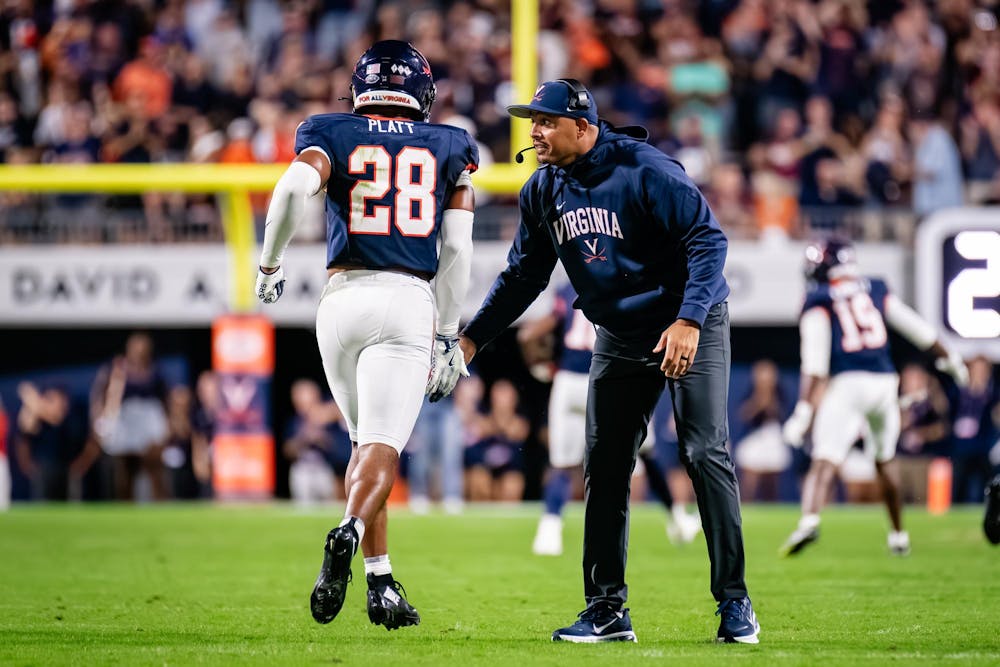
Coach Tony Elliott said his team is starting over.
Virginia finished the 2025 season ranked No. 16 in the nation and won 11 games for the first time in program history. It was a tremendously successful campaign. But Elliott does not want to adopt a continuation of that season. Instead, he challenged his 2026 Cavaliers to build something new.
For the first time, this reloaded roster will perform for the public at Saturday’s spring game. Divided into two teams, Virginia will showcase a slew of returners, transfers and potentially, early enrollees in the final round of spring practice.
Statistics in a scrimmage are not a perfect indicator of team performance come August. However, Elliott and his staff hope to see players take ownership of managing the hype associated with building upon a double-digit campaign.
“The hardest part is handling success,” Elliott said. “We have to go create this team's identity … We got to start over, we got to double down on our core values and we got to create an identity for this team based off of the foundation that's been laid from a program standpoint.”
The foundation is clear — Virginia is expected to contend for an ACC championship as one of the premier teams in the conference. Elliott envisioned this when he first became head coach ahead of the 2022 season.
This time around, though, the Cavaliers are not led by 2025 captains Chandler Morris, Sage Ennis, Jahmeer Carter and James Jackson. Instead, Virginia will rely on another transfer haul and returning contributors for steady leadership. At this moment, the 2026 captains have yet to be determined.
“Right now, I think it's more so on the coaches to do the leading whereas last year we had more of the guys in the locker room to do the leading,” Elliott said. “That helped us establish identity probably a little bit quicker. So it's just a different process with this group.”
This year’s team-building process was initially clouded by Morris’ appeal for another season of eligibility. Would the Cavaliers’ signal-caller play one more season of college ball? Could he be a major piece of continuity? These questions lingered around the program — but Morris ultimately did not win his appeal in local court.
Then all eyes turned towards Beau Pribula, the likely starter at quarterback.
Pribula, a graduate transfer from Missouri, inherits lofty expectations — especially compared to Morris. The former starter demonstrated incredible toughness and resiliency, fighting through injuries galore en route to captaining a storybook season. Pribula will have to handle the success of his predecessor while adapting to a new program.
Meanwhile, Elliott and his assistants continue to sharpen details, including areas of improvement he hopes to focus on. He explained that is eager to see fewer missed tackles defensively, as well as small but crucial details such as proper pad level and hand placement, eye discipline and catching the ball. Elliott also mentioned ball security and redzone offense, plus maintaining the Cavaliers’ elite third down offense and defense from last season.
Elliott also mentioned what he feels to be some strengths on offense, which includes one of the nation’s most experienced offensive line groups. That group is led by graduate guard Noah Josey, who has played the most snaps of any active Division I player. Josey is joined by other graduates in Monroe Mills, Drake Metcalf, Makilan Thomas and McKale Boley — forming what could be one of the most successful lines nationwide. At the minimum, Elliot feels that their experience is highly valuable.
“It's huge because Coach Elliott only has two eyes,” Elliott said. “I can only see so much. And there's a lot of things that happen in the locker room and then just in the community when the guys are out that impacts how we perform.”
As for the transfers on offense, Elliott spoke highly of some of Virginia’s more coveted additions — including junior receiver Rico Flores Jr., who has made stops at Notre Dame and UCLA.
"Rico has been as advertised and maybe a little bit more, obviously was very productive at Notre Dame his first year and then made several plays at UCLA last year,” Elliot said. “But I think he's a guy that has more versatility than I thought. I think he can play multiple positions for us.”
Elliott also praised the physicality, fit and personality of the Cavaliers’ two major running back additions in junior Peyton Lewis and senior Jekail Middlebrook. That trio of Flores Jr., Lewis and Middlebrook entered this offseason as under-the-radar pickups, and could earn extensive snaps for Virginia in 2026. Regardless of portal player rankings, Elliott emphasized the importance of finding the right players, not just the “best” players.
“The lesson [from last year] is that fit matters,” Elliott said. “I think you can get enamored with ability, especially with the portal, but fit matters. So you have to try and find that balance of guys that improve the talent level, but at the same time fit the institution, fit the program, fit the team and are willing to come together as a team. And so that's a similar message to this group.”
The fit, for now, could take more time to build. Teams are allowed a maximum of 15 spring practices in a window of just 34 days. Elliott and company will learn more about their team during the summer practice window, when they can organize nearly double the total practices of the spring season.
The spring window is especially difficult to assess given that several Cavaliers are currently battling injuries and will not play in the spring game, including Josey, senior linebacker Kam Robinson, graduate running back Xavier Brown, junior safety Ethan Minter, junior linebacker Landon Danley and more. Their absences, though, open the door of opportunity to underclassmen and newcomers to showcase their skills at Scott Stadium Saturday.
The spring game will begin at 3:30 p.m. and is free to attend, though it will not be broadcast online — the first and only preseason look for the 2026 squad will take place Saturday.
Read More

Volleyball finds itself on a roll after taking VCU down in straight sets
By Cierra Lyles | 4 minutes agoTaking the court against their host, the Cavaliers (3-1, 0-0 ACC) annihilated the Rams (1-3, 0-0 A-10) in straight sets, 25-13, 25-17, 25-22.

Burns’ fireworks propel Virginia men’s soccer to ‘settling’ win over Boston College
By Michael Liebermann | Yesterday“You know you’re good enough,” Burns wrote. “Do what you do, baby.”

With depth, consistency and experience, Virginia’s line play will make an impact in 2026
By Theo Moll | YesterdayThe Cavaliers have all the makings of a team poised to win the ugly battles with their experienced group of linemen.