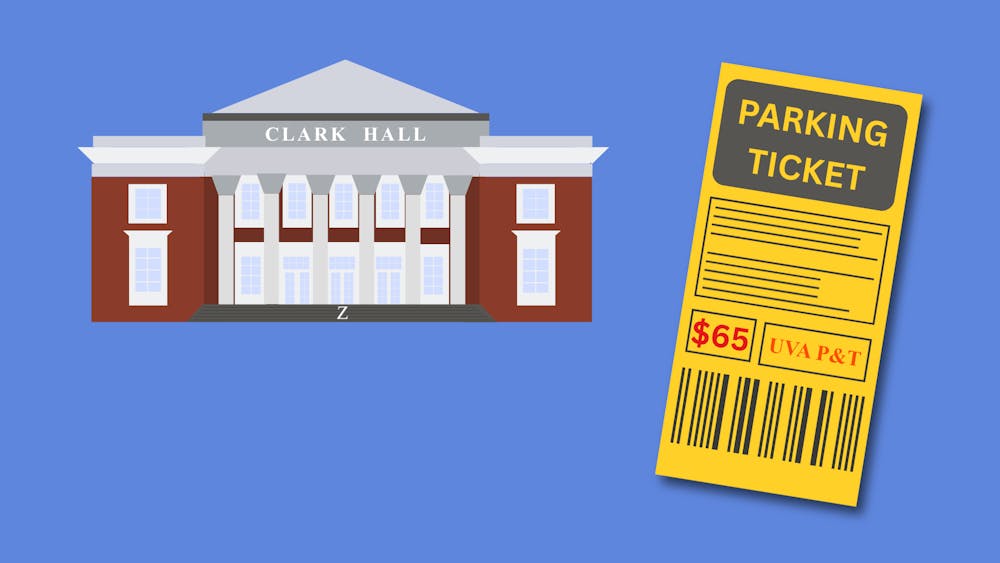
On May 7, I crawled out of the Clark stacks around midnight — bleary-eyed, head throbbing from a full week of exams and already dreaming of sleeping. Walking towards my car in the small lot behind Clark, I spotted it — a $65 parking ticket tucked beneath my windshield wiper. I had forgotten to add additional time onto my ParkMobile digital meter session. $65. My car was in a University-sanctioned spot. I was studying at a University library. It was the night before the last day of finals.
Although technically my fault, the incident reflects a larger issue festering on Grounds. Students are receiving financial penalties for parking at libraries. Almost every spot on Central Grounds opens to non-permit-holders after 5 p.m. for payment, and the few free spots closest to libraries fill up almost instantly. As a result, almost every spot located near a library comes at a price. For an institution that prides itself on academic ambition and community — that is a direct contradiction. The choice is simple — if you want to study, you pay. However, that choice becomes increasingly untenable during the most academically and emotionally taxing weeks of the year. If the University cares about their students in the ways that they claim, they should suspend parking enforcement at library locations during finals seasons, a move that costs little but means everything to students.
The most obvious damage the current system materializes is academic in nature. Libraries are the heart and soul of intellectual development and academic rigor, especially during finals. They boost collaboration, social interaction and increase work time — studying in groups, specifically, is scientifically proven to have a positive effect on both exam scores and mental health status. Accessible parking at libraries, therefore, is a critical factor in promoting that kind of interaction. If students who live far away — or drive to the library for any multitude of reasons — feel as though they are unable to park without paying the “study tax,” their alternative is studying alone in a dorm or an apartment. This default is detrimental, indirectly steering students toward habits like self-isolation and low-motivation while simultaneously discouraging new perspectives and an immediate support network. Quite evidently, parking fees and subsequent tickets discourage the academic behavior that the University claims to promote. If the University wants to continue championing academic excellence, then they cannot charge students for the privilege of pursuing it.
Not only do payments negate academic development and collaboration, but they also entirely undervalue student safety and accessibility. Countless students drive to the library for legitimate reasons. Some live more than 30 minutes from Central Grounds, fear walking home alone late at night or have time constraints. Regardless of the reason, students should never feel pressured to choose between their safety or giving up their credit card number — the exact choice that many today face. And while alternative transportation methods exist, such as the University Transit Service, they remain unreliable and inconsistent. Institutional alternatives and safety measures are falling short, but the burden of their failure should not fall on students.
At its core, the parking conundrum that I — and so many other students — faced during finals season is a microcosm of the broader economic issue University students face. A $65 parking ticket may seem like a small thing to write an entire article about. However, when that price sits on top of everything else students have to carry, it becomes a problem. For students, a $65 parking fine is not a slap-on-the-wrist inconvenience that reminds them to pay the digital meter next time. It is a wildly disproportionate amount, equivalent to a week’s groceries or a tank of gas.
In comparison, parking tickets for tollable spots in the city of Charlottesville range between $10 and $25. Yet, the University fine on Grounds is $40 more, an egregious price far from any reasonable punishment. If the University will not waive parking enforcement out of principle, they at least should have enough self-awareness to recognize how absurd it is to squeeze dollars from exhausted students while lounging atop a multibillion-dollar endowment.
What becomes clear from the current parking system is that the University does not care about its students' financial problems. If that is incorrect, then there must be a change. Parking at library locations on Central Grounds after 5 p.m. should be free. Or, at the very least, the University should reduce the $65 ticket fine to a reasonable price relative to the city of Charlottesville. Other universities have already made these efforts during finals, including the University of Georgia, the University of Delaware, West Virginia University and beyond. There is no need to eliminate parking enforcement altogether. Rather, the University should follow the lead of these institutions to align policy with academic priorities that tangibly show support for students during stressful times — an action that goes beyond just a wellness email.
To the University, I urge you to either start acting like you care about students in this small way, or stop claiming that you are simultaneously student-centered and academically rigorous. Act like you can understand what finals weeks look like mentally and socially for students. Act like you can understand the absurd financial pressure you put on students through the study tax. Act like you care.
Lucy Duttenhofer is an opinion columnist who writes about academics for The Cavalier Daily. She can be reached at opinion@cavalierdaily.com.
The opinions expressed in this column are not necessarily those of The Cavalier Daily. Columns represent the views of the authors alone.

Lucy Duttenhofer is a senior associate opinion editor for the opinion desk. She is a third-year Batten student majoring in Public Policy and Leadership and minoring in Spanish. She is from Summit, N.J., and she frequently writes about education policy and local and national politics.
Read More

YOUNIS: University networks protect rapists
By Ayat Younis | 16 hours agoWhen a university's response to sexual violence is limited, who is the institution actually protecting?

HAWKINS: The Cornell sexual assault scandal showcases the importance of student journalism
By Joshua Hawkins | YesterdayWhile the Cornell University administration faltered, it was the students who rose to the occasion.

CARON: Political cynicism is complacency, not productivity
By Jenna Caron | YesterdayDuring elections, our agency is only gone if we allow it to be.