
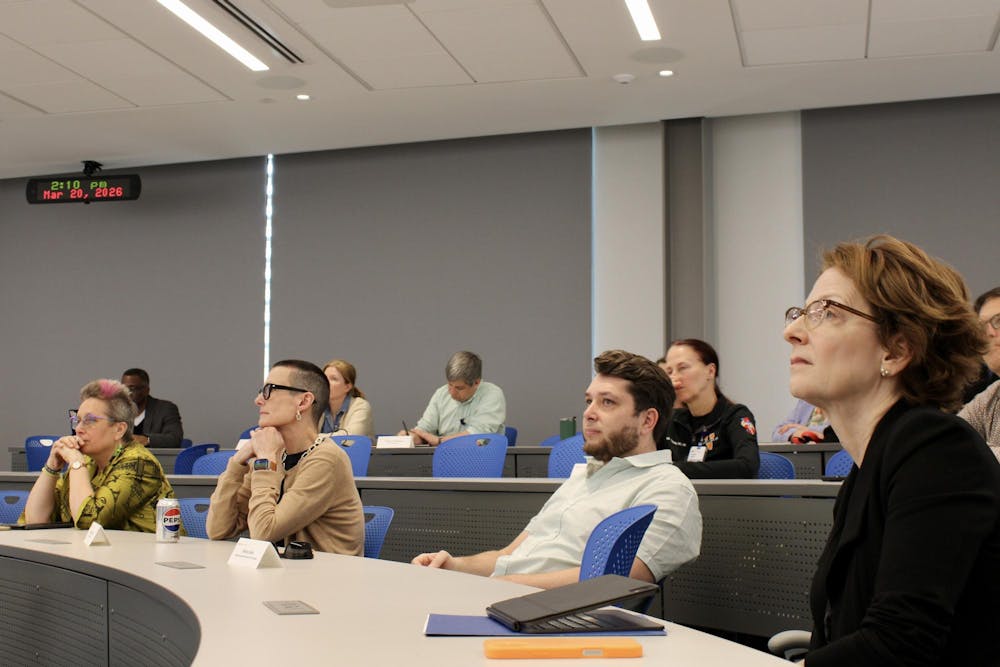
The Faculty Senate met Friday to hear statements from candidates for the Faculty Senate’s chair-elect position, three Executive Council positions and a position on the Faculty Senate of Virginia. Senators began to vote on these positions Monday. Senators also heard updates from Brie Gertler, interim executive vice president and provost, on her ongoing work and from Senate Chair Jeri Seidman on recent meetings with the Board of Visitors.
Law Prof. Andrew Block — who was not present but submitted a statement to be read aloud — and Law Prof. Rich Hynes each gave statements for the chair-elect position, which will begin this summer and transition into the Senate Chair position in 2027. Block emphasized his experience on the Executive Council and wrote that this experience will help him be an effective advocate for faculty.
“The chair-elect one day becomes the chair, and I think my past leadership experiences will help me to serve you in this role as well,” Block wrote. “Leaders need to listen, ask good questions, play well with others, support those they represent and, when necessary, make hard choices. I have substantial experience and demonstrated success in all these areas.”
Hynes discussed the role of the Faculty Senate, claiming that while they aim to provide advice to University leadership, the Faculty Senate has also become more active in state politics over the past year. Hynes said that he aims to remain nonpartisan and does not participate in political lobbying, and asked senators to consider whether they wished to remain politically engaged.
“If the Faculty Senate wants to remain engaged in the political process, heavily engaged, Andy Block is the obvious candidate, and it's not even close,” Hynes said. “By contrast, I have no interest in lobbying, in order to try to stay nonpartisan … I think we should think about that choice. Do we want to be engaged in politics? Because too much political intervention, especially at a partisan level, risks making U.Va. a political business.”
Senators additionally heard statements from faculty running for three positions on the Executive Council — the Senate’s leadership committee. These candidates included Dana Albon, medical director of the U.Va. Adult Cystic Fibrosis Clinic, Engineering Prof. Scott Barker, Assoc. Psychology Prof. Hudson Golino, Meredith Hayden, Chief Medical Officer at U.Va. Student Health and Wellness, Assoc. Music Prof. Michelle Kisliuk and Politics Prof. Len Schoppa.
Judith Thomas, director of faculty programs at the University’s libraries, also gave a statement for election to the Faculty Senate of Virginia, a statewide representative body for college and university faculty in Virginia. Thomas was the only one to speak for the position and said she was nominated for the position by the Faculty Senate Nominating Committee.
The Faculty Senate later debated a resolution on best practices for electing senators, which would support a document composed by the Representation and Governance Committee encouraging the University’s schools or departments to hold elections for senators — some currently appoint faculty members to the Faculty Senate. Ultimately, the Faculty Senate voted to send the resolution back to the committee to be strengthened with increased rationale for the importance of holding elections for representatives.
The resolution will be reconsidered during the Executive Council’s May 1 meeting, and if the Council approves of the edited resolution it will be considered by the full Faculty Senate May 8.
Gertler also shared updates with the Faculty Senate and noted that she will remain interim provost for the next year following the paused provost search and shared that she will begin focusing on strategic priorities. Throughout the past year that Gertler has held the position, she said, she has not begun working on strategic planning for the medium or long term because ongoing searches meant that a new provost could be appointed soon.
With the pause of the current search, Gertler said she plans to begin considering what strategic priorities she should focus on over the next year.
“I am being very deliberative about how I want to spend the next year,” Gertler said. “That's not a huge runway. But what is it that I should be focusing on? What do I want to accomplish? And if you have thoughts about that, I would really welcome them.”
Seidman also reported that she and Chair-elect Aaron Bloomfield met with the chair and vice chair of the Board’s Audit, Compliance and Risk Committee to discuss an ongoing review of last fall’s presidential search, although she could not share details of the review.
“I thought it was a really open and honest conversation, and I think they're being thoughtful about how they're going to proceed,” Seidman said.
The Faculty Senate’s Executive Council met with Rector Carlos Brown and Vice Rector Victoria Harker during the Thursday Board meeting, during which they discussed shared governance at the University, Seidman said. During the meeting, they specifically discussed BOV-006, a 2013 policy which stated that faculty would serve as non-voting consulting members on Board committees.
Currently, only one Board committee includes a consulting faculty member — the Audit, Compliance and Risk Committee — but Brown seemed open to returning to the policy’s outlined model, Seidman said.
During Thursday’s full Board meeting for the 2026-27 academic year, Seidman was elected as the faculty representative to the Board. Jim Lambert, outgoing faculty representative to the Board and engineering professor, thanked the Faculty Senate for trusting him in the position for the past year.
The full Faculty Senate will reconvene May 8 at 2 p.m.
Read More

Student Council considers creating an ad hoc committee to review UBE proceedings
By Lucia Gambacini | 49 minutes agoConsideration of the bill was postponed until the next general body meeting.

Health System Board Finance Working Group passes remote participation policy
By Lily Kostro | 58 minutes agoThe policy states that a member of HSB may participate remotely in meetings not open to the public, provided the member notifies the rector that they are unable to attend in-person due to an emergency, personal matters or a disability.

Less than three months out — what’s on the ballot this November in Virginia?
By Abigail Larkin | 1 hours agoHere is a closer look at what is on the ballot this November in Virginia’s elections for the U.S. Senate, U.S. House of Representatives and amendments to the Virginia Constitution.


