
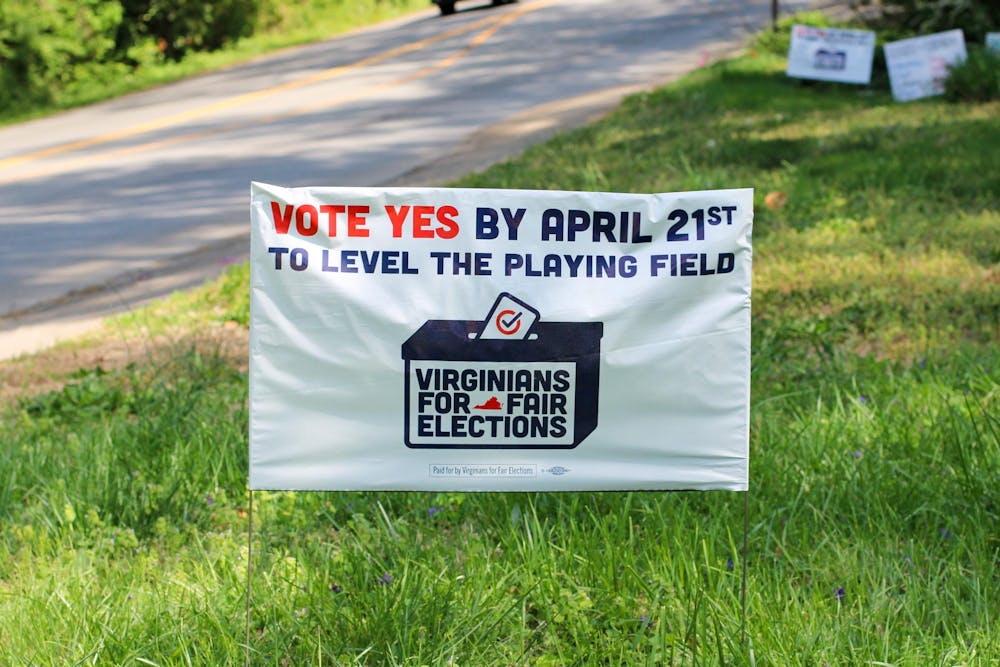
On April 21, Virginians will have to make an important choice for the future of the Commonwealth — to maintain the current voting system, or to respond to unfair initiatives nationwide by redistricting to a 10-1 Democratic-Republican ratio. Last year, President Donald Trump encouraged several red-leaning states to gerrymander voting districts in order to gain extra Republican seats in Congress, such as Texas, Ohio and Missouri. This has led voters across the country to raise several concerns about electoral fairness and democratic integrity — causing blue states to consider emergency district redrawing, such as Californians who passed Proposition 50 November 4.
In the midst of this nationwide redistricting brawl, all eyes are on Virginia after the General Assembly proposed a temporary, emergency referendum to redraw Virginia’s voting district map. This referendum would expire in 2031 after the next U.S. Census — a proposal essentially identical to California’s Proposition 50. While some view this initiative as a catastrophic power grab, redistricting into a Democratic majority is the only way to protect Virginians’ voices, especially ahead of the 2026 midterm elections.
A yes vote would allow the General Assembly to redraw Virginia's congressional districts in line with the actions of other states, in addition to making the proposed district map functional before the 2026 congressional elections. This redrawing would expire after 2031, then returning the responsibility of drawing the congressional districts back to the initial power of the Virginia Redistricting Commission. Conversely, voting no would leave the authority with the Virginia Redistricting Commission and Virginia's current districts in place for the 2026 midterms.
It is true that Virginia has one of the fairest district maps in the nation, and previous Virginia voters in 2020 voted to create this bipartisan redistricting commission. However, as a defensive response to gerrymandering initiatives nationwide, voters in Virginia must reframe how they think of redistricting — not as merely a discriminatory procedure. Gerrymandering is undoubtedly wrong, but this redistricting referendum is a last resort, rather than an enthusiastic opportunity for Democrats to “rewrite the rules” — it is an unfortunate necessity to protect national democracy for Virginians by improving overall representation.
National escalation by other states, starting with Texas, is producing the need for these sorts of referendums nationwide. Poor approval ratings for the Trump Administration across various pollsters are pointing to signs of a Democratic wave in the midterm elections, so rather than campaigning fairly, red states began gerrymandering in an effort to gain extra Republican seats. While the means of Virginia’s referendum are regrettable, Democrats are trying to even the playing field on a national scale ahead of the 2026 midterm elections. Virginians have to consider their national interests to remain politically relevant, and not retaliating will reinforce that red states can rig elections in their favor without consequence. The Commonwealth is a majority Democratic state, so it is important for Congress to reflect that reality, and ultimately, for Congress to represent both parties according to the size of the electorate behind them.
While gerrymandering alone is not ideal, as it disadvantages the minority party, the process for passing Virginia’s referendum embraces democratic values by requiring Virginians to decide. With this process, it is narrow-minded to frame this as a “power grab” if the voters ultimately decide how to move forward with the drawing of their own districts. An emergency like this is never ideal, and a solution will have shortcomings. Nevertheless, ensuring that the voices of Virginia’s voters are heard alongside the rest of the nation in a fair way will outweigh consequences. Fair representation of both parties in the national legislature should be a priority for Virginia in a political landscape of polarization.
The temporary nature of this referendum also ensures that the Commonwealth will not embrace the response to this situation as an enthusiastic seizure of power, but instead, as an essential adaptation to a political anomaly of presidential gambling into state representation. In 2025, Texans did not get to vote on their recent redistricting plan, which was instead exclusively carried out by the Texas House of Representatives and Gov. Greg Abbott at the direction of the Department of Justice. This action, not voted for by Texans, remains indefinitely. Contrastingly, after 2031, the Virginia Redistricting Commission would return to ensure bipartisan districting. The national responses among both red and blue states require other states to respond, and necessitate fairness amidst a rapidly changing political landscape.
Further adding to the benefits of this referendum, the initiative only changes the national congressional maps and leaves the state legislative maps alone, meaning that until the next census, the Virginia House of Delegates and the State Senate will stay exactly the same. At the federal level, rural republican voters may face imperfect geographic representation with this referendum. However, their broader policy preferences are still represented through other members of Congress. Indeed, this referendum ensures the variety of viewpoints of the Commonwealth are represented, while maintaining a voice at the federal level.
Standing on the sidelines will place the Commonwealth at a disadvantage if Virginians fail to approve this referendum. A changing political landscape means that Virginia has to adapt and respond — for this to happen, voters must redefine fairness and consider its role on a national level. Downplaying the wider political context surrounding this referendum minimizes the true consequences for Virginians and the Commonwealth. Refusing to act, and failing to vote yes, is to become complacent with unchecked power at the state and federal level.
Jenna Caron is an opinion columnist who writes about politics for The Cavalier Daily. She can be reached at opinion@cavalierdaily.com.
The opinions expressed in this column are not necessarily those of The Cavalier Daily. Columns represent the views of the authors alone.
Read More

U.Va. MEDICAL STUDENTS: Why e-bikes and e-scooters need real rules
By U.Va. Medical Students | 12 hours agoAs medical students who will soon be treating the consequences of these injuries firsthand, we believe e-bike and e-scooter safety is a public health issue the University and the Commonwealth can no longer afford to overlook.

OPINIONS: What to watch for this November election in Virginia
By Wylie Brunman , Scarlett Sullivan , Michael King and Joshua Hawkins | YesterdayFour opinion columnists write on upcoming ballot measures and key races for Virginia’s Nov. 3 general election.

YOUNIS: The false promise of neutrality at U.Va.
By Ayat Younis | 3 days agoAcademic excellence and diversity have never been competing ideals.


