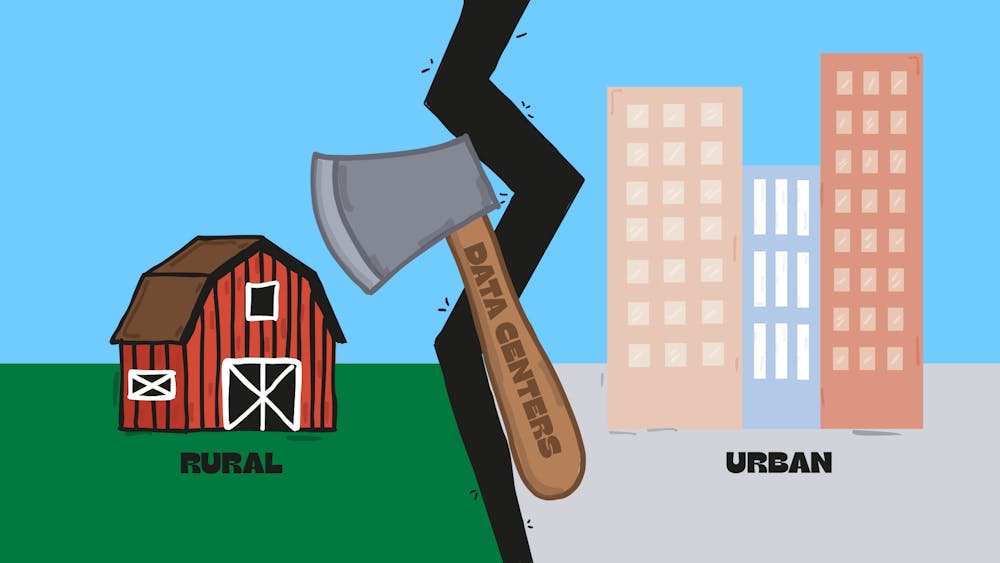
In March, a company called Valley Link proposed a project to build a massive transmission line through nine different rural counties. No, this project will not provide the needed internet access or energy to the area. It will, however, go towards fulfilling the energy demand of data centers in Northern Virginia. Despite backlash from local representatives and communities, developers are still moving through early planning and are expecting to receive approval from the Virginia State Corporation Commission soon. Although data centers provide many technological and economic benefits, most of these are only realized in wealthy metropolitan centers, leaving behind the rural counties. This reality is part of a broader history of the Virginia General Assembly neglecting this other side of the state by chasing what tends to be the pivotal vote of suburban areas in elections. If officials are to regain trust with the rural population and bridge the widening chasm between urban and rural interests, they must halt the construction of the Valley Link transmission line and other intrusive data center projects until local requests are met.
Projects like Valley Link’s mainly benefit northern metropolitan counties whose local economies will receive a boost from these new data centers. This is because companies can bypass physical urban constraints by extending these buildings into rural areas while keeping primary operations, tax revenues and the highest-paid jobs concentrated in Northern Virginia.
But beyond these recent issues surrounding the implementation of infrastructure needed for the rise of artificial intelligence, the story of Virginia’s neglected rural regions is a long, complex saga of economic decline and indifference. After the end of the Second World War, increased mechanization led to farms requiring fewer workers, destroying small farming families who relied on this income. Nationally, lax labor laws encouraging outsourcing and favoring commercial farmers spurred labor shortages that decimated rural communities in Virginia. Education and healthcare issues were exacerbated by this divide, driven by a reduced tax base from this economic stagnation. Virginia has, statistically, some of the worst rural deficiencies in healthcare. Additionally, Virginia's education funding formula heavily weights enrollment numbers, disadvantaging rural schools facing underenrollment. Clearly, there is an interconnected history of neglect for these communities. Understanding this history contextualizes these new data center invasions as yet another chapter in a long tradition of disregard for rural Virginia.
Today, the encroachment of AI infrastructure, through data center construction, poses a unique threat to these areas. As the internet traffic hub of the world, Virginia hosts more than 35 percent of all hyperscale data centers worldwide. Given the cheap land, lower taxes and less restrictive zoning laws, AI companies have begun to realize the benefits of shifting operations to rural counties, but it is the residents of these counties who bear the brunt. These data centers often soak up resources like water and electricity, straining energy grids and raising utility costs for locals. Even the smallest of these units requires as much power as 100,000 homes, and many data centers can be up to 20 times larger. Due to administrative gaps, residents often face massive energy bill spikes, with one report finding that $4.4 billion of costs were offloaded to residents in a few states, including Virginia.
Energy usage is not the only blight on these communities. Short-term gains in tax revenue and temporary jobs created are often offset by large tax breaks given to these corporations and the expertise required to operate these facilities, meaning struggling local communities feel little economic boost. Water consumption is another risk, as most large data centers consume up to five million gallons of water per day. This especially impacts rural communities due to the poor existing water infrastructure and local needs for agricultural irrigation. In Prince William County, for example, local supervisors are considering approval of a large data center that would likely threaten water quality and draw up to 500 million gallons of water from the environmentally significant Rural Crescent. Other key issues include noise pollution and low levels of long-term job growth, both of which are especially pertinent in places prized for natural tranquility and struggling with unemployment.
In spite of these inequities, these rural counties are beginning to fight back, and it is crucial that state legislators join their battle with tangible policymaking. In reference to the Valley Link project, Goochland County plans to spend $250,000 to advocate against this invasion. In Pittsylvania County, a 2,200-acre rezoning request for a massive data center was defeated after substantial local opposition pressured the board of supervisors. In Frederick County, over 22,000 residents signed a petition to put on the November ballot a plan involving a 2,600-acre data center overlay zone, meaning residents will vote on whether or not construction can begin. Across the state, these conflicts are becoming more common, stressing the need for statewide regulations. With over 200 more planned data centers set to be built, the Virginia General Assembly has little time to stall. Frameworks that protect rural communities — by restricting energy and water usage as well as requiring a ground-up approval process — must be established so that AI does not exacerbate this historic rural-urban divide.
As largely upper-class suburban students at the University, it can be easy to ignore issues outside of our bubble. But if we want a more united populace and to combat growing political extremism fueled by disillusioned rural voters, we cannot neglect these areas. The technology we take for granted has real consequences for struggling communities trying to protect their land. If Virginia officials are to stop turning a blind eye, it is up to all of us to highlight the threats these projects pose. As students of our state’s most esteemed public university, politicians often hold our voices in a higher regard than the average rural voter, making political participation in opposition to the construction of these data centers a pivotal move in this fight. Virginia cannot afford to continue its decades-long indifference to its forgotten communities.
Nat Taylor is an opinion columnist who writes about politics for The Cavalier Daily. He can be reached at opinion@cavalierdaily.com.
The opinions expressed in this column are not necessarily those of The Cavalier Daily. Columns represent the views of the author alone.
Read More

ADDISON: Criticism without introspection is a waste
By Lucas Addison | 18 hours agoThe Community of Trust must be more than a phrase we invoke to describe ourselves. It must be a standard by which we hold ourselves accountable.

HAWKINS: Florida gets education affordability right — Virginia does not
By Joshua Hawkins | YesterdayFlorida already has better weather — we do not need to let them beat Virginia at education affordability as well.

ANDERSON: Why I am ‘dark woke’ — and you should be too
By Beckett Anderson | 3 days agoArising from an internet meme, dark wokeism offers Democrats a youth-powered way out of the hole they find themselves in.