
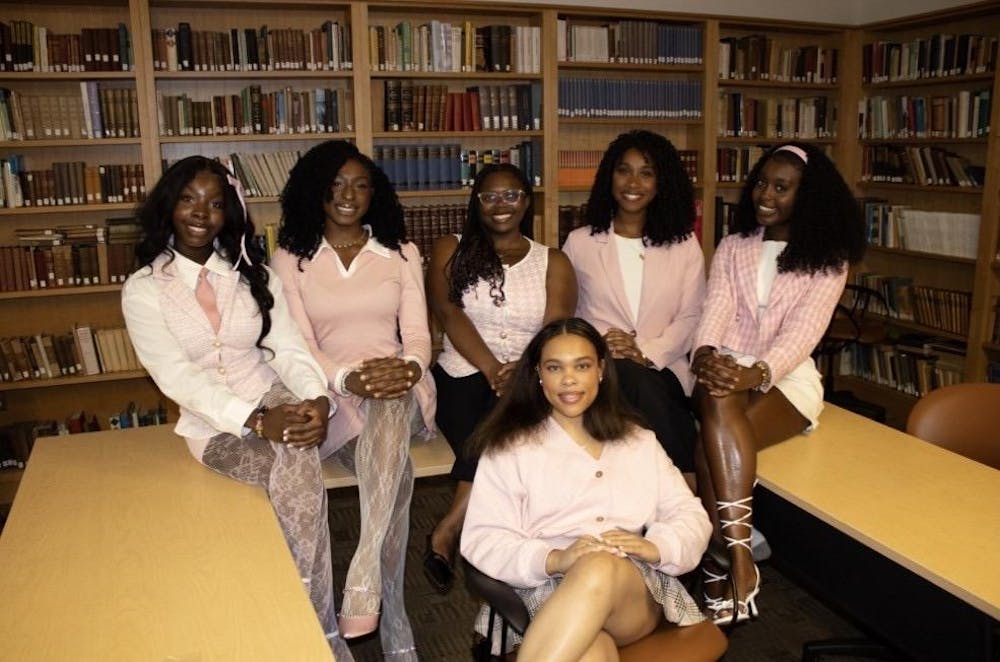
Correction: A previous version of this article did not fully reflect the breadth of BGU’s mission and leadership structure. In addition to cultivating community and mentorship, BGU was also founded to support retention efforts of Black women at the University. The article has been updated to include this part of the organization’s mission, and clarifies BGU’s leadership model.
A previous version of this article incorrectly stated that BGU was founded in 2022. BGU was founded in 2024. The article also incorrectly classified BGU as a chapter of a larger national organization. BGU is an independent, standalone organization. The article has been updated to reflect these changes.
Additionally, a previous version of this article did not identify the founders of the organization. The article has been updated to include the names of the four founders — third-year College students Genaba Diallo, Yannise Ladzekpo, Melinda Boamaah-Oduro and Azinwi Mbonifor.
For many first-year students, arriving on Grounds can feel like stepping into an entirely new world. Lecture halls are larger, expectations seem higher and forming new friendships can feel daunting. For Black women at the University — a predominately white institution — this transition can come with an added layer of isolation. In 2024, Black Girls United was founded at the University to address exactly that.
Since its formation, this relatively new Contracted Independent Organization has established a visible presence on Grounds. Founded by third-year College students Genaba Diallo, Yannise Ladzekpo, Melinda Boamaah-Oduro and Azinwi Mbonifor, BGU brings together participants from across the University to support and empower Black women at the University.
Throughout the past year, BGU has hosted a range of events — dance workshops in partnership with other CIOs like Asambé, to panel events to hear stories and experiences from BGU members and a brand-partnered session to learn about skincare with Good Molecules — all designed to help students build community and find a sense of belonging. Many of BGU’s events center the experiences of the Black community, but they are open to the wider student body, welcoming students of all races and backgrounds to learn and engage with Black culture.
What began as an idea sparked by students who wished they had more guidance when settling into the University and navigating young adulthood, has since grown into a sisterhood. According to Kahshiya Burke, BGU president and second-year College student, the organization does not just support members academically and socially, but it also gives them guidance in navigating the broader challenges of college life.
“Being a Black woman, being a Black girl, it’s something that really sets us apart,” Burke said. “[It gives] us … imposter syndrome, and the [BGU founders] wanted to create a community where girls come together and express that.”
At the heart of BGU is its big-little mentorship model, aimed at supporting first-year students during their transition to college. Mentors help first-years with a variety of things — from adjusting to the academic demands of college and picking courses to figuring out how to make friends in a new environment.
Each summer, University students who are interested in becoming mentors to incoming first-years fill out an application, detailing their intended majors, interests and hobbies to ensure thoughtful matches. The goal is not to create a rigid mentor-mentee structure, but to build a relationship rooted in trust — one where the bond between mentors and mentees can grow into a sisterhood and deep friendship filled with open conversation. The big-little mentorship model also works towards BGU’s goal of supporting retention efforts among Black women at the University, preventing transfers and reducing dropout rates.
Fafa Ackuayi, BGU mentee and first-year College student, notes what an important role her mentor played during her transition into life at the University. She explains how their similar academic interests established a baseline connection between her and her mentor, but that connection has since developed into something much more substantial.
“We’re both kind of [similar] academically in a sense, like she’s definitely helped me with advice on what classes to pick, because we’re both Pre-Med,” Ackuayi said. “She’s not just somebody who I [enjoy] as my mentor but she’s somebody who I enjoy as my friend.”
Beyond academics, Ackuayi said her mentor has also become someone she can lean on socially. She remembers the day their relationship shifted from a club-appointed pairing to a genuine friendship.
“We spent pretty much the entire day getting stuff from Walmart and Dollar Tree, and then helping UPC set up [an] event,” Ackuayi said. “Just spending that entire day with her, through all the mishaps … I almost view her as a sister now.”
BGU mentor and second-year College student Natiya Turner also began her involvement in the organization as a mentee. For Turner, BGU played a key role in her own transition to the University, giving her a place of solace and consistency during a time where everything else in her life was changing.
“I understand the struggle, what it was like being a first-year, being away from home … it’s just very difficult to navigate,” Turner said. “I come from a predominantly Black area, so coming here to a predominantly white institution … it was very much a culture shock for me.”
According to BGU’s founders, after BGU members complete their first year, they can then serve on the executive board, which empowers members early in their college careers. In addition to providing opportunities for leadership experience, the executive board’s structure ensures proximity in age and shared experience with first-year members, strengthening mentorship and relatability.
Beyond BGU's larger events with the broader student body, they also host several smaller activities like paint-and-sip nights, movie screenings and big-little sleepovers to foster connections between mentors and mentees in more intimate settings.
Members said that these quieter, more personal moments are where BGU's impact lies — the text messages between mentors and mentees, the familiar faces spotted across Grounds and the reassurance that someone who understands is only a call or a few hundred yards away. For Ackuayi, that sense of support extends beyond her individual mentorship pairing.
“Everybody’s so nice, everybody’s just so helpful,” Ackuayi said. “I feel like I can go to somebody who’s not my big if I have a question and that question could be answered without problems.”
In addition to their social programming, the organization has also carved out a space for deeper dialogue within the Black student community. For example, “Tough Conversations with Black Women & Men,” was hosted in collaboration with the Black Men Initiative and invited students to engage in conversations about race, colorism and relationships — issues that often go unaddressed despite their significance within the Black community.
As BGU continues to grow, the executive board hopes to expand the organization’s reach beyond the confines of the University. They hope that the organization — and all the support it provides to its members — can create a space of solace for Black collegiate women across the nation.
“We want our organization to be able to expand,” Burke said. “We're still [a] pretty small and newer organization, and I hope that in the years to come that it grows and we're able to maybe make it a state-wide thing or national [initiative] for each school. Hopefully we can build off of this [foundation] at U.Va.”
The roots BGU has built at the University are grounded by the core mission of sisterhood and retention — creating a space where Black women feel seen, supported and understood. For Turner, that sense of belonging that BGU fosters is what sets it apart from anything else on Grounds.
“Everytime I go to a BGU event, no matter how I [am] feeling, I’d go and I generally just feel very comfortable automatically. I’d feel very relaxed,” Turner said. “There was no uncomfortability … I just felt at home.”
Read More

The Ozempidemic — is social media telling the full story?
By Dana Douglas | 2 days agoTo strain the surplus of information about GLP-1 medication circulating on social media, The Cavalier Daily spoke to those on the frontlines of the phenomenon — University medical professionals and a student prescribed GLP-1 — to uncover what this development actually looks like for the future of weight management, diabetes treatment and American healthcare as a whole.

One poke bowl, endless possibilities
By Astrid Cheng | 4 days agoThough this version is my personal favorite, this recipe is meant as a starting point, not a rulebook.
Learning from the land at the University’s Morven Sustainability Lab
By Kendra Mickle | 5 days agoSpread across nearly 3,000 acres of rolling hills, luscious forests and farm lands, the property has become a hub for sustainability education and experiential learning for the University community.


