College athletics are unique in that fans themselves can often swing the tide in favor of their school’s team. Home advantage is certainly a factor in professional leagues, but the camaraderie and passion at that level pales in comparison to the high-energy, field-rushing, court-storming ways of collegiate sports.
Moments of genuine connection and fervor between fans are what set the college atmosphere apart, and can be an integral boon to a team's performance. Yet, at times, it feels like Virginia sports fail to take advantage of this potential edge. That is no fault of the teams themselves, but rather, an indictment of the self-proclaimed student fans. The fanbase has shown their potential in moments like the field storm against Florida State — however, it remains to be seen if this ardent support is a sign for the future or a mere flash in the pan.
Showing this potential just once is far from a sign of a truly dedicated community. The purest fanatics show up week in and week out, not just once a year for a prime-time showdown. This lack of a consistent commitment from the students is where Virginia often falls short. The Florida State game should have lit a fire under fans and students alike, as it proved that the community has what it takes to be one of the best in the nation. But so far, such a fire has yet to be rekindled, as it seems the fans have become complacent after one shining moment.
During a season where Virginia football finished at the top of the conference and as regular-season champions, such low student turnout is a clear indicator that a change in fan culture is warranted. Out of the 10 public schools in the ACC, Virginia had the second-lowest average attendance for football games this year, with only California trailing.
There are many possible explanations as to why Virginia’s fan turnout appears so low. Some fans may be hesitant to spend a portion of their beloved weekend at a football game. It’s also possible that many don’t see the point in showing their support in a game where the Cavaliers are expected to either win or lose by multiple scores.
Regardless of the justification, the rationale is deeply unfair to not just the program, but the athletes on the field representing the University. Is it reasonable to expect athletes to give 100 percent of their effort week in and week out, if the fans themselves cannot show up whole-heartedly for six or seven Saturdays every year? If fans want the best from their team, they must show their best as fans.
With a passionate enough fanbase, stadiums and arenas have the capability to make it nearly impossible for visiting squads to win. Raucous crowds make playcalling and communication incredibly difficult, while some players struggle to handle the pressure of tens of thousands of their opponent’s fans heckling them. Such zealous support infuses itself into the play of the home team as well, providing them with additional energy to propel them forward. This fact holds true regardless of talent, consistent from the top of the power conferences down to the bottom of the division.
The University of Alabama at Birmingham stands as a testament to this truth. The Blazers managed to win 42.5 percent more games at home than away over the past five years, a mammoth figure which leads the subdivision.
This number likely results, not from chance, but strategy. An active effort has been made by the UAB students and athletic directors to prioritize bolstering fan experience at home. The directors have increased their social media output regarding games, hired more customer service workers to accommodate bigger crowds and manufactured a “festival-like atmosphere” for fans to enjoy. The success is now simply the fruit of their labors, showing that establishing a great home environment can actively result in more wins for any team, even one that has historically struggled.
Additionally, Coach Tony Elliott has frequently emphasized the importance of “packing Scott.” Following the performance shown against Florida State, Elliott could not give enough praise to the students and fans who showed up for the game.
“That's what Scott Stadium is supposed to be like, and that's what I envisioned when I decided to take the job here,” Elliott said. “And man, really, really proud of the students and the fans for showing up … it made a difference. It made [for] a very, very difficult place for a good football team to come in here to play … The atmosphere was unbelievable."
While Virginia fails to produce it consistently, that energy that Elliott praises is commonplace for many programs around the nation, and not just for fans of football. In fact, home-court proved the deciding factor in a marquee college basketball game just last week. No. 9 Kansas faced off against No. 1 Arizona, but minutes before tip off, Jayhawks freshman and top NBA draft prospect Darryn Peterson was ruled out with flu-like symptoms. Arizona looked to be a machine heading into this face-off — it was undefeated, skilled at every position and showed no signs of slowing down. Despite taking the court without their best player, Kansas somehow prevailed.
Presumably, a key factor in the victory was the fan presence at Kansas’s home arena, Allen Fieldhouse. The arena was nearly exploding with energy that the Kansas players fed on throughout the night, and little by little wore Arizona down. The Wildcats could not cleanly get into offensive sets or communicate effectively. Free throws became anything but free for them as well, as they only made 57 percent, a huge step down from their season average of 73 percent.
Virginia students and fans alike should heed these examples and grasp that if a community is going to have expectations of being conference- or even national-title contenders in their sports — as fans tend to voice on a variety of media outlets — they must do their part to assist them.
The University community stands on the precipice of a moment where they can whole-heartedly devote themselves to the cause of their teams and push them farther than they otherwise would go. Or, they could continue with tepid support and give such programs no reason to chase anything more than mediocrity. The University and the teams have done their part. Now it is time for the fans to do theirs.
Read More
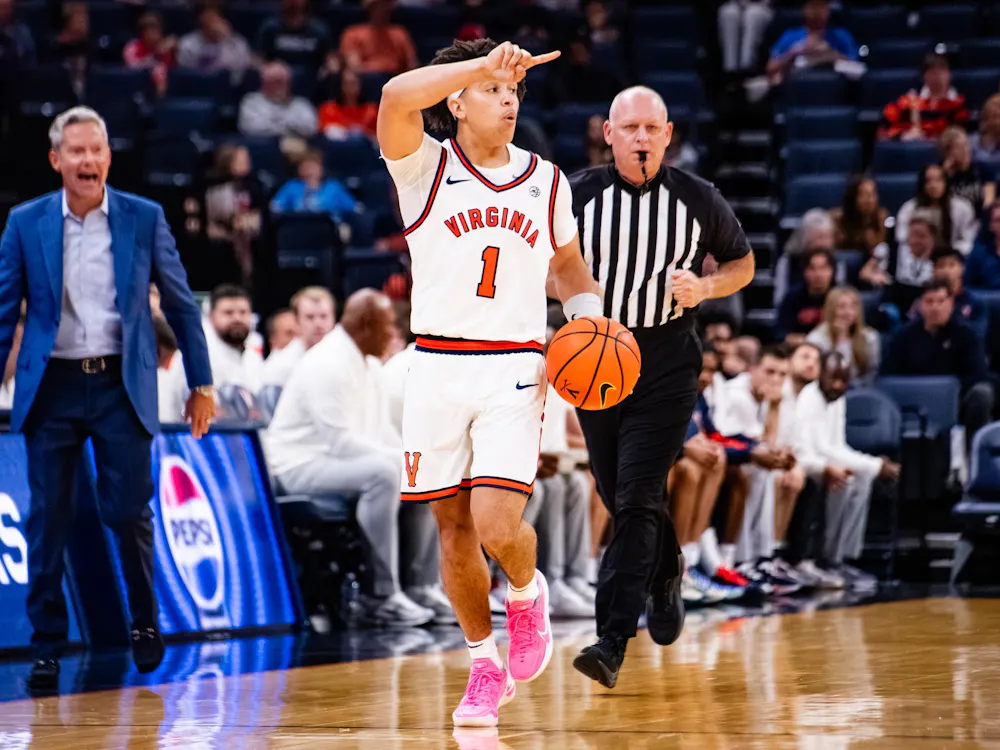
Five takeaways from the first two Virginia men’s basketball exhibition showcases
By Jordan Zimm | 13 hours agoWith one more exhibition remaining at Villanova Thursday, here are five takeaways from Virginia’s first two preseason tests.

Virginia volleyball looks to extend historic winning streak to 10 against Virginia Tech
By Jonathan Altshuler | 14 hours agoWhile both teams have struggled recently, Wednesday’s result further strengthened the Cavaliers' advantage in the rivalry — which remains one-sided.

Virginia volleyball extends winning streak against Virginia Tech with four-set victory
By Jonathan Altshuler | YesterdayThe Cavaliers defeated the Hokies in four sets Wednesday night at Memorial Gymnasium with scores of 25-19, 25-19, 22-25 and 25-23. This was the Cavaliers’ first win since Sept. 25, extending a five-year winning streak against the Hokies since 2022.