This past November, I went to a concert at the Jefferson Theater with my mom. We went to see Dawes, an indie-folk rock band, which was a full-circle moment for us after years of singing their songs on drives to practice and school. On our way to dinner, we played one of our favorites, “Most People,” in the car. I went to setlist.fm to figure out where the song was located in their track list. Our hearts sank to our stomachs when we figured out they rarely played the song live.
Disappointed, we shuffled into Birdhouse for a wonderful pre-show meal, where I double-checked to make sure the tickets were secured in my Apple Wallet. I realized that both tickets were in row A, the first row of the mezzanine — the suspended, balcony-like seats that protrude over the orchestra.
I then had a striking realization — I had to make a poster. It felt like fate chose our seats — I could drape the poster over the mezzanine without having to hold it up or disturb anyone. And the band would definitely see it, right?
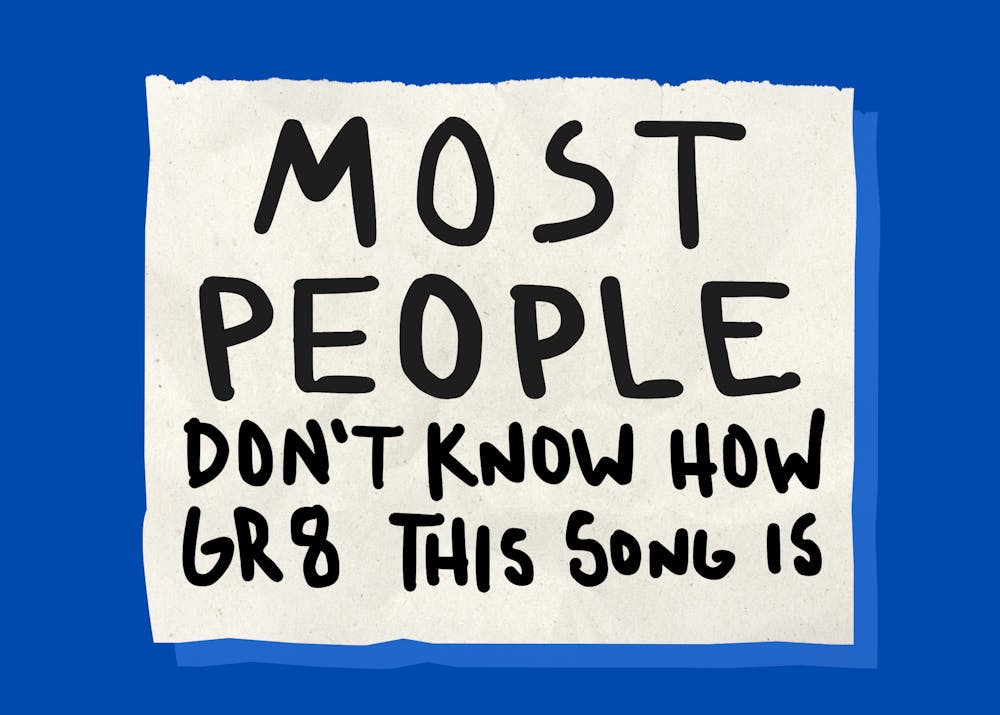
With stomachs full of chicken and hearts full of ambition, my mom and I drove to the Downtown Mall. I sprinted to CVS, grabbed a posterboard and a Sharpie and scrawled “MOST PEOPLE don’t know how gr8 this song is.”
In the self-checkout line at CVS, a man in a cowboy hat asked me what my message to the band was. I told him I really wanted them to play “Most People.” He smiled and said it was a great pick, adding that he also hoped they would end up playing it. While I obviously agreed, I seriously doubted a flimsy poster would make a difference.
As soon as we sat down, I chewed up several pieces of gum I had in my purse, and used them like tack to stick the poster to the wood. Once secured, I was able to enjoy the first set of the concert, in which they played their album “All Your Favorite Bands” from start to finish, including songs like “Somewhere Along the Way” and “Right On Time.” Throughout the set, I kept looking down at my gum-suspended poster.
Maybe they’ll see it. Maybe it matters. But probably not.
And then the second set began.
A familiar chord progression hummed from the stage — one I knew instantly. My mom and I looked at each other, eyes wide and mouths agape as “Most People” floated into the theater. The entire room erupted and belted the chorus of the song, “And she thinks most people don't talk enough about how lucky they are … But she doesn't know most people feel that same way.”
“One small voice,” my mom said to me, still beaming. And that really got me thinking.
With student election campaign season beginning Feb. 15, students will have the opportunity to voice their opinions through votes in this formative time for the University. Students will have the chance to elect representatives from Honor, the University Judiciary Committee and Student Council, giving them a chance to shape the leadership and direction of the University’s student self-governance organizations.
However, last year's student voter turnout only consisted of 22.5 percent of the student body. This number could be attributed to the notion that one’s individual voice would not have a large impact in the grand scheme of things.
I, myself, admit that it can be so easy to fall victim to the tyranny of the majority, to believe that your individual opinion does not matter. And as I walked into the Jefferson Theater on that night, I would be lying if I said I didn’t feel that same quiet doubt creeping in. Hanging up my poster felt almost silly. Why would a band change its carefully planned setlist for one request taped up with chewing gum? The Jefferson Theater can hold 750 people. Would my one wish even matter?
And right on time, I was reminded of the impact one small voice can have.
Watching this band rewrite its setlist because of one flimsy poster reaffirmed the fact that individual voices actually can influence what comes next. They can influence a decision, change the energy in a room and move people, sometimes literally, into harmony.
If you think about it, voting works the same way — it’s the collective impact of individual voices. Like a band, each instrument is small on its own, but incredibly powerful when they reverberate together.
The moment those opening chords rang out, I felt something shift — not just in the room, but in the way I understood the impact of individual action. The truth is, change rarely begins with a crowd. It begins with one idea, one person who's brave enough to advocate for what they believe in. It begins with one voice that makes others pay attention. I finally understood that Margaret Mead quote in my mom’s office and middle school classrooms across the world — “Never doubt that a small group of thoughtful, committed citizens can change the world. Indeed, it is the only thing that ever has.”
And if a flimsy poster can rewrite a setlist, imagine what a vote — a formal, counted and institutionally recognized voice — can do.
On Grounds, this power isn’t abstract. It lives in the student elections that enable elected candidates to allocate funding, set priorities and speak on behalf of the student body. Students can change the direction of their University the same way a crowd can change the energy of a concert.
So whether it’s in a conversation, a concert hall or a voting booth, your voice has the power to shape what comes next. So use it.
Read More

Delicious on a dime: Charlottesville’s best restaurant deals
By Lucy Larsen | 5 days agoFrom wraps and wings on the Corner to imported wine and tapas on the Downtown Mall, these are the perfect spots to treat both your taste buds and your wallet for under $25.

Play the organ
By Elizabeth Adams | September 25, 2026The college side quest does not need to be the multi-semester jaunt that my organ adventure has become, and it certainly doesn’t have to make sense.

Girls Who Lift brings gender inclusivity to the gym
By Sadie Adams | September 23, 2026By providing this safe space in the gym, Girls Who Lift encourages more women to take up weightlifting as a hobby.