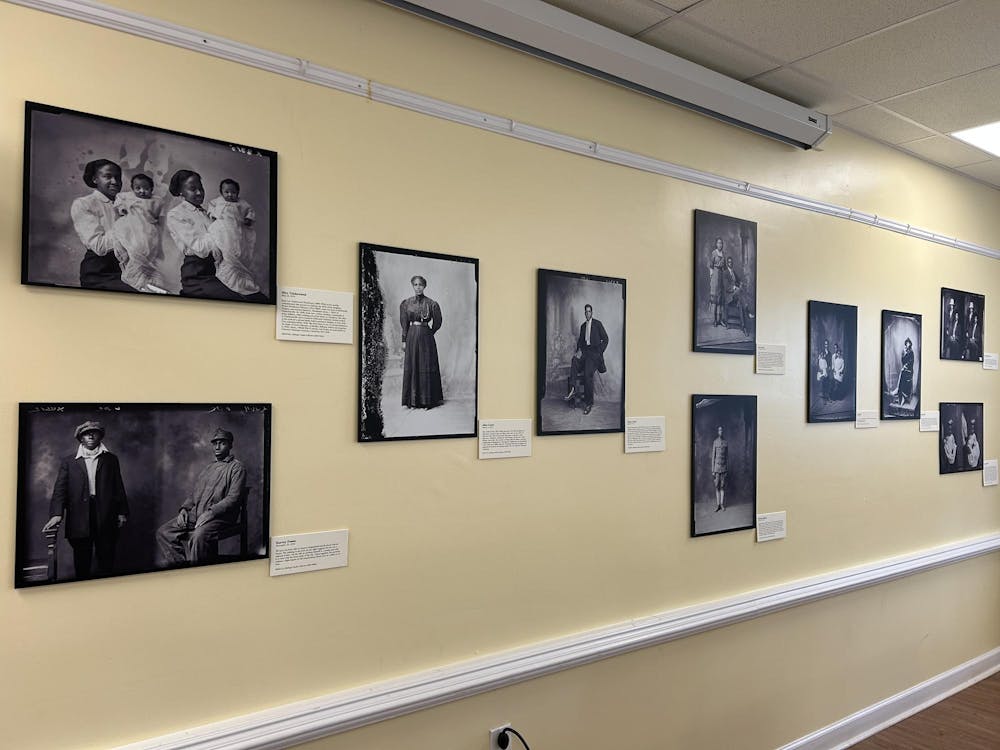
The “Visions of Progress: Portraits of Dignity, Style and Racial Uplift” exhibit — on display at the local Trinity Episcopal Church until March 11 — features a series of portraits capturing African American Charlottesville residents from the 1920s. According to John Edwin Mason, curator of the exhibit and professor emeritus of history, the portraits showcase the dignity and pride of their subjects amidst heightened oppression at the time.
The portraits come from a collection of 10,000 glass plate negatives — glass sheets that were the main method of capturing images before film — given to the University in 1978 from the Holsinger Studio, Mason said. As the primary Charlottesville portrait studio of the late 19th and early 20th century, the negatives provided by Holsinger were all taken between the 1890s and 1920s. The exhibition chose a small sample from the over 500 negatives that captured African Americans, and was originally displayed in the University’s Special Collections Library in 2022 and 2023, drawing record numbers of visitors.
Mason said he sees the existence of these portraits as an extraordinary act of refusal of exclusionary historical narratives. According to Mason, the portraits were a way for African Americans to demonstrate agency in telling their own story instead of accepting the depictions thrust upon them by society.
“These portraits were made at the height of the Jim Crow era, which is to say at the height of racial oppression in the United States,” Mason said. “And yet you cannot see oppression in these portraits. And that’s how people wanted it. They wanted you to know that they are not defined by their oppression.”
The African American figures are portrayed with an air of dignity and pride, defying the racist caricatures prominent throughout the United States at the time, particularly in the South. The portraits are full of personality and expression and highlight aspects of Black life like family, churches, schools and businesses.
This aspect of the photography is particularly evident in a portrait of Dr. George Ferguson, one of the first African American physicians to open a private practice in Central Virginia. In the portrait, Ferguson is sitting in a chair dressed in a stylish three-piece suit. To his left stands his daughter, Louise, wearing a white shirt and skirt and to his right is his son, George Jr., leaning on his father and crossing his legs. Louise would later become a career librarian at the Cleveland Public Library and George Jr. went on to become a leader of the Charlottesville National Association for the Advancement of Colored People. He was a part of the organization in the 1950s when the group sued the city of Charlottesville to follow the Brown v. Board of Education decision to integrate schools.
The spirit of the portraits and the collection’s title reflect the “New Negro Movement” during the Jazz Age of the 1920s. This movement was characterized by upward mobility, progressive attitudes, demanding constitutional rights and cultural self-expression.
Mason started working on the project in 2015 with collaborators like Worthy Martin, Assoc. Professor Emeritus of Computer Science, exhibition curator Holly Robertson and a team of seven undergraduate researchers. Using the studio’s ledger book along with other documents like military records, birth and death certificates, street directories and newspaper articles, the team did deep dives into the lives of the people captured.
The research is presented in the form of brief biographies of the subjects next to their portrait that explain the likely circumstances for which they would be getting their photo taken as well as what was recorded of their life afterwards. For Mason, these blurbs remind the viewers that each sitter was a person with a real life of joy and hardship that extended beyond the single recorded moment.
“Their words and pictures work really well together, because one is doing things that the other cannot,” Mason said. “The words can explain and words can make an argument, but the visuals can give you a much richer sense … for what it feels like.”
Over the last few years, the exhibit has been mobile. After its longest stint at the Special Collections Library, it made stops at the Black History Museum and Cultural Center of Virginia in Richmond and the Westminster-Canterbury of the Blue Ridge retirement community before appearing at the Trinity Episcopal Church in Charlottesville.
Trinity is no stranger to opening up its halls as an exhibit space for local artists, as the “Visions of Progress” collection will be its sixth exhibit in the past two and a half years. Mason said that the current location is very personal for him, as his father was ordained as an Episcopal priest and Mason himself has been a member of Trinity since moving to Charlottesville in the 90s. Mason said he believes having the portraits in a historically Black church like Trinity also symbolizes the importance of Black institutions, connecting the past and present through faith and local communities.
“There are African American institutions that have made it possible for African Americans not to be crushed by oppression. The church is certainly near the top of the list,” Mason said.
For Rector of Trinity Episcopal Church Cass Bailey, it’s been fulfilling to see members of the Charlottesville community who have ties to individuals in the portraits come to the church to see the exhibit.
“There are some people who still have some connections in the community who know the exhibit is here and they’ve seen it,” said Bailey. “I saw the exhibit when it was at U.Va., but having it in your space, your home so to speak, it just gives a different feeling and a sense of pride. So it’s good to be a part of this.”
The exhibit’s next stop will be at Charlottesville High School, either later this spring or this upcoming fall, and Mason said he hopes to bring it to other schools in the region. Mason said that he and his team are excited about the idea of the collection reaching young people, and impacting them in the same way he was impacted when he first saw them. He hopes that the portraits and the stories that go with them remind people today of the resilience and strength demonstrated by these individuals in claiming their personhood, and that the fight is far from over.
“One of the things that looking at these portraits can do is remind people that we’ve been walking for a long time, and there’s a long way to go,” Mason said. “But we keep walking … And no matter how bleak things look now, the struggle continues. It’s a long march, and we cannot be defined by outside forces. We have to be defined by what’s inside of us.”
Read More

beabadoobee shines on her electrifying album ‘Pylon’
By Kelsey McIntyre | 34 minutes agoEven though beabadoobee began writing rock music as a teenager, this is certainly her most adventurous project in terms of genre.

Lizzy McAlpine soars to new heights on ‘Angel’
By Alena Touve | 1 hours agoLizzy McAlpine’s “Angel” is a triumph of sonic experimentation and lyrical ability, channeling both folk and musical theater into one harmonious product.

Girls in pearls, guys in … jerseys
By Zoe McFarland | 21 hours agoAs University tradition continues to coexist with changing trends and tastes, game day fashion will likely continue to resist simple characterization.