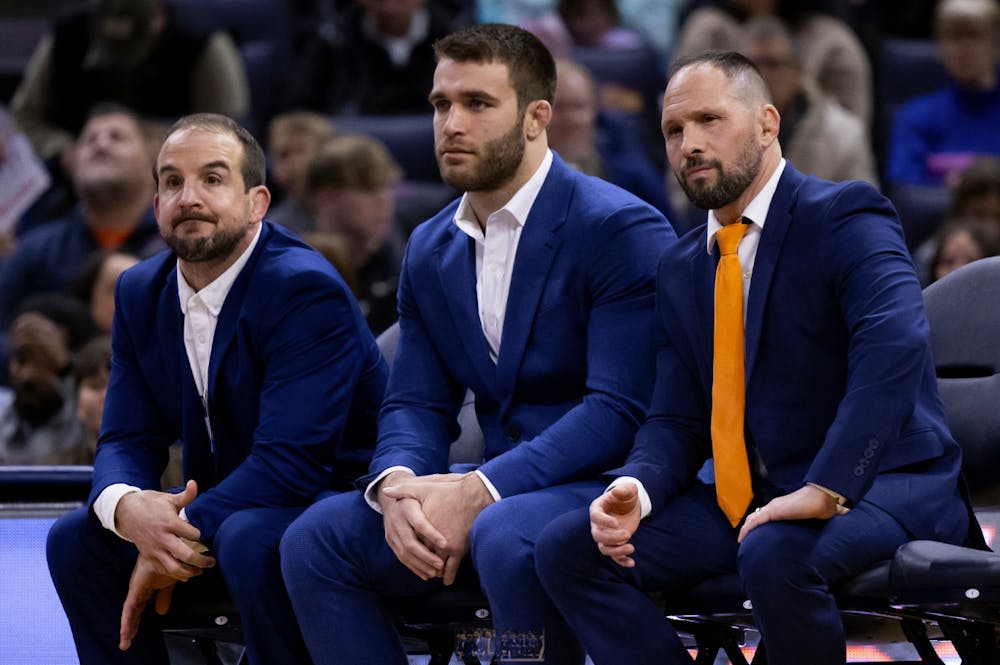
In his 20 years coaching at Virginia, Coach Steve Garland has installed three foundational values of the wrestling program — focus, discipline and consistency. From 2017 to 2023, these values served as the backdrop to Michael Battista’s wrestling career at the University, shaping the athlete and man he wanted to be. Several years after graduating with his masters degree, Battista is back — instead of a singlet, though, he has adopted a role under Garland as an assistant coach.
As a young wrestler, Battista hit Garland's recruiting radar early. A Northern Virginia native, he began attending youth clinics put on by the Cavalier wrestling program during middle school. Years later, the two connected at clinics in Northern Virginia during his high school days. As a recruit, Battista had the strength and physical characteristics needed to be competitive at the college level but needed molding in terms of technique and direction.
“I always tell the guys, if your ‘why’ is not right, nothing's right,” Garland said. “[Battista] had to figure out his ‘why’ while he was here.”
Battista’s “why” was about more than how successful a wrestler he wanted to be. Rather, it was about how he wanted to be as a person, how he conducted himself, how he held himself accountable. This mental aspect has become a point Battista and Garland preach to their wrestlers — be process-oriented. Being process-oriented was the foundation on which Battista built his “why.” The pair emphasizes that the wrestlers may not always get the outcomes they desire, but they should not allow results to dictate the kind of athletes or people they are.
“But it wasn't just from the wrestling standpoint, it was like who I wanted to be, like the kind of character I wanted, the kind of discipline, I wanted the mental toughness,” Battista said. “Those were things that transcended wrestling … I just wanted to be that guy.”
Ultimately, he did become “that guy” — a hugely successful Cavalier wrestler. On the mat, Battista was a two-time NCAA Tournament qualifier with podium finishes at both the U23 world team trials and U.S. Open, in addition to boasting over 70 career victories. As a scholar, he earned three All-ACC Academic Team nods, three NWCA All-America Scholar honors and both a Bachelor’s and Master’s degree from the University.
After receiving his Master’s, Battista moved to Texas for a tech position. Seven months later, he moved back to Northern Virginia, where he managed a lifting gym. Battista admits that doing everything from personal training to sales and scheduling was rewarding, but exhausting. As he was beginning to feel burnt out, Ian Parker left his assistant coaching position with the Cavaliers to join the Northern Iowa staff. Garland’s phone call reached Battista with perfect timing.
Garland wanted one of “his guys” — former wrestlers and alumni of the program — as part of the coaching team. Thus, Battista slotted into Parker’s role excellently. Now, Battista brings a unique perspective to the staff. As a former wrestler who learned under Garland, he has firsthand experience from the same point of view as the current athletes.
“It was kind of surreal, you know, going from being the athlete to the coach now, but also having the relationship with all these guys, especially the fact that I'm coaching guys that I used to wrestle with,” Battista said. “I've had to learn how to manage that … These guys are my friends, but at the same time, I'm their coach now.”
Garland believes that Battista’s accessible perspective brings added relatability to the staff’s coaching and process-oriented messaging. The athletes need only look at Battista for evidence of what that process-oriented approach can do. Rather than focusing entirely on the results — his wins, losses or statistics — he put that energy into what he could control every day, which was the way he practiced, prepared, recovered and maintained his positive attitude.
Now, Battista is able to help wrestlers with their development in the same areas he grew himself — whether it be a lack of motivation, subpar performance or a negative mindset about practice. To reinforce this development, the coaching staff held one-on-one meetings with some of the wrestlers and to discuss their goals on and off the mat, just like Garland did with Battista when he was a wrestler.
“Like Michael said, I’ll steal his line,” Garland said. “It's about who you want to be. Who do you really want to be?”
Garland knows it is a message easier preached than adopted, especially with young, college-aged men. But he strongly believes it is one that can shape the way an individual’s life is lived, one that will carry over from an athletic career to a professional one, just as Battista has done.
“This isn't just about wrestling,” Garland said. “How you wrestle is how you live your life, and how you live your life is how you wrestle. That's why most of our alumni are so successful. Because the lessons that they learned in that transformation process then apply to real life.”
Battista hopes to bring a taste of that alumni success back to Virginia. As a member of the coaching staff, he is returning the favor to the program and the people that helped shape his identity and career.
Read More

A chance meeting led field hockey assistant coach Brendan Creed to Charlottesville
By Adair Reid | 5 hours ago“Ultimately we haven't won this thing here, so that kind of is a big attraction for me in terms of let's do something for the first time,” Creed said. “There's something to chase, which I think is also really exciting.”

On the recruiting trail, Virginia baseball finds future Cavaliers
By Drew Dillman | 5 hours agoWhether it be in Virginia or across state lines, incoming first-years or experienced veterans, Coach Chris Pollard has found a way to recruit talent for the 2027 season and beyond.

Sloan, ‘Mr. Reliable,’ scores first career goal as Virginia trounces Gardner-Webb
By Michael Liebermann | 13 hours ago“I thought I was going to be scoring goals from the minute I got here,” Sloan said.