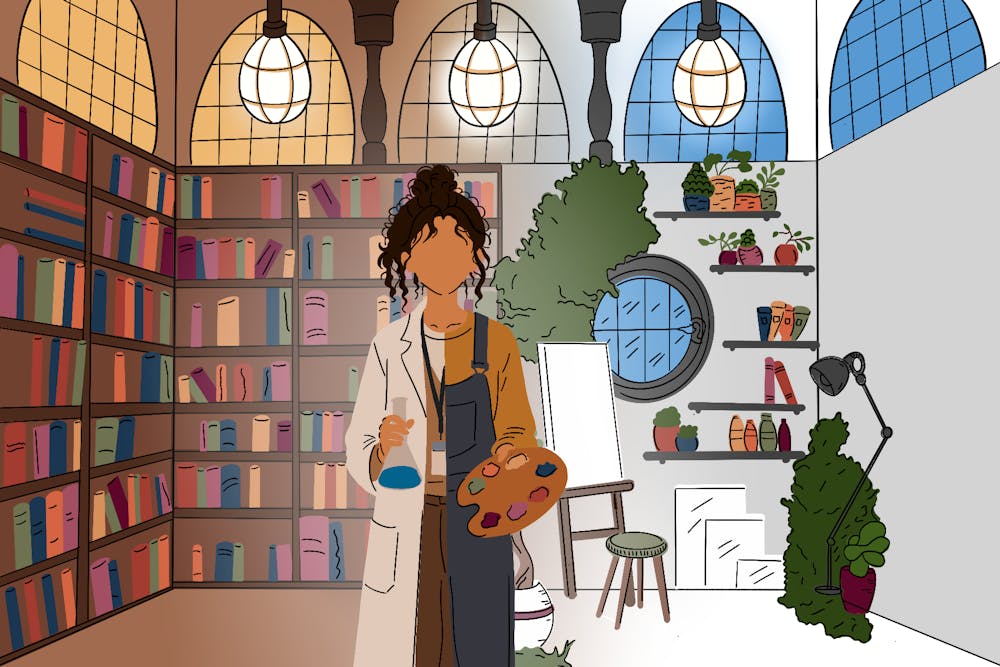
Choosing one’s major seems to remain an eternal challenge for all college students. To many, selecting a major is akin to selecting a path in life. However, despite the perceived gravity that comes with major declarations, many students at the University have found a way to dive into interests across disciplines, making the case that one does not have to sacrifice their affinity for the arts in academia.
In the transition from high school to college, the arts are often put aside and dismissed as passion projects rather than stable career paths. Other, more career-focused majors are perceived as being more worthy of a degree than one in the arts, causing students to feel as though they need to pick a more practical path. As a result, many students find themselves in love with both arts and another, less artistic discipline, ranging from politics to medicine. Be it programs in drama, art history or music, the University offers a wide range of degree paths that allow students to tailor their academic journey to one that aligns with their passions, not just their career plans.
The University’s curriculum allows for students to easily pursue different avenues of study whether they came to Grounds with a certain path in mind or if they discovered this passion upon their arrival. With certain restrictions set in place due to major and school requirements, as well as general education disciplines, students may find themselves boxed in when selecting courses early in their time at the University. However, student creativity — be it through a passion for the arts or navigating a packed schedule — knows no bounds, as many pursuing multiple academic paths often showcase.
In a statement to The Cavalier Daily, Sophia Gallivan, rising third-year College student double-majoring in politics and Media Studies with a prospective minor in studio art, wrote that — despite being daunting — her concerns about credit allocations were eased after talking to Asst. Studio Art Prof. Marisa Williamson about her plans for the future. After taking courses in the department and being accepted into the Echols Scholars Program after her first year — which waives general education course requirements and enables students to have priority enrollment — Gallivan expressed that she wanted to find a way to integrate studio art into her academic path.
“I felt totally incapable of taking studio [art] again after years of not making art but my professor reassured me that I belonged in her class,” Gallivan wrote. “Applying to [the Echols Scholars Program] after my first year allowed me to have even more schedule freedom which I am incredibly grateful for.”
Some students also come to college with a substantial amount of credits, making doubling up on majors or pursuing a minor a more feasible process. Additionally, many classes fulfill multiple disciplinary requirements, which may make freeing up one’s schedule a more manageable task.
Arts classes can also provide a creative outlet from more intensive classes in a course load. Art inherently requires a creative way of thinking, and Isabella DeMark, a rising third-year College student double-majoring in Global Sustainability and studio art, said that her schedule allows her to alternate between using different parts of her brain.
“Most majors at U.Va. aren’t hands-on, they’re more academic and lecture based,” DeMark said. “Then I’ll have art [which] uses a different part of the brain, so it’s not like I’m using my brain the same way all day.”
While taking art classes can offer an alternative perspective to balance out a student’s day, these classes can also bring students out of their comfort zone. Pursuing creative opportunities can feel daunting, and arts classes often push students to share their work amongst their peers, enabling students to further expand their viewpoints. From having work displayed in the Ruffin Gallery in some classes to peer-based critiques throughout semester-long courses, curriculums in the arts can engage students both critically and inventively, offering opportunities to engage with one another.
Gallivan explained that diving into art disciplines at the University has allowed her to interact with different perspectives through public displays of her classmates’ work and has opened new doors for her academically and creatively.
“I feel much more well-rounded and it has been incredibly rewarding to see a part of U.Va., the arts program, that I was not previously familiar with,” Gallivan wrote. “I have found so much joy in seeing the creations of my classmates displayed in places like [the Ruffin Gallery], somewhere I probably would not have ventured otherwise.”
Although art can feel completely separate from other disciplines to some students, many have found ways to meld their passions together. Many students pursuing art and another major said that they are able to bring their artistic way of thinking into their more analytical classes. Mary Gombos, a rising fourth-year Education student double majoring in kinesiology and studio art, wrote in a statement to The Cavalier Daily that she often blends her love of medicine with her art.
“I have created many pieces related to medicine and healthcare,” Gombos wrote. “Some projects have focused on anatomical structures, such as a sculpted human heart, while others have explored broader themes and commentary related to hospitals, patient experiences and the healthcare system.”
While the expansive nature of many students’ course loads broadens the range of academic opportunities available to them, Gombos wrote that the biggest challenge to anyone thinking of taking on more than one discipline is the balance between the areas of study.
While it may be a challenge to balance two disciplines — even when managing time correctly — pursuing extracurricular activities related to them can be an alternative, yet equally enriching experience. Naomi Diener, a rising fourth-year Education student majoring in youth and social innovation and minoring in dance, explained that opportunities to dance and teach the art form have been meaningful to her outside of the classroom.
“I’ve loved all the student leadership opportunities that I’ve had through the dance program,” Diener said. “I feel like I’ve really been able to get involved in that as a community. And the [Education] school I also love … there are a lot of opportunities [for community involvement] that they talk about.”
Outside of the University, the merging of artistic and academic interests have influenced these students' professional lives, allowing them to utilize both sets of skills. Gombos explained that, to potential employers, her art is a physical manifestation of her hard work.
“While my transcript and coursework show my academic performance, my art provides tangible evidence of my creativity, attention to detail and growth over time,” Gombos wrote. “I can point to specific printmaking, sculpture and drawing projects that showcase skills that are harder to capture on paper alone.”
Across the University, students take a wide range of paths related to both their time spent on Grounds, as well as their plans for careers after graduation. Diener stated that, while she does not want to be a full-time dance teacher after graduation, she has found ways to incorporate dance into her teaching in preschool classrooms.
“It has been really cool to see how the kids love to dance, or they love to move,” Diener said. “That’s like the one time where no kids are bickering with each other … It is cool to see the skills that develop from that both socially and also in terms of motor skills.”
Whether one’s passion lies in sciences, humanities, arts or the plethora of other disciplines the University offers, there are many ways for students to pursue varied interests in their coursework.
“If you genuinely enjoy something, don’t shy away from the opportunity,” Gombos wrote. “Some of the most meaningful experiences I’ve had at U.Va. happened because I decided to pursue interests that seemed completely unrelated on paper.”
Read More
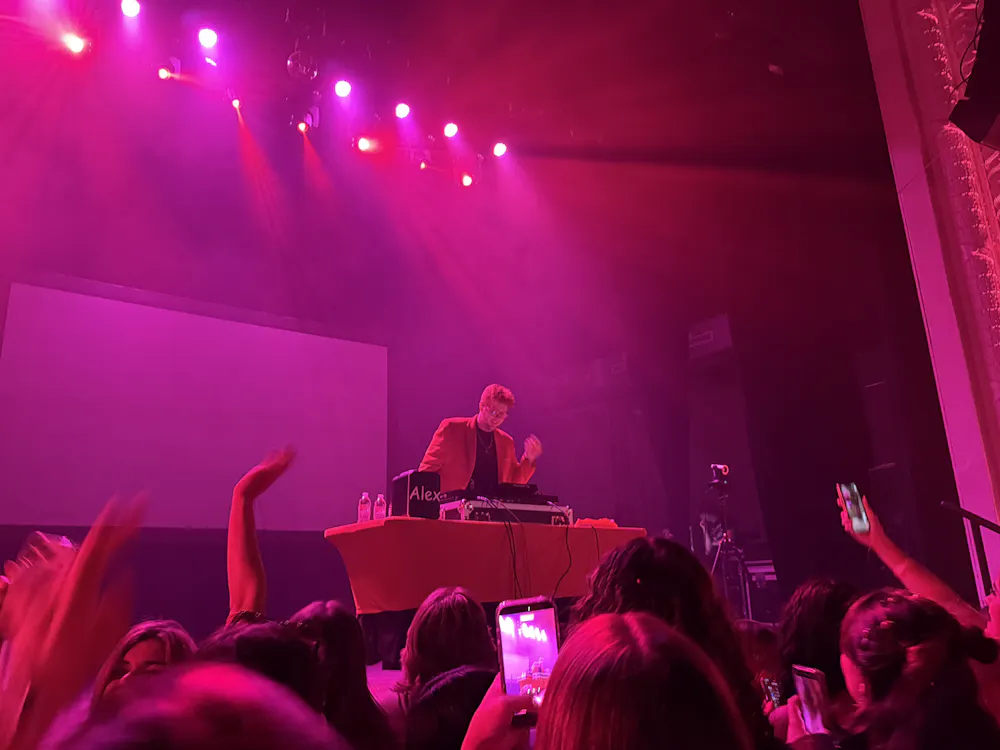
Big Red makes Charlottesville’s day on his ‘Day Made’ tour
By Bridget Baile | 21 hours agoFor the chronically online, Big Red’s “Day Made” tour lived up to its name.

On Repeat: 2010s indie rock songs to listen to on NFL Sundays
By Darya Bartol | YesterdayFootball-filled Sundays can cause a rollercoaster of emotions even in the most stoic of fans. These 2010s indie rock hits represent this emotional turbulence whether celebrating with friends or mourning in solitude.

Sasha Fishman’s ‘Lemniscata’ puts water in motion at Ruffin Gallery
By Preet Manukonda | 2 days agoThe fountain-like installation and accompanying pieces explore the circulation of water through both human-made and natural environments.