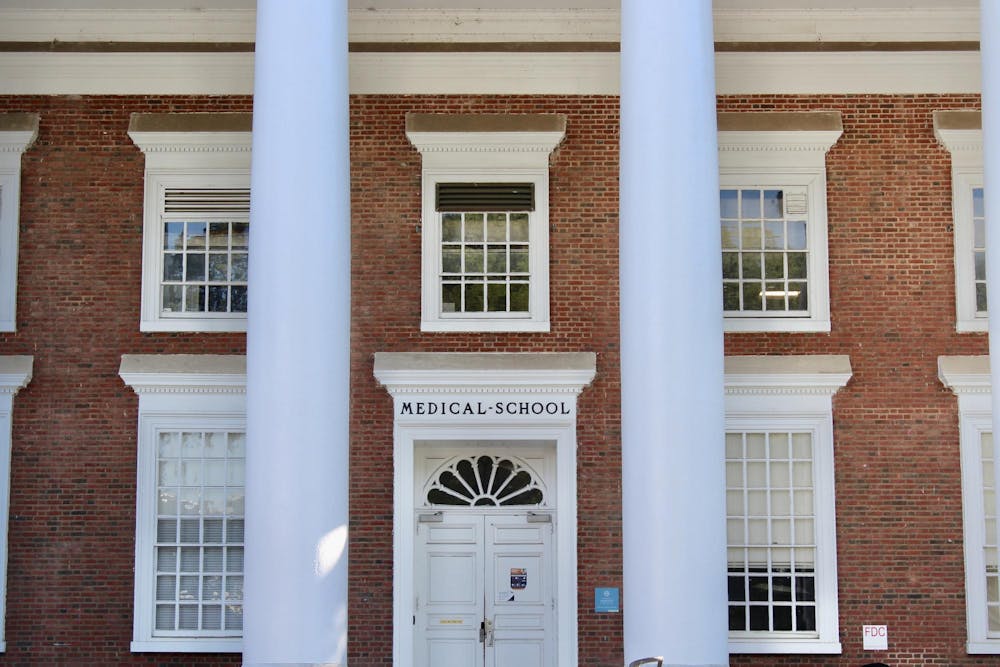
Despite certain peer schools having lost National Institutes of Health research funding to their respective medical schools, the School of Medicine at the University has managed to increase the amount of NIH funding it is capturing by 20.4 percent from 2024 to 2025. Compared to other medical schools that received funding increases — like Duke University School of Medicine and University of North Carolina at Chapel Hill School of Medicine — the University’s School of Medicine increase in funding outpaced these other increases.
For the University's School of Medicine, NIH funding sources are a critical component of its total research funding. According to Eric Swensen, the public information officer for U.Va. Health, the School of Medicine received about $300 million in total research funding for fiscal year 2025. More specifically, the School of Medicine received $203,283,468 of this research funding from the NIH. This means NIH funding accounted for about 68 percent of its total research funding.
Joshua Barney, deputy public information officer for the School of Medicine, wrote in an email statement to The Cavalier Daily that research funding from the NIH is critical to nearly all of the research work that is done by the School of Medicine. The NIH awards its research funding to universities, medical schools and other research institutions after vetting applications for grants.
Barney said that one way the University has been able to capture a significant amount of NIH funding amongst a “tremendously competitive” research funding environment is due to strides made by physicians, scientists and other team members as well as the launching of the Paul and Dianne Manning Institute of Biotechnology.
The Paul and Dianne Manning Institute of Biotechnology aims to increase innovation and stimulate collaboration amongst scientists and researchers across the Commonwealth to develop life-saving treatments, and is set to open in 2027.
“Our [NIH funding] efforts have been boosted by the launch of the Paul and Diane Manning Institute of Biotechnology,” Barney wrote. “The institute is bringing together leading experts in academia and industry to accelerate how quickly our discoveries can be turned into new drugs and cures for the patients who need them most.”
According to Barney, the Manning Institute has contributed to the boost in NIH funding the School of Medicine is receiving. This is because the NIH has indicated its priority to fund institutions with patient-first research, which the Manning Institute is committed to through the development of new treatments and medications. Barney also said the Manning Institute is helping to make Central Virginia an “ecosystem of innovation” with economic benefits across the Commonwealth, which he said he hopes will inspire further NIH investment.
Barney said that the Manning Institute and the funding it is helping to bring in is allowing students to be on the frontier of modern medicine and work towards improving the health of Virginians and beyond.
Since the Trump administration took office Jan. 20, 2025, many higher education institutions across the country have lost significant amounts of research funding. A significant amount of this funding loss was from organizations such as the NIH. As of June 4, 2025, NIH grant terminations had cost academic institutions over $3.8 billion in funding since Jan. 1, 2025 and the total number of grants that had been terminated was up to 2,282.
Of the terminated grants, 52 percent — $2 billion dollars worth — were grants that had previously been awarded to medical schools and hospitals, the other $1.8 billion was cut from other academic research institutions.
In a press release June 11, 2025, Danielle Turnipseed, chief public policy officer of the Association of American Medical Colleges, said that research cuts such as those from NIH pose risks to academic health systems that include research labs and medical schools, like U.Va. Health.
“The impact on academic medicine will be enormous,” Turnipseed wrote. “Academic health systems can only absorb so much without significant harm to biomedical research, medical education and patient care.”
According to University President Scott Beardsley in a recent presentation to the Board of Visitors, these NIH research funding cuts are affecting some of the top research schools in the country, causing them to lose hundreds of millions of dollars in funding. Beardsley said during his presentation that he attended a recent conference where certain peer research institutions discussed their significant funding losses, but that the University has thus far avoided some of the negative effects of federal funding cuts because of its strong financial position.
“When I was at the [Association of American University's] school meeting, there was a panel [of] the top research institutions in the country, so Johns Hopkins, Duke and UNC were discussing what had happened to them on the research landscape,” Bearsley said in the June 6 Board meeting. “Johns Hopkins lost hundreds [of millions of dollars], and they were all thinking about how they are going to cut costs. That's an issue.”
Below is a breakdown of the University's School of Medicine increases or losses in funding alongside peer institutions' respective increases or losses in funding between FY 24 and FY 25 based on data that was provided by Swensen. The figures show the amount of NIH funding obtained by peer medical schools per FY and their respective rank based on a national scale of total NIH funding.
University of Virginia School of Medicine — 20.4 percent increase
From 2024 to 2025, the School of Medicine increased its amount of NIH funding by 20.4 percent. The School of Medicine also increased its national NIH funding ranking in comparison to other U.S. medical schools from No. 39 to No. 36. Its total amount of NIH funding in 2024 was $168,870,875 and in 2025 it was $203,283,468. From 2021 to 2025, the School of Medicine increased its total amount of NIH funding by 37.1 percent and saw a rank increase from No. 42 to No. 36.
Barney emphasized the School of Medicine’s efforts in its innovative research and how that helps to propel NIH funding.
“We’re taking innovative approaches to tackling some of the greatest challenges in medicine, from the deadliest cancers to the most devastating neurodegenerative diseases, and this is creating many opportunities for our students and trainees to participate in research at the very leading edge of medicine,” Barney wrote. “We are excited to see our discoveries benefit patients across Virginia and beyond and ultimately improve the health of people around the world.”
Duke University School of Medicine — 13.1 percent increase
From 2024 to 2025, the Duke University School of Medicine also saw an increase in the amount of NIH funding it received by about 13.1 percent — a figure that is 7.3 percentage points lower than the University's increase.
The Duke University School of Medicine also increased in its funding ranking from No. 13 to No. 9. Its total amount of NIH funding in 2024 was $454,891,637 and in 2025 it was $514,509,019. From 2021 to 2025, the Duke University School of Medicine saw a 15.4 percent decrease in total funding and saw a decrease in its rank from No. 3 to No. 9. The school’s NIH research funding comprised about 83 percent of its total amount of funding from grants and research contracts in FY 25.
University of North Carolina at Chapel Hill School of Medicine — 1.1 percent increase
From 2024 to 2025, the UNC School of Medicine saw a 1.1 percent increase in NIH funding — a figure that is 19.3 percentage points lower than the University’s increase. Its rank also increased from No. 19 to No. 18 during the same period.
Its total amount of NIH research funding in 2024 was $349,006,984 and in 2025 it was $353,001,816. From 2021 to 2025, the UNC School of Medicine increased its total amount of NIH funding by 1.5 percent — a figure 35.6 percent lower than the University. Its rank did not change during that time. The school’s NIH research funding comprised about 55 percent of its total amount of funding from grants and research contracts in FY 25.
University of Maryland Baltimore School of Medicine — 1.7 percent decrease
From 2024 to 2025, the UMD School of Medicine saw a 1.7 percent decrease in NIH funding and its rank decreased from No. 40 to No. 41. Its total amount of NIH funding in 2024 was $167,849,423 and in 2025 it was $164,995,948. The school saw an 18.4 percent decrease in NIH funding from 2021 to 2025, and its rank decreased from No. 32 to No. 41 during that same period. The school’s NIH research funding comprised about 33 percent of its total amount of funding from grants in FY 25.
Northwestern University Chicago School of Medicine — 7.1 percent decrease
The Northwestern University Chicago School of Medicine saw a 7.1 percentage point decrease in NIH funding from 2024 to 2025 and had a rank decrease from No. 15 to No. 17. Its total amount of NIH funding in 2024 was $414,130,627 and in 2025 it was $384,786,250. The school saw an increase of funding of 7.9 percent from 2021 to 2025 and had no change in its rank during that period. The school’s NIH research funding comprised about 55 percent of its total amount of funding awards in FY 25.
New York University School of Medicine — 10.7 percent decrease
From 2024 to 2025, the NYU School of Medicine saw a 10.7 percent decrease in NIH research funding, which was also marked by a decrease in its funding rank from No. 11 to No. 13 nationally. The school’s total amount of NIH funding in 2024 was $490,227,441 and in 2025 it was $437,996,810. From 2021 to 2025, NYU saw a decrease in funding by 45.9 percent and had its rank decrease from No. 1 to No. 13 during that same period.
National Context
More funding cuts of about 40 percent to the NIH were proposed in the federal administration's budget for FY 26, but Congress struck down the proposed cuts in the budget and instead increased the NIH’s budget by $415 million from FY 25.
The administration's proposed FY 27 budget, released April 3, includes a roughly $5 billion reduction in funding for the NIH — about a 10 percent decrease from FY 26. Congress has not yet approved a budget for FY 27. Barney said that NIH funding is a “vital pillar of the School of Medicine’s research enterprise” and it is critical in funding research projects that develop medications and treatments that benefit patients across the country.
Michael Racz is a staff writer on the news desk. He is a second-year student in the College majoring in Biology with plans to go to Medical School. Outside of The Cavalier Daily, Michael is a member of the Emergency Medicine Scribe Program and the Alpha Epsilon Pi fraternity. He enjoys writing about health topics and student self-governance.
Read More

Faculty Senate releases its annual committee reports from the 2025-26 academic year
By Jaylynn Perez | 6 hours agoThe Faculty Senate — a body of approximately 82 elected faculty representatives from across the University’s schools — represents faculty on academic matters affecting multiple schools such as degree programs and major curriculum changes.


Charlottesville’s emissions are on the rise, staff explain at City Council meeting
By Luca Bailey | 17 hours agoThe Charlottesville City Council held its final regular meeting of the month Monday evening, where a presentation from City staff detailed that Charlottesville’s greenhouse gas emissions have been consistently on the rise since 2022.