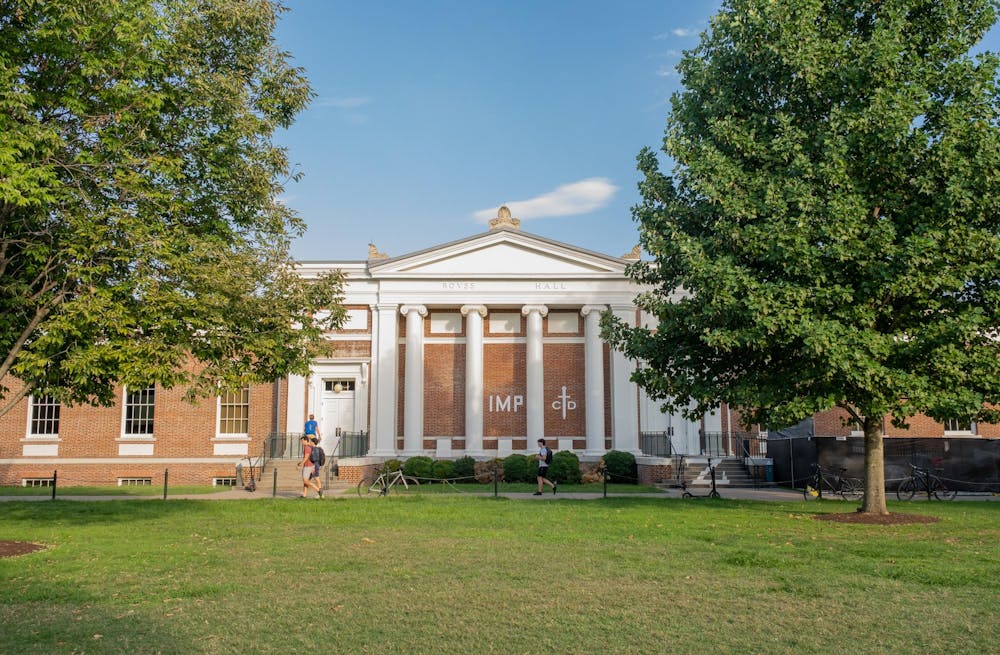
This spring marked the second year that first-year students could apply to the McIntire School of Commerce under its new three-year program structure, and the first year in which first-year students were the only applicants eligible to apply for admission. Last year, both first- and second-year students were eligible to apply to McIntire into three-year and two-year programs, respectively, in separate admission cycles.
According to Brooke Braun, executive director of marketing and communications for McIntire, the school received 876 applications this cycle, the exact same number of applications that were received by first-year students applying in the 2025 cycle. The acceptance rate for the 2026 cycle was 43.5 percent, with 381 students receiving acceptance offers. Of the 381 students who received offers, 372 students accepted their offer, making the matriculation rate 97.6 percent.
The admission rate for the 2026 McIntire admission cycle saw a decline when compared with last year's admission rate for first-years applying into the three-year McIntire program — which had an admission rate of 44 percent. Additionally, 876 applications received in the 2026 cycle means that about 22 percent of the Class of 2029 applied to McIntire.
McIntire admissions trends
2025 is not shown. 2019–2024 figures are from McIntire’s published statistics for current UVA student applicants.
Offer rate fell to 43.5 percent
Generative AI was used to assist in generating the visuals. All writing and reporting in this article was done by Cavalier Daily staffers.
The 2026 admission cycle also saw an increase in the mean admitted student GPA from 3.86 in last year’s first-year admission cycle to 3.9 this year. In general, the GPA profile of admitted students was higher in the 2026 admission cycle than it was in the 2025 three-year program admission cycle.
For example, 97 percent of students admitted in 2026 had a GPA of at least 3.7, compared with 86 percent in the 2025 admissions cycle. Additionally, 85 percent of admitted students in 2026 had a GPA of at least 3.8, compared with 77 percent of students in the 2025 cycle.
Mean cumulative GPA reached 3.90 for admitted students
Generative AI was used to assist in generating the visuals. All writing and reporting in this article was done by Cavalier Daily staffers.
While the number of submitted applications did not change between this year’s admission cycle and last year’s first-year student admission cycle, the number of applications increased from the number received in last year’s second-year student admission cycle and overall since 2019.
In last year's admission cycle for second-year students applying to the two-year commerce program, 726 applications were received, meaning there was an increase of 150 first-year applicants since last year’s second-year cycle. Additionally, there was an increase of 316 applicants in the 2026 cycle as compared to the 2019 cycle.
The number of offers has remained relatively stable in the last couple of years, with 55 more offers extended this year than in 2019 and five fewer offers made this year compared with last year’s three-year program.
Applications rose sharply in 2026
Generative AI was used to assist in generating the visuals. All writing and reporting in this article was done by Cavalier Daily staffers.
Further analysis of the GPA admission data, acceptance rate trends and application volume is available in graphical formats throughout the article.
The 2026 cycle also saw the removal of the HireVue video essays from the application, meaning the application only consisted of written essay supplements.
Students have both praised and criticized the application's new format. Benjamin Muhlendorf, newly admitted rising second-year Commerce student, said removing the video essays eliminates applicants' opportunity to demonstrate their ability to think on their feet and respond to questions in real time — skills he said he believes are central to the McIntire curriculum.
“It is my opinion that removing [video supplements] and instead only using [written] essays is a mistake, primarily because I see McIntire's curriculum as emphasizing participation and public speaking,” Muhlendorf wrote. “Removing quick-thinking ability from the selection [process] seems to contradict that focus.”
According to newly-admitted rising second-year Commerce student Ella Burbige, the application and supplemental essays were extensive, but she said she had adequate resources from students, organizations and the school itself to complete her application.
“I think it was definitely a rigorous application, so I was working on it throughout the entire second semester, but I got really great help from a lot of older McIntire students in the clubs that I'm in [and] the McIntire Admissions Committee,” Burbige said.
Burbige and Muhlendorf also both acknowledged the benefits of the new three-year undergraduate program due to its alignment with finance career recruiting timelines in fields like investment banking and consulting. Employers within the financial services industry, particularly at large investment banks, begin recruiting for third-year internship positions during a student's second year on Grounds — these positions can later turn into return job offers.
Building on the benefits of the new program, students from the incoming class voiced optimism about being exposed to the McIntire curriculum earlier and building relationships with peers within the school. They cited programs like the Integrated Core Experience — a program completed in the third year that puts McIntire students into “blocks” of 40-45 students and tasks them with solving real-world business dilemmas for companies like Hilton and Solidcore.
“I am most excited about meeting many new people in the class of 2029, as well as learning more about financial markets and how they shape the world around us,” Muhlendorf said. “Being in smaller classes with similarly interested cohorts seems like a great place to study.”
Christopher Wang, newly admitted rising second-year Commerce student, said one of the aspects of McIntire he looks forward to is the opportunity to build relationships with classmates.
“I think a lot of people I've talked to [who] are older [mention] building relationships with other people in the Commerce school,” Wang said. “It's not like the other schools because you are split into the [integrated core blocks] your third year and building those relationships is definitely something I'm looking forward to.”
The McIntire School of Commerce, according to Braun, is unable to provide incoming class demographics such as residency status or gender. Braun said “class profile data” may become available in August.
Michael Racz is a staff writer on the news desk. He is a second-year student in the College majoring in Biology with plans to go to Medical School. Outside of The Cavalier Daily, Michael is a member of the Emergency Medicine Scribe Program and the Alpha Epsilon Pi fraternity. He enjoys writing about health topics and student self-governance.
Read More

Students pay University Mandatory Fees — what do they cover?
By Isabela Delgado | 23 hours agoThe amount a student pays in fees is dependent on several factors, such as a students’ residence in- or out-of-state and their school of enrollment.

Honor Committee introduces proposal to change sanction appeal process
By Isabela Delgado | YesterdayThe proposal includes the addition of a governing body that would oversee the appeals process and decide if a student's appeal is deemed legitimate.
From the Archives: 2000s
By Peyton Franz and Alayjah Gillus | 2 days agoCavalier Daily writer, John Adams, pranks students with a column stating that a newly installed “no TJ” policy will go into effect, preventing graduates from Thomas Jefferson High School for Science and Technology from attending the University and expelling all current students who graduated from TJHSST.