Correction: A minor detail was removed from the article because it was placed out of context. The article has been updated to accurately contextualize the information provided to The Cavalier Daily.
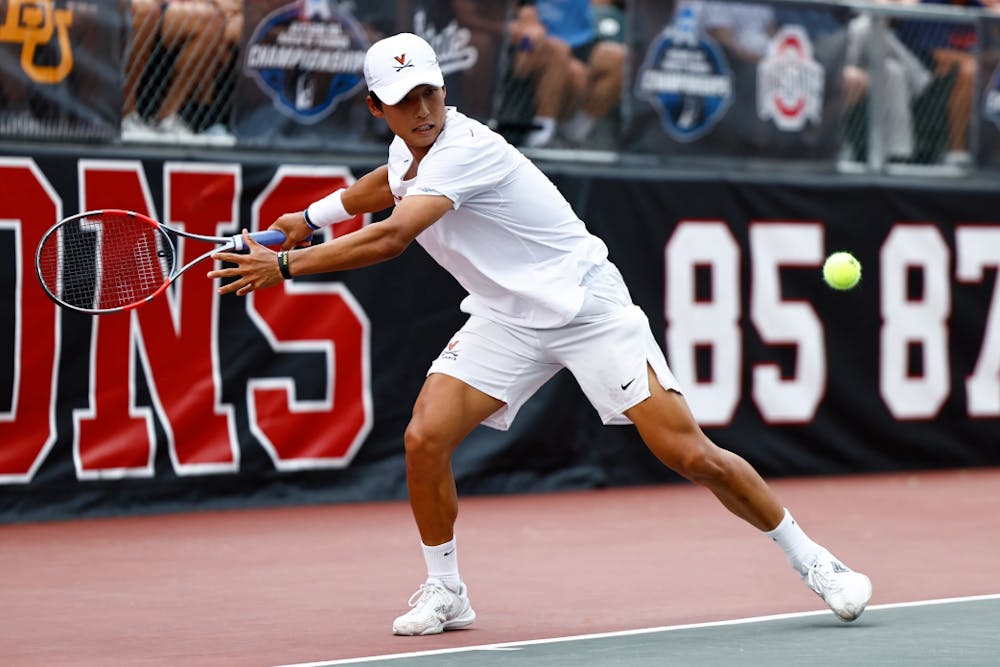
With Virginia’s season on the line against Texas in the NCAA Championship match, Jangjun Kim stood calmly at the baseline during a second-set tiebreak.
The match had already stretched deep into the afternoon heat. Teammates watched courtside. The crowd grew louder after every point.
Kim was unfazed, focused only on the ball in front of him.
There is a word Kim says to himself on a deuce point. Not loudly in the way a typical player might pump their fist and shout. Kim says it quietly to himself in Korean.
“딱 하나.” (Ttag hana). Focus on just this one point.
Not the championship. Not the crowd. Not the fact that he is one of the only Korean players in American college tennis, 5,000 miles from home. Just this one point.
That commitment to staying focused on the task at hand had become central to the way Kim competed all season.
Throughout the postseason, the Cavaliers repeatedly lost doubles points and dropped first sets, forcing comeback after comeback. And through nearly all of it, the biggest moments often drifted toward Kim.
Against Columbia and South Carolina, Kim won critical third sets. Against Mississippi State, he was leading in a third before play was clinched. He rallied for another three-set victory against Wake Forest, then stayed composed through a pivotal second-set tiebreak against Texas in the final.
These results only partially explain his impact. As a freshman, Kim’s talent flashed inconsistently while still adjusting to college tennis, primarily competing at Lines 5 and 6 and finishing 16-7 overall. By the spring of his sophomore season, he had become something entirely different.
Kim moved up to Lines 3 and 4 singles and emerged as one of Virginia’s steadiest players, finishing 25-9 overall with a 16-6 spring dual-match record. But beyond the wins themselves, Virginia came to rely on the calmness Kim brought into pressure moments. He rarely showed emotion or allowed momentum swings to change his approach. It was the quiet consistency that made him one of the team’s most dependable players.
Kim said that composure was intentional.
“No grunting, no reaction after the point,” Kim said. “Just calm.”
His coach agreed.
“He’s just a silent assassin out there,” Coach Andres Pedroso said.
Kim grew up in Seoul, South Korea, in a tennis culture that exists mostly outside the visibility of the Western game. Korean tennis has no Rafael Nadal or Novak Djokovic. The players who come through its system grind through tournaments with the same ambition as their European or South American counterparts, but with less supportive infrastructure and significantly less recognition.
To get the flexibility elite junior tennis requires, Kim attended online school through high school while training at Dignity Tennis Academy in Korea. By the time he arrived in Virginia in January 2025, he had already spent years competing far from home — from all across Asia to even Australia — knowing what it meant to be somewhere foreign.
Kim first encountered the idea of American college tennis when he competed in the U.S. Open Junior tournament in September 2024, where he met Pedroso. Ultimately, Kim chose Virginia because of the honesty he felt from Pedroso and the culture surrounding the program, he said.
“Some other schools were telling him it was going to be easy and I told him it was going to be hard, really hard, but it’s going to change your life,” Pedroso said.
Pedroso turned out to be right.
Getting acquainted with life in Charlottesville was its own adjustment. Online school in Korea had given Kim flexibility, but not the experience of sitting in a lecture hall and balancing Division I athletics. Like many athletes, Kim had to adapt quickly to the structure of his new college life. For him, the transition was made even harder by the language barrier.
And at a university where international students make up about five percent of the total population, some parts of home were difficult to replace.
When Kim misses home, he goes to DOMA, a Korean restaurant on Main Street, or watches the Korean drama “그 해 우리는,” in English “Our Beloved Summer.” When asked the first thing he wants to do when he returns to Korea, his answer comes quickly — eat kimchi stew.
At times, the adjustment affected his tennis, but Kim attacked it the same way he approached matches — quietly and persistently.
“[There has] been monumental effort that [Kim] deserves a lot of credit for,” Pedroso said. “He’s gotten into a routine and he’s built momentum academically. That’s kind of allowed him to relax a little bit and be able to train a little more, and he’s playing better tennis because of it.”
Last summer, Kim stayed in Charlottesville to take summer classes and continue improving his English while training. Pedroso said Kim earned an A in his summer course, a milestone the coaching staff viewed as a major accomplishment considering the transition he was navigating.
Pedroso credited Assistant Coach Brian Rasmussen, Virginia’s academic support staff and tutors for helping Kim adjust. But he emphasized that much of the progress came from Kim himself.
“He’s learned English, he’s doing great in school, he loves the United States now, he’s made lifelong friends,” Pedroso said. “So it's an all-around amazing U.Va. student athlete story."
That growth off the court mirrors the steadiness Kim developed on it.
Around his wrist, Kim wears two rubber black and yellow bracelets that say “Push Through It,” something a trainer made for him seven years ago after a serious shoulder injury in Korea nearly required surgery. Kim spent nearly a month in the hospital recovering and has worn the bracelet ever since.
Years later, that same mentality still appears in the way Kim competes — 딱 하나, focus on just this one point.
Kim does not play with the theatrical flair of Andres Santamarta Roig or the authoritative presence of Dylan Dietrich. He plays his shots, retrieves the difficult balls, resets when he needs to and waits. And then, when the moment is right, he steps into his forehand and drives it through the court with a pace and precision that catches opponents off guard.
His presence has also started resonating beyond Virginia’s lineup.
Kim shared that he is believed to be among the first Korean players to compete in American Division I college tennis, part of a generation beginning to explore the NCAA pathway more seriously.
One Korean tennis account described him as “the future of Korean tennis,” tracing his journey from ITF Juniors in Korea to Virginia and calling his NCAA success part of “writing a new chapter in Korean tennis history.”
Kim himself told The Korea Herald that, "Going forward, I want to continue showing that Korean players are fully capable of challenging themselves and succeeding on the NCAA stage.”
When Virginia played Vanderbilt earlier this season, Kim faced Hoyoung Roh, another South Korean player. To his knowledge, it was the first time two Korean players had ever met in a U.S. college tennis match.
A Korean tennis supporter even drove 10 hours to attend the match and later posted about it on Instagram.
“Three Korean players in one NCAA match,” the supporter wrote in his post. “For me, this felt like a Yonsei versus Korea University rivalry match.”
Kim’s significance has also become visible inside the Virginia community. At home matches, groups of Asian students regularly support him, many seeing themselves represented in high-level college tennis for the first time.
“Being a Korean-American myself, it is inspirational watching Kim represent both my school and country,” said Eric Lee, Class of 2026 alumnus. “Tennis is not exactly dominated by Asian players, which makes him a trailblazer for the sport. He also plays with great ferocity, and really rises to the occasion no matter the opponent, which really embodies the U.Va. spirit.”
What makes Kim’s story resonate so deeply is not simply that he is Korean, but the path he took to get here — leaving Korea by himself, adapting to a different language and culture, while becoming one of the most dependable players on a national championship team.
For Kim, though, the experience at Virginia has always meant more than tennis.
“I feel like I’m going to be a good person after I graduate here,” Kim said.
The adjustment to life in the United States gradually became something Kim learned not just to manage, but to grow through. And in many ways, the same steadiness that carried him through that transition became one of the qualities that made him indispensable to Virginia’s lineup.
In the biggest moments of Virginia’s national championship run, Kim never seemed rushed by the noise around him. While crowds got louder and matches swung emotionally, he narrowed the court down to something smaller.
One point.
딱 하나. Focus on just this one point.
Read More

KEPPLER: The University’s lack of transparency in Agugua-Hamilton’s departure sets a dangerous precedent
By Sofie Keppler | YesterdayFormer Virginia women’s basketball head coach Amaka Agugua-Hamilton has officially reached a settlement with the University following her departure April 4 after four years with the Cavaliers.
No. 11 women’s soccer defeats Northwestern in season opener
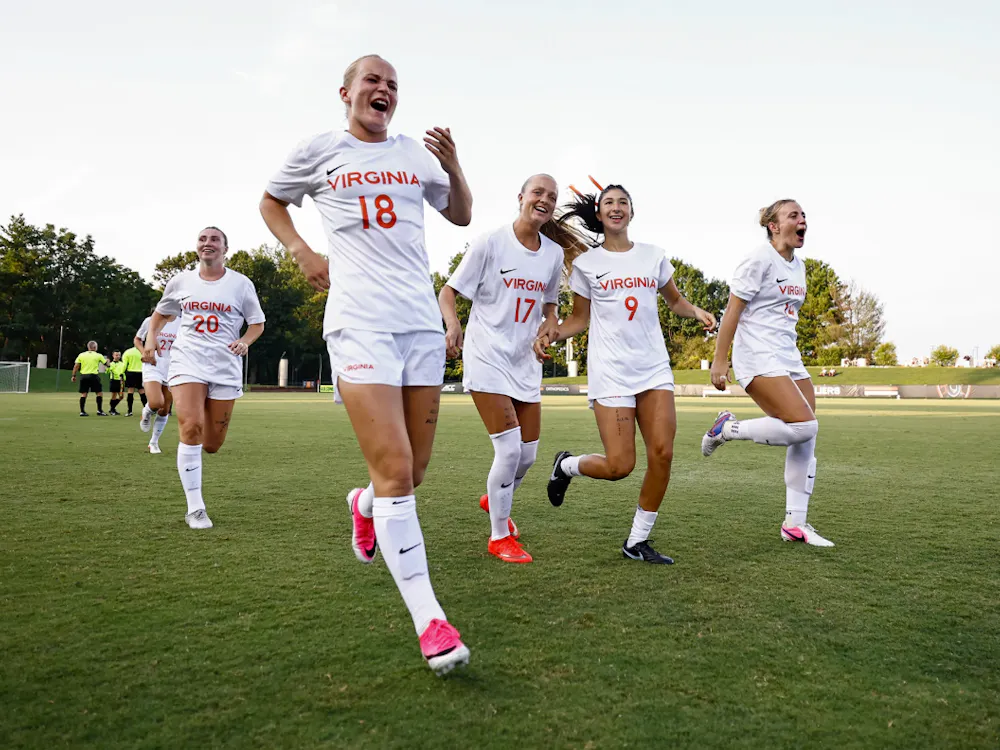
By Peter Kratz | 5 days agoWhen the Cavaliers had opportunities to attack on the wings, they attacked relentlessly. Great deliveries came from both sides of the pitch into the Northwestern box, putting duress on the Wildcats’ backline and not allowing them to regroup and counter.
How will Virginia women’s soccer fare in its upcoming season?
By David Sewall , Peter Kratz and Sofie Keppler | 6 days agoWith the Cavaliers’ first contest scheduled for Wednesday, three Cavalier Daily beat writers tackle questions about this year’s squad, anticipated matchups and how the team may perform during the 2026-27 campaign.