

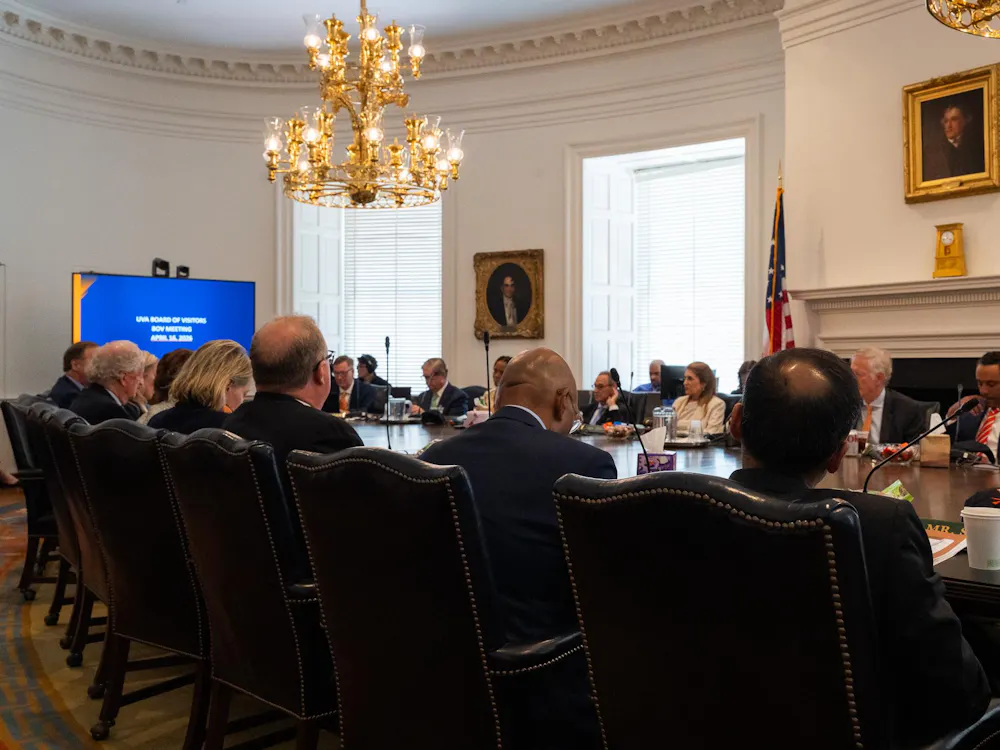
The Board of Visitors’ Health System Board met Thursday and discussed recent leadership changes across the Health System, presented a new set of strategic pillars and priorities and distributed information on the history and current status of U.Va. Health’s telemedicine offerings.
Dr. Mitchell Rosner, U.Va. Health chief executive officer and executive vice president for health affairs, opened the HSB’s meeting by discussing recent leadership turnover, highlighting Jeanne Alhusen, who was recently named interim dean of the School of Nursing following Marianne Baernholdt’s resignation. The HSB also recognized Tammy Snyder’s appointment as CEO of the University Medical Center and Chief Nursing Officer Kathy Baker, for stepping in as interim CEO following Wendy Horton’s resignation in July 2025.
Rosner also provided remarks regarding Baernholdt’s resignation as he opened the meeting, complimenting her commitment to expanding research, promoting community health initiatives and growing the accelerated Bachelor's of Science in Nursing program. Rosner also said that during Baernholdt’s time as dean, she advocated strongly for the School of Nursing and also worked to integrate the school into the broader Health System.
Following Rosner’s remarks, Alhusen addressed the HSB, outlining her commitment to the School of Nursing and her hopes of supporting its students, faculty and staff in the ever-changing health care landscape.
“I think the challenges before us, from workforce needs, to increasing complexity of care, to rapid changes in science and technology, really mandate that we change how we educate the next generation of nurses," Alhusen said. “I think schools of nursing, and in particular our School of Nursing, have an important role in not simply responding to those changes, but in really leading those changes.”
Additionally, Snyder introduced herself to the HSB and spoke on her first month becoming acclimated to the University Medical Center. She also outlined her goals as CEO, including improving employee engagement, quality and safety and operational efficiency.
Next, Rosner discussed the leadership structure with HSB members and explained that despite each leadership position having its own set of responsibilities, the positions work closely together and regularly interact across all fields from finances to education.
Lastly, Rosner discussed updating branding for U.Va. Health’s new strategic plan entitled “One Future Together | Health and Hope for All.” According to Rosner, the new plan is organized around three primary pillars — “Strengthening Our Foundation,” which includes digital and AI innovation, exceptional patient experiences and superior quality and safety, “Expanding Excellence and Advancing Discovery,” which focuses on improving research and promoting distinction in education and “Caring for Our Patients, Our Teams and Our Communities,” which includes workforce development, team building and community engagement.
Following Rosner’s remarks, the HSB watched a video that highlighted the journey of Dr. Mark Lepsch, primary care physician for U.Va. Health, who recently underwent open-heart surgery with U.Va. Health’s Heart and Vascular Institute for treatment of a bicuspid aortic valve and will soon return back to work treating patients.
Additionally, the HSB received informational impact reports detailing the history of telemedicine care at U.Va. Health, which began in 1995. Since telehealth services launched, there have been more than 897,000 telemedicine appointments and there has been a continuous rollout of new telehealth offerings since that time.
The impact report highlighted major developments in telehealth, including the 2006 launch of a program providing 24/7 remote neurologist support to emergency departments and EMS teams across the Commonwealth, the 2010 launch of telemedicine services for high-risk obstetric patients and the expansion of telehealth programs beginning in 2020 during the COVID-19 pandemic.
Next, the impact report detailed a variety of telemedicine statistics for the 2026 fiscal year. During fiscal year 2026, U.Va. Health had about 150,000 video and phone visits, 3,100 virtual urgent care visits and a 96 percent patient satisfaction rate. Additionally, telemedicine programs had patients that ranged in age from five days old to 104 years old and were offered in 21 different languages. The impact report also states that telemedicine platforms allowed for $26 billion in professional billing charges — which is revenue captured for provider services.
The impact report also details multiple telehealth programs currently in place at U.Va. Health that have had large impacts on patients. One such program mentioned in the impact report is the pediatric tele-echo program. The program was launched after a U.Va. Health physician consulted with another physician about a critically ill newborn who was stranded in Winchester, Va. during a snowstorm.
The newborn had been born with a life-threatening heart condition, and the consultation allowed the physicians to collaborate remotely and determine that a lifesaving medication needed to be administered. The medication ultimately saved the patient’s life, and the case prompted the creation of the pediatric tele-echo program.
Another program detailed in the impact report is the U.Va. Telestroke Program which provides 24/7 neurologist support to EMS crews and emergency departments across the Commonwealth, which helps to enact life-saving care measures even before the patient arrives. In one case detailed, a patient was evaluated by a U.Va. Health neurologist while en route to the hospital, which allowed him to receive CT imaging and life saving medications just minutes after arriving in the emergency department.
Another case was able to identify a severe large vessel occlusion at a community hospital, and because it was identified, life-saving medications were administered and the patient was able to be transfered to the University Medical Center rapidly for surgery.
The impact report also details U.Va. Health’s international partnerships, through which physicians provide support to care teams at medical facilities in countries including Rwanda, Uganda and Guatemala. These partnerships also allow U.Va. Health specialists to provide direct consultations to patients around the world.
Lastly, the impact report details strategic priorities that the Health System has for advancing its telemedicine initiatives over the next couple of years. The strategy includes four main pillars including advocating for policy changes to increase access, addressing state health priorities like expanding maternal health and behavioral health programs, expanding equitable access for all Virginians and driving system transformation to ensure good patient telehealth experiences.
The full Board meets once per quarter and the next HSB meeting will take place during the Dec. 2-4 meetings.
Michael Racz is a staff writer on the news desk. He is a second-year College student majoring in biology with plans to go to medical school. He enjoys writing about health topics and student self-governance.
Read More
Board of Visitors discusses the implementation of AI in research and academics
By Jaylynn Perez | 11 minutes agoThe Board also received an orientation on changes to NCAA athletics, completed its annual Atlantic Coast Conference certification, heard a report from Aaron Bloomfield, Faculty Senate chair and engineering professor, and discussed the University’s ongoing searches for a provost and several deans.

Audit, Compliance and Risk Committee discusses risk management, internal auditing across University
By Charlotte Gabriel | 15 hours agoThe meeting commenced with opening remarks and a meeting overview by Owen Griffin, Committee chair, Commerce Class of 1994 and Darden Class of 1999 alumnus. The Committee also welcomed Steven Weber, new director of Health System Audits.

Finance Committee reviews UVIMCO investment performance, approves Darden housing rates
By Avantika Jadhav | 16 hours agoThe Committee also approved updates to the University’s six-year institutional plans and state funding requests and heard an audit report of the Strategic Investment Fund.


