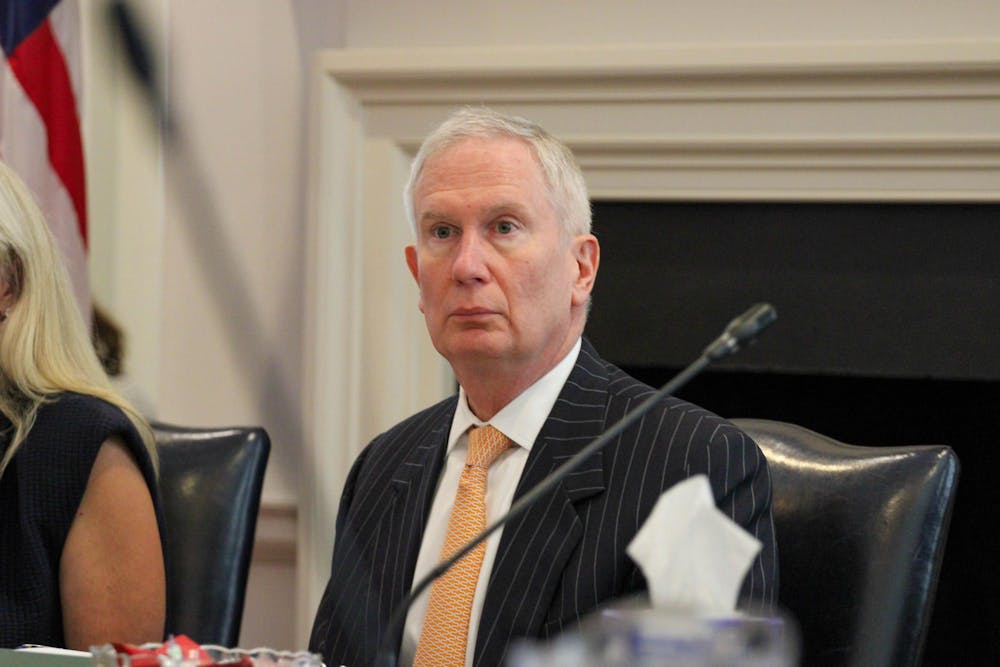
It has been almost an entire semester since Interim University President Paul Mahoney assumed the top role of University leadership. Mahoney was placed in this role as a temporary replacement for a beloved former University president and as a caretaker of a broken University community. This environment of controversy put Mahoney in an unenviable position from the outset, situated in a quagmire of an overzealous government, a controversial Board of Visitors and an underserved and rightfully distrustful University community.
Given the multiplicity of stakeholders and crises, there was much discussion of key priorities for this interim period. Chief among these topics discussed was a restoration of institutional stability and a recommitment to the inclusion of University stakeholders in key decisions. Yet, Mahoney’s reactions throughout this semester lay bare a failure to adequately achieve either aim. It is often said in politics that the success of an administration lies within its first 100 days. Well, 114 days in, Mahoney’s interim period in University leadership has failed to address the present concerns of the University community and further exacerbated the risk of long-term and intractable crises in the future.
The importance of this assessment on Mahoney’s performance is only intensified due to Mahoney’s increasing openness to being selected as the permanent president by the presidential search committee. The development of Mahoney’s rhetoric about the position over time, from initially planning to “get out of the way” to cryptically refusing to comment on his “interest or non-interest,” only makes current concerns about his leadership more salient.
Admittedly, Mahoney has faced unprecedented and unstable circumstances. He entered leadership amidst a gamut of no-confidence votes towards the Board of Visitors and continues to contend with calls from the Faculty Senate for Rector Rachel Sheridan and Vice Rector Porter Wilkinson to resign. However, his reaction, or non-reaction, to these crises has shown a distinct lack of awareness of the concerns of the community he is charged with representing. In this way, Mahoney’s silence only further fosters the feeling that the University president’s office is as absent from community engagement and care as it would be if the leadership position were never filled.
Mahoney’s position throughout his term has been one of deference — a deference that, amidst community protests, denigrates the role of a University president as authentically representing their community. When asked about the Faculty Senate’s calls for Sheridan and Wilkinson’s resignations, Mahoney’s response was that he did not have a response. When asked about calls for the presidential search committee process to be delayed until a legally legitimate Board was in place, Mahoney’s view was that he had no view. Perhaps the most obvious epitomization of Mahoney’s desire to be protected from, rather than to protect, the University community, was his decision to be accompanied by a police guard as he entered the Faculty Senate.
Each of these incidents has placed Mahoney between two University powers — the Board and the University community. It is striking that, in each incident, Mahoney has chosen to defer to the Board, a tendency typified by Sheridan’s common co-signing of Mahoney’s correspondences. Mahoney’s consistent deference to the Board serves as an indictment of his ability to empathize with and represent an outraged community in a time of peril.
Mahoney’s failures towards the community are obvious not only through his words, but also with his actions. While Mahoney’s rejection of the Trump administration’s proposed “Compact for Academic Excellence in Higher Education” reflected community sentiments, his contrasting authorization of an agreement with the Justice Department to suspend their investigations into the University only furthered anxiety felt by University stakeholders. Community members were neither included in nor informed of this agreement until it had already been signed, a defining moment which signalled that any claimed care for the thoughts of University members was performative at best. Moreover, the Agreement provision of quarterly federal reviews until 2028 saddles our University with a lack of security for years to come, falling short of the goal Mahoney set for himself this semester of stabilizing the University institutionally.
Taken together, Mahoney’s rhetoric and actions risk creating a new and concerning precedent for what it means to be a university president. In the search process for former University President Jim Ryan, the University’s candidate requirements included being an “inspiring leader” who could “motivate relevant constituencies” around a “strategic vision.” While these were qualifications that Ryan surpassed during his term, they are similarly responsibilities undermined by Ryan’s forced resignation, the farcical agreement signed by Mahoney and his responses to critical events on Grounds. In this way, rhetoric that devalues the importance of the University community and actions that denigrate the institutional stability of our University signal a reduced standard to future university presidents.
The responsibility of a University president, interim or permanent, is profound — as former University Rector Robert Hardie describes, it is the need to be a “servant-leader.” As the presidential search process and Mahoney’s interim leadership continue unperturbed by deep community concerns, the importance of reaffirming this quality has never been greater. This semester, Mahoney has failed to be an empathetic servant towards our University community and has floundered in being a strategic leader for our University’s institutional stability. To those candidates for our presidency at other universities and atop our own, do not continue this precedent.
The Cavalier Daily Editorial Board is composed of the Executive Editor, the Editor-in-Chief, the two Opinion Editors, two Senior Associates and an Opinion Columnist. The board can be reached at eb@cavalierdaily.com.
Read More

TAYLOR: Do not sell your soul for the résumé
By Nat Taylor | 2 days agoWhile no company is perfect, truly ignoring your moral integrity only leads to psychological distress and the erosion of the personal values that our University is meant to help build.

WELLS: The shame is not Cornell’s alone
By Stephen Wells | 3 days agoSo why do universities look the other way? Why do they endlessly tolerate the gross conduct of fraternities that operate in a despicable manner right under their administrations’ proverbial noses?
ADDISON: Criticism without introspection is a waste
By Lucas Addison | 4 days agoThe Community of Trust must be more than a phrase we invoke to describe ourselves. It must be a standard by which we hold ourselves accountable.