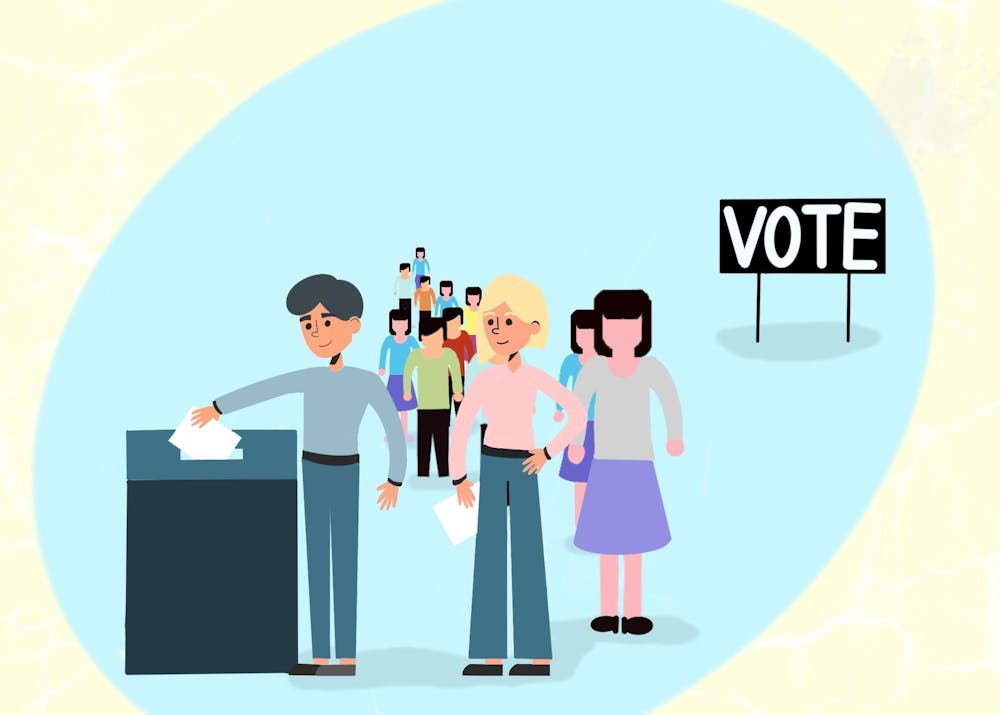
In this year’s Spring General Election, the most salient factor was the unprecedented amount of student engagement with turnout in the election for Student Council president more than doubling from 2025. The energy of candidates, campaigners, organizations and voters permeated the discourse on Grounds, leading to an election season marked by a genuine enthusiasm for the future of student self-governance at the University. Though not perfect in all respects, this year’s elections should be lauded as a stepping stone to achieving greater student engagement in the future.
Leading this spike in engagement were the elections for Student Council executive positions. In the race for president, turnout jumped from less than 12 percent last year to approximately 25 percent of the student body. That excitement manifested in The Cavalier Daily and University Board of Elections’ Debate for Presidential Candidates, which, though not traditionally a highly attended event, filled the debate room. In addition to this, the Jefferson Literary and Debating Society hosted its own debate for down-ballot candidates, and both events provided candidates the opportunity to present their platforms to students in public, energetic forums. When combined with the proliferation of social media material and electioneering activities, the races for Student Council executive positions exemplified an election season undergirded by fervent engagement for student self-governance.
This year’s elections were also notable for their absence of referenda, votes on which have typically garnered more engagement than votes for president. The last several general elections featured high-ticket referenda on issues such as the multi-sanction system for the Honor Committee, the University Guide Service and financial divestment initiatives. It is quite possible the lack of such referenda contributed to an increased engagement with candidates. However, engagement with candidates must be sustained by students’ own enthusiasm rather than the mere lack of more compelling items. Though referenda more directly encapsulate the substance of student opinion on certain issues, candidates are the ultimate agents of student opinion, using their platform and position to implement the substantive changes that students demand.
That deepening engagement, furthermore, becomes all the more important as the issues student organizations face become increasingly momentous. As demonstrated by Student Council President Clay Dickerson, student leaders have the ability to shape student discourse and debate on contentious issues such as University administration and national politics through a variety of means, including Lawn protests, coordination with other University student organizations and negotiations with University leadership. These student leaders must be guided by the opinions of the students they serve if their actions are to have any semblance of support from the broader student body. Ultimately, these opinions are best expressed during election season, as debate around candidates reveals the priorities students value.
The level of student engagement in this year’s elections is not valuable merely for the percentages. Rather, participation in the process of self-government is the foundational principle by which students' desires can be translated into a tangible product and respected by the University community. Participation provides legitimacy to decisions made by students. When the opinion of students is made tangible through debate and elections of student leaders, other stakeholders on Grounds are forced to at least pay cursory attention to it. Faculty and University leadership cannot ignore a student body critically engaged with the issues that affect it, and it is much more difficult to belittle the decisions of student leaders when they arise through an impassioned process. Instead of presupposing that decisions that disagree with faculty and leadership opinion are the product of naive students, University stakeholders will realize that students themselves are influential stakeholders, replete with demands and desires of their own.
There is no telling what the coming year will bring for student self-governance at the University. What is certain, however, is the need for students to play a prominent role in University governance going forward. Though this year’s elections were a first step, much work remains. Approximately 75 percent of students did not vote in these elections, continuing a trend of notable apathy towards participating in the University’s unique system for student autonomy. What remains, then, is the need to carry that zeal into the future, and this year’s turnout shows students are well-placed to do precisely that.
The Cavalier Daily Editorial Board is composed of the Executive Editor, the Editor-in-Chief, the two Opinion Editors, two Senior Associates and an Opinion Columnist. The board can be reached at eb@cavalierdaily.com.
Read More

U.Va. MEDICAL STUDENTS: Why e-bikes and e-scooters need real rules
By U.Va. Medical Students | 18 hours agoAs medical students who will soon be treating the consequences of these injuries firsthand, we believe e-bike and e-scooter safety is a public health issue the University and the Commonwealth can no longer afford to overlook.

OPINIONS: What to watch for this November election in Virginia
By Wylie Brunman , Scarlett Sullivan , Michael King and Joshua Hawkins | YesterdayFour opinion columnists write on upcoming ballot measures and key races for Virginia’s Nov. 3 general election.

YOUNIS: The false promise of neutrality at U.Va.
By Ayat Younis | 3 days agoAcademic excellence and diversity have never been competing ideals.