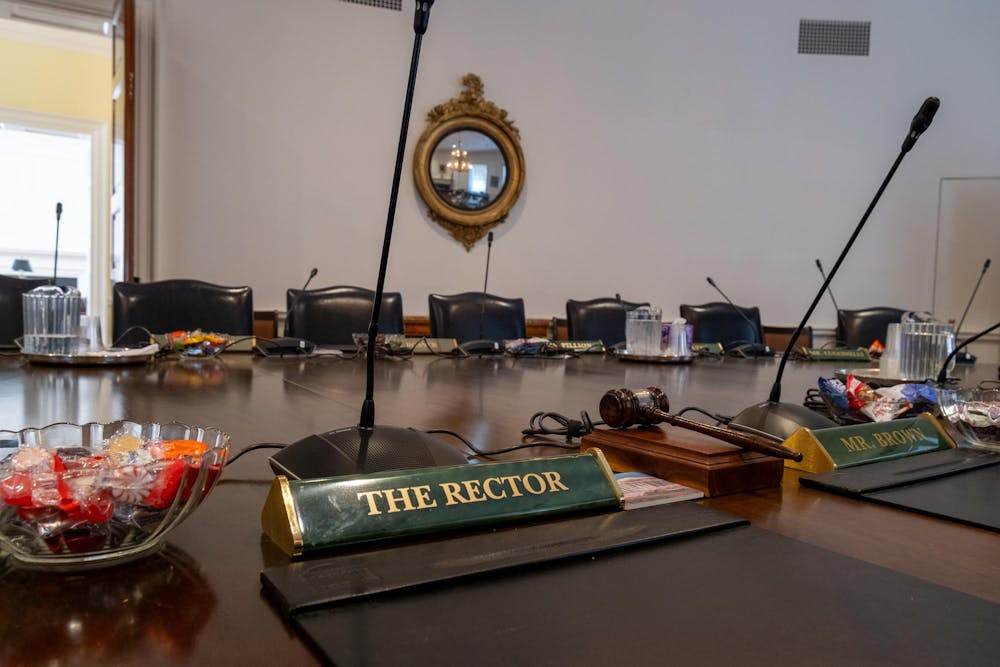
Board of Visitors Rector Rachel Sheridan released an eight-page letter Nov. 13 recounting her perspective on the events leading up to former University President Jim Ryan’s resignation in June. This, in turn, prompted Ryan to send a letter to the Faculty Senate Nov. 14, which shared an account he wrote this summer of the circumstances leading to his resignation.
The two letters recounted the same experience in drastically different ways which leave more questions than answers. However, there is one question that the letters are able to help answer — what role does and should transparency play in our community? Unsurprisingly, the manner in which these accounts were released and the content of the letters themselves reveals that there is a marked difference in how the two University leaders explain and value transparency.
Looking around at this community, it is clear to see that the University’s beloved tenet of shared governance depends on transparency — not as a courtesy, but as the condition that allows all stakeholders of the University to participate meaningfully in decision-making. Transparency signals that decision-makers are willing to open the rationale behind their choices to scrutiny, collaboration and, when necessary, dissent. While Ryan positioned transparency as an intrinsic part of shared governance and institutional trust, Sheridan’s delayed disclosure — triggered only when her authority was threatened — views transparency as a strategic tool to secure support. One of these approaches undermines the very collaborative ethos that shared governance is meant to uphold. And it’s not Ryan’s approach.
Sheridan’s account was released the day before the Faculty Senate was scheduled to vote on a resolution calling for her and Vice Rector Porter Wilkinson’s resignations — not when the community demanded clarity for months on end or when the University signed an agreement with the Department of Justice. Rather, her transparency arrived when the legitimacy of her ability to lead was challenged. While Ryan also withheld his account, it is worth asking which of them was at the helm of the University when these calls for transparency were made. Why should the University community receive more transparency from an individual who is, and has been since the end of June, effectively external from University governance, rather than their very own Rector?
Sheridan’s and Ryan’s approaches to transparency are revealed not just in the manner of recounting but also the substance of the letters themselves. Take one discrepancy in content between the two letters — the dissolution of diversity, equity and inclusion at the University. For Ryan, this dissolution was the foundational issue that sparked the entire chain of events — the Board’s resolution on DEI was not only drafted by the governor’s office but Gov. Glenn Youngkin proclaimed on national television that “DEI is dead.” In Sheridan’s account, however, she never refers to DEI as a fundamental part of the story. Instead, she frames the issue as one of the University’s noncompliance with federal law, not a moment of federal or state overreach. By not mentioning DEI, the narrative intentionally shifts away from a discussion of larger state and federal political actors involving themselves in the University’s affairs
The Faculty Senate’s response in a vote of no confidence does not simply reflect the anger of the University community regarding the outcome of Ryan’s resignation. Instead, it characterizes a deeper frustration with a failure in transparency. Stakeholders across the University community were left in the dark, receiving selective disclosures only after pressure mounted or authority was threatened. But more troubling was the failure of internal transparency — the opacity within the Board itself. Board members themselves did not know about the resignation or the inner workings, which Sheridan reveals in her statement.
Sheridan’s omissions of certain parts of Ryan’s account are not just discrepancies in detail. Rather, they appear as strategic methods to shift responsibility and depersonalize accountability. Sheridan’s perspective neglected to include a person who was a major character in Ryan’s story — Beth Wilkinson, a high-profile lawyer who Ryan believes was hired for the sole reason of pressuring Ryan to resign. By not mentioning Beth Wilkinson, Sheridan’s narrative removes the appearance that coercion to resign may have occurred. The calculus behind these omissions deeply contrasts the candor inherent to Ryan’s letter, which begins with an apology on its lack of concision and an acknowledgement of the Nov. 13 anniversary. And in this contrast, it is evident to what end transparency is utilized — for genuinely informing our community, or for protecting one’s position.
The real crisis is not resignation, but transparency. When transparency becomes a tool rather than a principle, governance itself becomes a performance rather than a practice. The University's identity has long rested on the ideal of shared governance — but ideals mean nothing if they can be bypassed whenever they become inconvenient. What remains to be seen is whether this moment marks a turning point — one in which University leadership chooses not just to invoke transparency when pressured, but to genuinely commit to it as the foundation of its legitimacy.
The Cavalier Daily Editorial Board is composed of the Executive Editor, the Editor-in-Chief, the two Opinion Editors, two Senior Associates and an Opinion Columnist. The board can be reached at eb@cavalierdaily.com.
Read More

TAYLOR: Do not sell your soul for the résumé
By Nat Taylor | 20 hours agoWhile no company is perfect, truly ignoring your moral integrity only leads to psychological distress and the erosion of the personal values that our University is meant to help build.

U.Va. Health’s telehealth program approaches 1 million visits
By Vrinda Vashisht | 21 hours agoThe program arose from the challenge of U.Va. Health physicians traveling to communities across Virginia to treat patients who could not easily reach Charlottesville.

WELLS: The shame is not Cornell’s alone
By Stephen Wells | YesterdaySo why do universities look the other way? Why do they endlessly tolerate the gross conduct of fraternities that operate in a despicable manner right under their administrations’ proverbial noses?