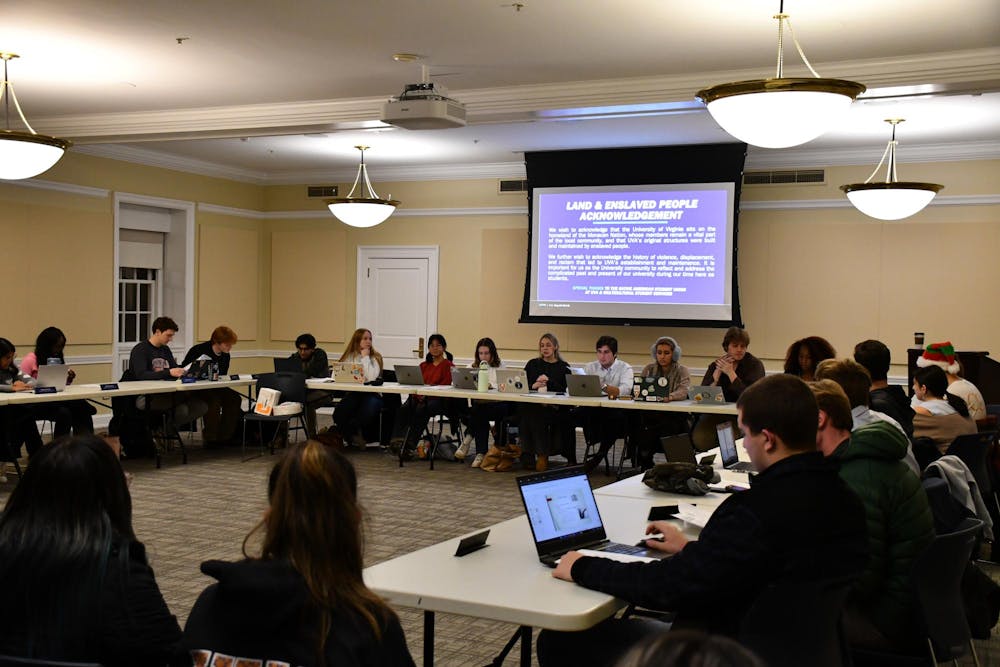
Student Council concluded its final meeting of the semester Tuesday by unanimously approving three legislative pieces, including the formal recognition of 45 new contracted independent organizations after months of internal review. Representatives also approved the appointment of a new co-director for Mutual Aid — a University network of community members created by Student Council that aims to provide support to students in crisis. They also passed a resolution calling on the University to establish clearer guidelines for releasing technology updates, responding to student concerns about changes made earlier this year with the WahooEats app.
The unanimous, official recognition of 45 CIOs was a months-long effort of collaborative vetting according to Michael Mitchell, Student Council vice president for organizations and third-year Commerce student. Mitchell said that each organization had been jointly examined by the Student Council’s Organizations Recognition Committee and Appropriations Committee and Student Engagement to ensure all structural requirements were met. Mitchell expressed relief that the bill process was completed.
“It’s been a long time in the making, so thank you all for your patience,” Mitchell said. “They’re going to be great additions to the U.Va community.”
Student organizations seeking CIO status must meet specific criteria set by the University and Student Council — including having at least 10 members, ensuring officers are fee-paying students, maintaining a constitution on file, signing the CIO agreement, adopting the non-discrimination policy and demonstrating sustainability through an operational plan.
Many organizations highlighted their missions during public comment, ranging from Cavalier Beekeepers, HoosOnAux, the Jefferson Consulting Collective, the Darden Disability Alliance, BeSomebody and the Wise Initiative for Student Engagement.
Second-year Commerce student Pierce Brookins spoke on behalf of HoosOnAux, describing the organization as a space for celebrating diverse music tastes and fostering collaboration for students to share their favorite artists and genres. The organization plans to provide platforms for music discovery through events, playlists and student-run projects.
Darden student Claudio Martinez represented the Darden Disability Alliance, a graduate-level CIO focused on community, advocacy and professional support for Darden students navigating disability-related challenges. Martinez said that the alliance was also created to serve as a liaison for students who need faculty support.
Third-year College Student Marlise Lucas represented the Wise Initiative for Student Engagement, which connects students from the University’s Year-in-Wise program — a one-year program at the College at Wise for waitlisted, in-state applicants before they can transfer to the University. Lucas explained that the organization aims to ease the transition between College at Wise and the University by helping students navigate academics and find community support.
Mitchell noted that representatives allocated roughly $443,000 in Student Activities Fee funding to support the over 800 CIOs. He confirmed that rolling funding requests would open for the newly recognized organizations as an opportunity to request financial resources. Active CIOs are eligible to request up to $20,000 per semester for itemized events or activity expenses.
Representatives also unanimously passed a resolution urging the University to adopt formal guidelines for when new technology services are updated or released. Under the resolution, major technological changes — including new systems and major updates — should not be implemented during the week before each semester begins and the period after final exams end. Emergency fixes and bug repairs would still be allowed at any time.
The resolution was prompted by concerns arising during the WahooEats app launch earlier this fall — a new app platform intended to replace GrubHub, the University’s current mobile dining system. Third-year Engineering representative Aiden Wycinsky cited challenges faced by students during Welcome Week, especially first-years who were still adjusting to Grounds. He said that these new guidelines for changes to technology would help ensure that new systems are fully developed and minimize disruptions to students’ academic and campus life.
“[The resolution] prevents [the University] from rushing things along and then building on it as the semester goes,” Wycinsky said. “With all these changes, I think that it’ll give students beneficial products that won’t be confusing to use, and they’ll have time to … explore and understand.”
In addition, representatives unanimously approved the appointment of a third co-director for Mutual Aid for the upcoming semester. Micah Andrews, Student Council chief of Support and Access Services and third-year College student, explained that first-year College student Clint Wilson was appointed to the vacant Mutual Aid co-director position and will be taking over the grants portion of Mutual Aid’s operation.
Clay Dickerson, Student Council president and fourth-year College student, also highlighted the ongoing applications for the Karsh Institute of Democracy’s Civic Cornerstone Fellowship — a program that allows students to engage in structured dialogue, mindfulness practices and learn about American democracy. Applications are now open until Jan. 19 at 11:59 p.m.
Student Council will reconvene for its weekly general body meetings Jan. 13.

Jaylynn Perez is a third-year College student from Chesapeake, Va., majoring in government and Public Policy and Leadership. She currently serves as a news senior writer and video staffer, after previously serving as senior associate editor for the news desk. She enjoys covering topics such as University governance and local politics.
Read More

From the Archives: Fraternity life
By Maisy Callahan and Emily Conway | YesterdayMore fraternities decide to partner with the Historic Renovation Corporation, a University-affiliated agency that provides tax credits for the restoration of historic buildings.

Center for Politics hosts Tom Perriello to discuss AI, congressional responsibilities
By Melody Yuan | 2 days agoAt the event, titled “The Deep Divide Between How the People and the Powerful Are Thinking About AI,” Perriello also referenced his Sept. 22 article “To Wary Working People, AI Preemption Is the New Nafta” in The New Republic during his discussion.

U.Va. Health’s telehealth program approaches 1 million visits
By Vrinda Vashisht | 2 days agoThe program arose from the challenge of U.Va. Health physicians traveling to communities across Virginia to treat patients who could not easily reach Charlottesville.