
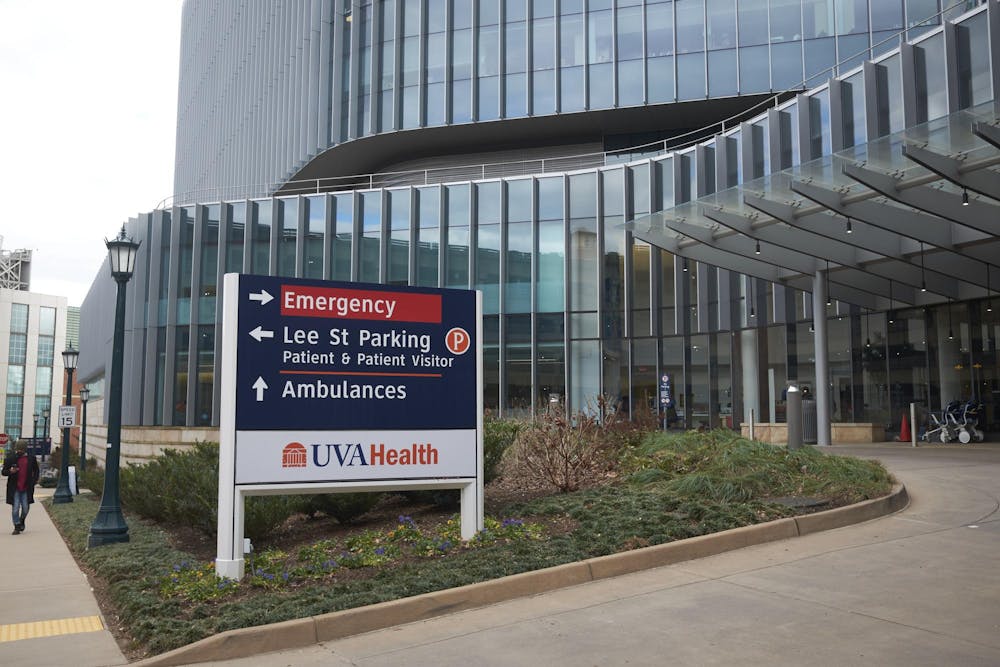
Members of U.Va. Health Management hosted a question-and-answer town hall in McKim Hall and on Zoom Tuesday. The panel was composed of six members of U.Va Health’s management. Panelists shared outlooks on healthcare following the adoption of Trump’s One Big Beautiful Bill, financial predictions, strategy for growth and topics pertaining to human resources for staff.
The Town Hall series was created by Craig Kent, the former CEO of U.Va. Health to share developments with the public. Following Kent’s resignation in February, Town Halls were shifted to address questions arising from leadership changes. Since Rosner was hired as CEO in September, there have been monthly town halls in October, November and December. The event began with opening remarks from Mitchell Rosner, chief executive officer of U.Va. Health and executive vice president for health affairs.
Rosner, in his opening remarks, said that U.Va. Health has plans to grow by including medical access for University employees, creating a walk-in clinic on Grounds and expanding primary care offerings in central Virginia. Additionally, Rosner said that there is a shortage of physicians, and his leadership team will investigate this in January.
“We want to make sure that every U.Va. employee can get their primary care here at U.Va. Health, and we feel that that's a responsibility that we have to all of you,” Rosner said. “There is a huge weight for primary care and a real shortage of primary care physicians, so that's going to be a priority.”
To faciliate growth, Stephanie Schnittger, U.Va. Health Chief Financial Officer, said that the changes to medical coverage by the One Big Beautiful Bill will have an effect. The Bill will likely mean having to take care of more patients without coverage, which will increase U.Va. Health’s costs. According to Schnittger, this will limit how much they can reinvest back into the business.
“We're expecting these headwinds to really pressure our margins, and those margins are critical for reinvestment, strategic growth and building the infrastructure of our health system, ”Schnittger said. “It's very critical that we are able to … be as efficient as possible.”
Moving from the national level to the state level, with the gubernatorial transition this upcoming January, Jen Siciliano, chief external affairs officer of U.Va. Health, said that leadership has been talking with Gov.-elect Abigail Spanberger and her team about matters concerning U.Va. Health. Siciliano said that as part of the Commonwealth’s budget that will be passed in 2026, there will be provisions on Medicaid and other health-related spending and that her team will be seeing how the budget will affect U.Va. Health.
Currently, U.Va. Health has a special partnership with the Commonwealth’s government, alongside Virginia Commonwealth University Health. The partnership assists in paying U.Va. and VCU Health for the discrepancy between the cost of treatment for Medicaid patients and the payment the hospital receives from Medicaid. U.Va. and VCU Health are eligible for this partnership because of their status as state-owned teaching hospitals.
Schnittger said that this partnership ensures that in the short run, U.Va. Health will continue to be able to take care of both Medicaid and indigent patients, or patients who don’t qualify for Medicaid but cannot afford private insurance. In the long run, however, Schnittger said U.Va. Health may exceed reimbursement caps, meaning it will suffer losses from taking care of more patients than it is getting reimbursed for.
The One Big Beautiful Bill, in addition to its changes to healthcare insurance, also made cuts to research funding, and Colin Derdeyn, interim dean of U.Va. School of Medicine, mentioned the implications of the Financial Accountability in Research Act. If passed, it could further reduce the amount of money the University could receive in research funding. However, Derdeyn said that in the long run, funding for research will likely return to normal levels.
“In terms of what the outlook looks like there, there's broad bipartisan support for research, for the NIH and I think the long term outlook looks pretty good,” Derdeyn said. “Short term may be problematic.”
Looking to U.Va. Health’s future initiatives, Jason Lineen, chief strategy officer of U.Va. Health and interim chief of U.Va. Health Children's, spoke on the role of artificial intelligence in healthcare. He said that U.Va. Health is looking into AI that can be used in operational use cases and not clinical use cases. Lineen also said that U.Va. Health is working alongside peer institutions to better implement AI in health care.
“[AI is] going to revolutionize how we deliver care. We're actively studying it,” Lineen said. “We want to have a careful and cautious approach, especially as it relates to direct patient care.”
Rosner said that U.Va. Health’s culture makes the institution special — according to Rosner, U.Va. Health staff members help patients in small yet impactful ways, which is what differentiates U.Va. Health.
“Hospitals [and] healthcare systems are really places of refuge for patients and families. They’re places where people turn to when they're the most vulnerable,” Rosner said. “They are places where people count on finding kindness and thoughtfulness and care, and that's a really unique place to be.”

Edward Christopher is a staff writer on the News desk as well as an advertising representative of The Cavalier Daily. He is a second-year student in the McIntire School of Commerce and is from Northern Virginia. Edward enjoys covering state politics and University developments.
Read More

English department considers AI’s place in the classroom
By Lily Kostro | 2 days agoFor the University’s English department, some professors have chosen assignments that utilize AI in writing, while others take the approach of completely eliminating students’ access to generative AI in their writing process.

The Cavalier Daily joins amicus brief supporting student press at University of Alabama
By Jaylynn Perez | 3 days agoThe Cavalier Daily joined 39 other collegiate news organizations and 15 student editors from across the country in signing an amicus brief Sept. 2.

Student Council considers creating an ad hoc committee to review UBE proceedings
By Lucia Gambacini | 3 days agoConsideration of the bill was postponed until the next general body meeting.


