
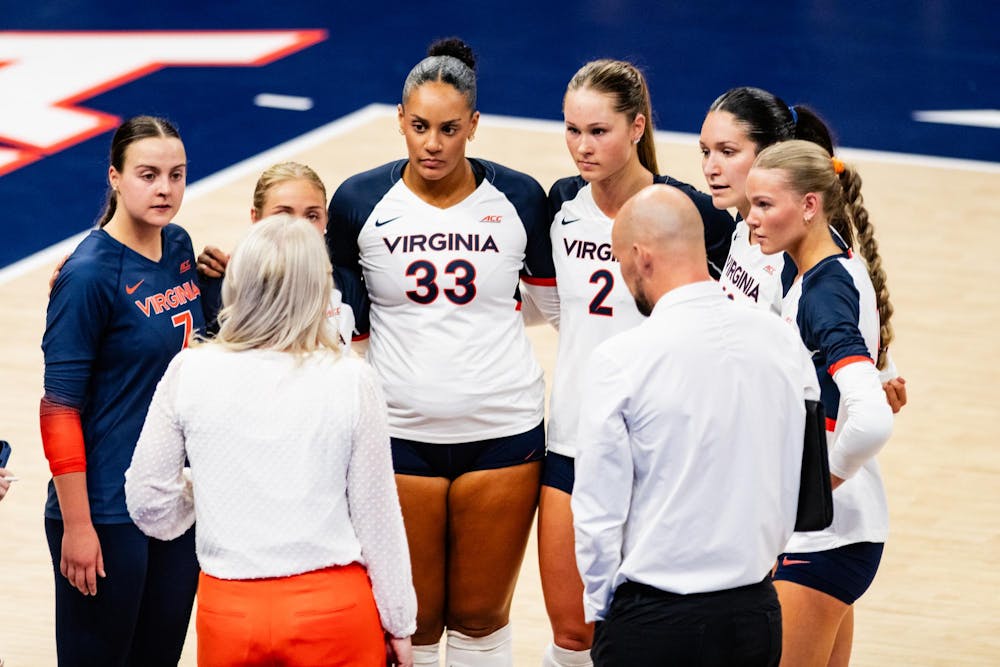
Virginia volleyball is in the midst of a 25-year drought in which it has not appeared in an NCAA Tournament.
As the 2025 season progressed, the Cavaliers fell apart, finishing their season ranked 13th in the 18-team ACC with a 13-17 record and a 6-14 conference record.
While the Cavaliers had a talented squad, something just did not click. Three Cavalier Daily beat writers discuss the season’s flaws, along with what to look forward to in 2026.
What was the missing puzzle piece for Virginia volleyball this season?
Victoria Blankenship, Staff Writer: A drop in Cavalier veterans definitely hurt the team. While the Cavaliers had senior libero Kate Johnson this year, she was unfortunately the only four-year player for Wells’ team. All of the other seniors in her class were transfers. Lack of continuity can hurt a team — constantly taking on new players without a stable handful of teammates that have been there through it all can hurt consistency and chemistry.
Lauren Halak, Staff Writer: There is a stark difference now compared to 2024. Last year, defensive specialist Milan Gomillion led the Cavaliers’ defense. Her 487 total digs on the season ranked second in the ACC. She also recorded a career-high 37 digs, second-most in a single match in program history. This year, junior defensive specialist Katie Barrier’s team-leading three digs per set is almost 1.5 less than Gomillion’s average. While many factors play into this disparity, Virginia’s ability to respond to quick, powerful offenses is key.
Cierra Lyles, Staff Writer: The Virginia offense lacked multiple power options. Without enough consistently productive options, opposing teams were able to plan their defenses around blocking the team’s stars. This forced tougher situations for the Cavaliers, making their offense easier to scout and slow down, while also making it harder for the offense to sustain over long matches. With Boothe graduating, Virginia must find not only a replacement for her powerful arm, but additional power-hitters that help keep defenses honest.
With Memorial Gym closed for renovations, the team played most games at the AFC and select matches at JPJ. How did 'venue-hopping' affect the Cavaliers?
VB: The AFC held up surprisingly well as a temporary home. Early on, the team appeared unfazed by the change in scenery, and crowds still packed the smaller space. The issue wasn’t the AFC itself, but rather the inability to stay there. Once they got into the groove of the season, it got harder to keep up with the changing locations — from the AFC, to away venues, to JPJ and back to the AFC — preventing the team from settling into a rhythm on their own court.
LH: The transition to the bigger stage at JPJ did not yield positive results. When asked about the change, Wells stood firm in her belief that “home is people” and Virginia fans make the atmosphere. Virginia went 2-3 in JPJ despite previously being undefeated in the arena. While playing multiple matches in a basketball arena is an exciting step for the program, the team did not adjust well to playing frequently in such a cavernous space, and the home-court advantage evaporated over the season.
CL: A major drawback this season was the dilution of fan energy. In recent years, the JPJ Takeover was one of the most highly anticipated events of the season, with fans packing the arena. By turning a special occasion into a recurring series, the novelty wore off — after the first match, fans were far quieter and the arena far less full. The venue-hopping didn’t single-handedly sink the season, but it chipped away at the crowd intensity that can help fuel the team’s performance.
What does Virginia volleyball need to look like to get to the championship level?
VB: Both Commonwealth Clash games this season capture how Virginia needs to perform if it wants to contend. In their first matchup with Virginia Tech, the Cavaliers could have faltered after losing the first two sets — instead, they stayed focused, executed digs and mitigated mistakes. In the second matchup, Virginia easily shut down the Hokies’ offense, building off of its first win. These rivalry matchups brought out the Cavaliers’ best play — they need to bring this energy to future games.
LH: Virginia’s victory against Michigan was a true display of grit and its potential to build back to the championship level. The first matchup saw three players notch double-digit kills, a team effort where several players acted as offensive and defensive threats. Instead of relying solely on Ennist, Virginia rallied against Michigan as a cohesive unit. If the Cavaliers can find this rhythm consistently and give Ennist just enough of the offensive spotlight, they have a shot at dismissing this season as a one-off in the Wells era.
CL: Wells frequently echoes one goal — get back to playing Virginia volleyball. Instead, the Cavaliers need to identify this team’s standard. It’s easy to look at the 2024 season as the winning formula, but it's important to remember that this is a new team enduring growing pains and seeking a new identity. This is not to say that Virginia should drop the Virginia volleyball standard altogether — rather, they should find the right version. The Cavaliers need to find what works for the 2026 team if they want to become national contenders.
Read More

Heading back to Charlotte, the Cavaliers hope to do away with the memories of old
By Theo Moll | 10 hours agoBut as this team travels from Charlottesville — just as its predecessor did last December — it has an opportunity to do something special.

The Cavaliers start the fall season with a strong showing at the Kitty Harrison Invitational
By Anderson Kim | 14 hours agoVirginia women's tennis started its fall season on a high note at the Kitty Harrison Invitational.

Trial by fire greets Virginia’s young lineup in a 16th-place finish
By Joby Jung | YesterdayMen's golf has a respectable history with the Inverness Intercollegiate in the past, but 2026 did not go the same as the Cavaliers finished towards the bottom of the standings.


