
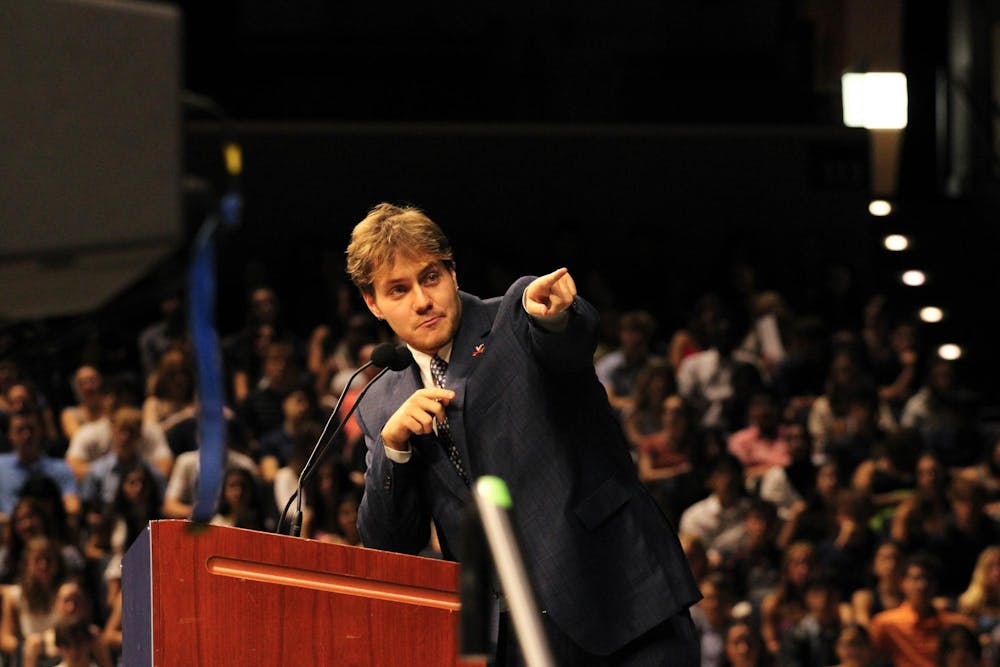
Fourth-year College student Clay Dickerson served as Student Council’s president for the 79th term, and throughout the year, led the student body through key changes in University administration — four different University presidents and a reshaping of the Board of Visitors. Further, his term was also centered around increasing accessibility for students through initiatives such as the Cavalier Career Closet to provide free business attire to students.
Just four months into Dickerson’s term, former University President Jim Ryan resigned under pressure from the Justice Department, and a search for the University’s 10th permanent president began. Dickerson, alongside Student Council executive members, spoke out against the presidential search process with a vote of no confidence in the Board Aug. 8 due to what they said was a search that lacked transparency and student input.
Dickerson said that through the major change in University leadership, student self-governance was “at its most powerful, yet most vulnerable [point] in its history.” He further noted his pride for the way the University community came together over the summer and remained “resilient” against ongoing turbulence.
“I think I've realized how strong U.Va. can be when we are united. I think there were points during this year in which we were so divided that it weakened that magic … but the power of togetherness really shines through here,” Dickerson said. “There truly is a brighter tomorrow when we're all part of it, and we all share our visions and our architecture.”
Dickerson ran for Student Council president in February 2025 on the “Brighter Tomorrow” ticket alongside Michael Mitchell, vice president for organizations and third-year Commerce student, and Princess Wuraola Olubuse-Omisore, vice president for administration and graduate public health student. Dickerson had specific goals to increase resource accessibility for low-income students, many of which he accomplished.
Dickerson cited his proudest achievement in the position as the creation of the Cavalier Career Closet. With help from Micah Andrews, chief of Support and Access Services and third-year College student, Student Council partnered with My Career Closet — a D.C.-based organization focused on providing solutions to professional wear problems. The Cavalier Career Closet grew into a sizable resource of professional clothing available to University students free of charge.
“Something I was really passionate about doing was the Career Closet. U.Va. was the only university in the Commonwealth without one,” Dickerson said. “I got to realize that something like the Career Closet was truly a need and it has so far unimaginably affected students’ lives.”
Dickerson also focused his attention on strengthening the Council’s relationship with the students at the College at Wise. Council members visited the College at Wise’s Student Government Association in the fall, and Dickerson described the trip as the “most fulfilling experience” in his role.
“I can’t even describe how grateful they were that we took the time to go down there," Dickerson said. “We took the time to … invest in their student life, go to their meetings, speak at their meetings … care about their history [and] care about why they are tied to the University of Virginia.”
The commitment to an improved relationship between the two campuses was solidified with a memorandum of cooperation sponsored by Dickerson and Imane Akhanous, chair of the Representative Body and fourth-year College student, Oct. 20. The memorandum establishes that the two organizations will work together to put forth legislation which is mutually beneficial for both campuses and will maintain a strong working relationship.
Beyond his own accomplished goals, Dickerson emphasized the success of other members of his executive team this year. A key pillar of the “Brighter Tomorrow” platform was to audit the internal Council budget, for which Wuraola Olubuse-Omisore has worked on lowering internal spending and increasing club appropriation to achieve a higher utilization of funds. Currently, Dickerson reports that utilization is approximately 75 percent — higher than the utilization rate of 64 percent at the end of the 78th term in March 2025.
Dickerson’s platform also had the goal of establishing a higher number of advisory boards to operate regularly. Advisory boards are a collection of students and University stakeholders who work together to address specific community concerns, and Dickerson credited Lily Dorathy, Student Council chief of coalitions and fourth-year Batten and College student, for her efforts in creating and organizing these boards. He named the Student Council’s Student Well-Being and Safety Response and the Public Service Advisory Boards as two successful advisory boards to come out of this term.
“We never had a consistent structure, and/or administrative partners at these [advisory board] meetings,” Dickerson said. “Now … we have a structure that is going to be transitioned, and these meetings will continue and outcomes will only grow.”
The Student Well-Being and Advisory Board, whose goal is “to enhance safety across Grounds” and “create a culture of care and resilience,” was able to run surveys that found useful data on students’ sense of safety on Grounds and also inspired the creation of initiatives like HoosConcerned.org — an online forum in which students can post concerns and receive direct updates from Council members as to how those issues are being addressed.
The Public Service Advisory Board, which is designed to serve as “the front door to public service at the University,” successfully launched the “Walk with Honor, Lead to Serve” campaign focused on strengthening the link between leadership, honor and public service on Grounds. The Public Service Advisory Board also introduced the American Disabilities Act-accessible Guidebook to Ethical Service, increasing the inclusivity of leadership and service resources on Grounds.
In terms of his road to becoming president, Dickerson said he never originally saw himself in that position but emphasized his passion for service as the reason he joined Student Council his first year. Dickerson began as a member of the Administration branch of the Council, which oversees internal operations, and said he learned about the larger structure of the organization. The next year he operated in the Cabinet as the director of Financial Accessibility, preparing him to later take on the role of chief of SAS — the branch responsible for providing accessible resources to students, particularly first-generation and low-income students.
Dickerson shared that he was most strongly drawn to the latter two roles because of the impact he saw his predecessors have on low-income students and others in need.
“I just felt really inspired by their dedication to uplifting the folks who need it the most, and I have always found my heart trending in that direction,” Dickerson said.
Dickerson explained that the mentorship he received within Student Council — specifically from Brookelyn Mitchell, former Council vice president for administration and Class of 2025 alumna — had the effect of encouraging him to run for the position of Student Council president
“I think for a low-income student, mentorship is invaluable because you don't always have the pathways to success that other students do,” Dickerson said. “By having those around you see something in you, you can really blossom.”
Dickerson also left words of advice for Mitchell, the incoming Student Council President. Dickerson said the role of president requires uplifting of every student voice, from every “nook and cranny” at the University, and that while it can be easier at times to look away from concerns, it is important to remain cognizant of all student needs.
“You have to have a heart for those who may not show theirs to you,” Dickerson said. “Serving those who might not expect you to serve them … is what’s so empowering about this [University], and that is how unity is achieved.”
Dickerson’s term began March 30, 2025 and ends March 29. Mitchell will begin his term March 30.
Read More

Honor Committee continues discussion of changing appeals process
By Isabela Delgado | 23 hours agoThe proposed change would allow the Committee to better determine whether a sanctioned student's appeal is legitimate and would establish new qualifications that an appeal would need to meet to be allowed to continue through the appeal process.

Professors say rise in AI-use has pushed redevelopment of courses
By Komal Reddymachu | 23 hours agoProfessors in three University departments described their experience with AI use in their own classrooms where large language models pushed them to rewrite assignments, restructure exams and in some cases, rebuild entire courses.

The Board will convene Sept. 16-18 — here is a preview of its meeting agendas
By Grace Little | 2 days agoThe full University Board of Visitors will convene Wednesday through Friday to discuss artificial intelligence strategy, updates regarding the provost and dean searches as well as the buildings, finances and compliance of the University.


