
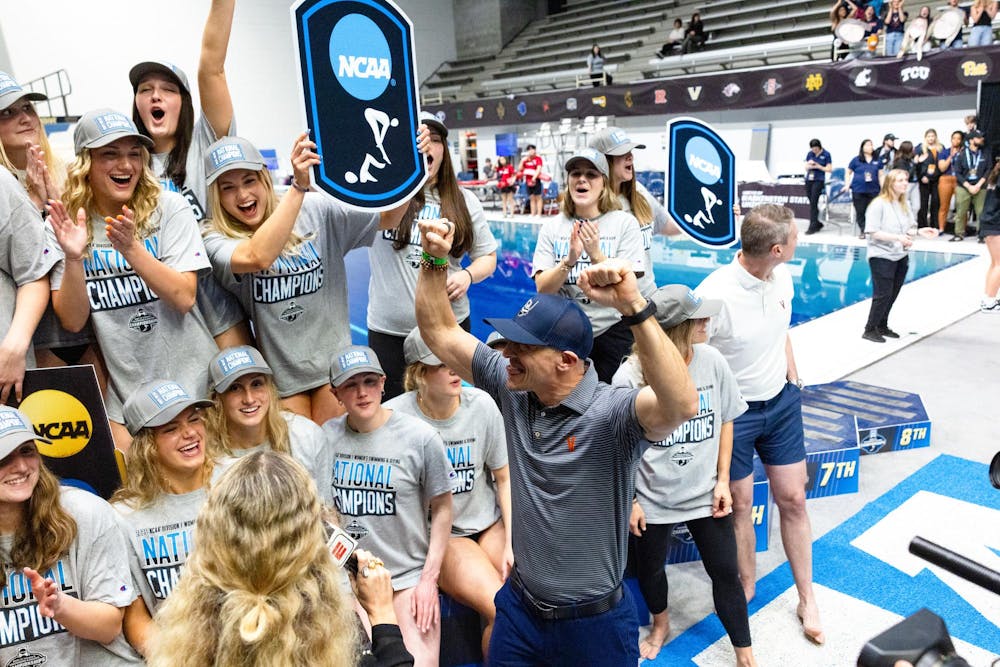
In his first few years with Virginia swimming, Coach Todd DeSorbo’s message to blue-chip women’s recruits was simple — come to Virginia and make history. Prior to their first national championship in 2021, phone calls were being made in a trophyless office, promising banners that didn’t yet exist.
In DeSorbo’s years of tenure leading up to the Covid-19 pandemic, the program won a single ACC title in 2018. The Cavaliers had never finished better than fifth at NCAAs — but DeSorbo's first complete recruiting class in 2019 was the one that began to change the tide.
During this time, Virginia could sell something nobody else in the traditional top echelon could — a chance to be the first. Recruits like Kate Douglass and the Walsh sisters were essentially told, sure, you can go to Stanford with 11 NCAA titles, to Texas with seven, to Cal with four. Or you can come to Virginia and make history.
Fast forward to 2025, and the women have now won five straight NCAA titles and five straight ACC championships, routinely setting NCAA and American records. DeSorbo can no longer sell the chance to win a first title to recruits. Instead he sells the chance to win a sixth consecutive title — the first run of its kind in NCAA women’s swimming history — and more.
So, what happens with recruiting when the tables have turned all the way around?
The recruits DeSorbo talks to now are mostly high school juniors — swimmers who won’t arrive on Grounds for another two years. If you’re a high school swimmer who watched Virginia hoist the NCAA trophy for a fifth time, you’re not being recruited for title number six. You’re being recruited for title eight or nine.
No women’s swimming and diving program has ever pushed this kind of run, so it becomes harder and harder to picture yourself walking into a locker room chasing an eighth or ninth consecutive championship. For them, DeSorbo’s sales pitch may start to bump up against the limits of plausibility.
These elite teenage recruits are competitive by nature. Joining the best team in the country is fun, but being part of the class that ends a dynasty — and a class that headlines a new one — might be even more appealing to some. Virginia’s own history actually backs that up.
Back in 2018, DeSorbo’s recruiting pitch somehow landed the No.1 prospect in the class of 2019. Kate Douglass, who is now an NCAA record holder, world record holder and Olympic Champion, went against the grain by pledging to the Cavaliers. Back when she was a junior in high school, most insider recruiting sites had her heading to Stanford — the safe and obvious choice for a top-tier recruit.
Douglass had every reason to pick the Cardinals and slot into a dominant program with proven success. Instead, she chose the riskier option and helped drag an ambitious ACC underdog to the upper echelon of the sport.
Around Douglass’ commitment, DeSorbo built out an entire core in his first Virginia recruiting class, highlighted by then-No. 8 recruit Margaret “Ella” Nelson who also bought in early. Not long after came the Walsh sisters — Alex in 2020 and then Gretchen in 2021 — who formed the backbone of the dynasty as we now know it. By 2021, the Cavaliers broke through for their first national title in Greensboro, N.C..
For a while after that, it felt like every time SwimSwam updated its swim community-famous “Way Too Early” recruit rankings, at least one future Cavalier sat on the top line. But as college swimming edges into the post-Walsh era, the recruiting map suddenly looks a lot more crowded.
On paper, the reasons to pick Virginia nowadays are obvious. But now, the No. 1, No. 2 and No. 3-type talents you’d instinctively pencil in for Virginia in this era are scattering across the country. SwimSwam’s updated rankings for the girls’ class of 2027 have Audrey Derivaux — a four-time World Junior champion with NCAA A-final worthy times and the consensus No. 1 recruit in the country — heading to Texas.
The No. 3 swimmer in that same class, Fairfax, Va. medley star Sadie Buckley, is also verbally committed to the Longhorns. The top freestyler in the class, No. 2 Rylee Erisman, whose times would already play in NCAA relays and finals, recently reclassified from 2027 to 2026 and chose California.
If you’re a phenom staring at the current college swimming landscape, choosing a historically successful program like California or Texas is not some baffling rejection of Virginia and its new-school success. It just means the Cavaliers are no longer selling novelty. They’re selling maintenance. And after five rings in five years, maintenance is a harder emotion to bottle and sell.
Now that Derivaux, Buckley and Erisman have all announced their commitments, the Cavaliers have missed out on the top three domestic recruits for three years in a row. It may be tempting to see decisions like these as warning signs. But it might be healthier to see them as proof that the Virginia women did their job a little too well.
However, it does not help when the rest of the swimming world is pressuring recruits to ponder the latter. When Virginia wins NCAAs by triple-digit margins, the meet feels pre-emptively decided — there have been years where the Cavaliers have essentially been mathematically out of reach, even before the last night of swimming had begun.
For a fan base and coaches trying to grow women’s swimming nationally, that’s a problem. The swimming world wants more diversification of talent — fans constantly comment on online forums about wanting someone, anyone, to make the team race interesting again.
None of this is to say Virginia women’s swimming is suddenly going to fall off a cliff. The Virginia women are still formidable and could absolutely win title number six, even if the top of the recruiting market is no longer a foregone conclusion for them. They still have absurd talent on the roster — Claire Curzan, Anna Moesch, Aimee Canny, Sara Curtis, Katie Grimes, Tess Howley, Cavan Gormsen, Leah Hayes, the list goes on — who are more than enough to keep them in the championship conversation for at least the next year, if not beyond that.
Few college programs in any sport get the chance to chase a sixth, seventh or eighth straight national title. But if that dominance means some recruits would rather try to end the run than extend it, that’s simply the tax of being the best. And for a program that once sold itself on the dream of maybe winning one title someday, it’s a pretty luxurious problem to have.
At some point, the women’s run of national titles will end. That’s just how dynasties work. What matters is whether Virginia is prepared for what comes next, but if the last eight years have shown us anything, it’s that they know exactly how to do that. The rest of the country is just finally catching up — sometimes by joining the Cavaliers, and sometimes by daring to try and beat them.
Read More

Taking stock as Virginia men’s soccer finally leaves Charlottesville
By Michael Liebermann , Mofeoluwa Akande and Noah Cinel | 38 minutes agoAfter a lengthy homestand to kick off the season, Virginia men's soccer finds itself in a shaky position with a 3-3-1 record. Three writers assess where the team is now and what is of note in the future.

No. 9 Virginia field hockey slips in defensive slog against No. 8 Duke
By Adair Reid | 2 hours agoThe absence in the cage would match the Cavaliers’ zero sum score — Virginia lost to the Blue Devils (5-1, 1-0, ACC) 0-1 in Durham, in a match decided by a single penalty corner.

No. 13 women’s soccer gets back to winning ways against Miami
By Peter Kratz | 9 hours agoThe Cavaliers (5-1-2, 1-1-0 ACC) were dominant in a 3-0 defeat over the Hurricanes (6-2-1, 1-1-0 ACC).


