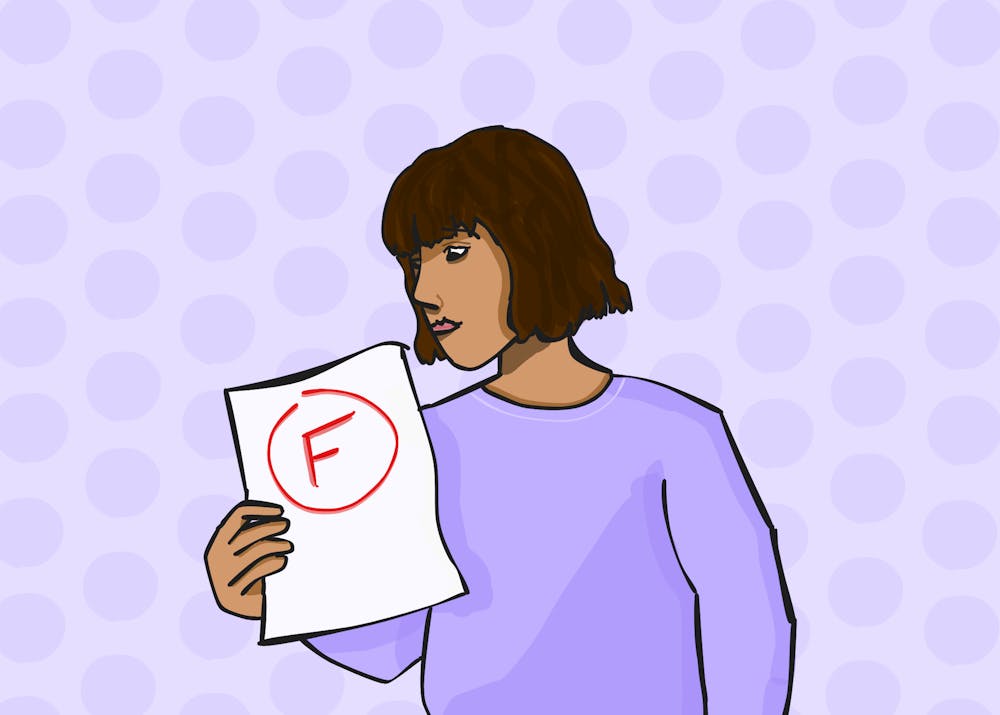
I failed an exam for the first time as a third-year in college. And the worst part? It was a class filled with mostly first-years.
I was sitting in West Range Café eating a caesar wrap when I got the dreaded notification that my exam was graded. My heart instantly sank to my stomach as I prepared for disappointment, knowing how difficult the exam had been. To my surprise, I didn’t just do poorly on the exam, as I had expected, but I failed the exam entirely. In that moment, every accomplishment I’d ever earned disappeared from my mind, and all I knew was that I was a failure.
In the days that followed, I moved through a cascade of emotions. The shock I felt from seeing my grade quickly gave way to denial as I tried to convince myself that a grading mistake had been made. Waves of anger and regret also followed, and I criticized myself for not having better prepared for the exam or taken the class a bit more seriously. For weeks, I hid my grade from my friends and family out of embarrassment.
College is hardly the first time I have experienced academic validation. In fact, I have spent almost my entire life burdened by this unhealthy relationship between my self worth and grades. Growing up, I was encouraged to earn good grades in school, but as I got older, this motivation slowly turned into obsession. This was an obsession that continued to deepen until earning an A produced a sense of satisfaction that little else made me feel. As the years passed, the line between obsession and healthy ambition blurred, and with it went my worth as an individual beyond academic achievement.
A few days after the exam, a late night conversation with my roommates revealed that academic validation affects nearly every student in one way or another, especially at a place like the University. The four of us voiced similar frustrations with our classes and grades, blaming our lack of work-life balance and our professors for our poor performances this semester. Although each of our experiences differed slightly, it was clear that we all held the belief that our grades were a reflection of our intelligence and future success. This belief coupled with disappointing grades left us, like many other students, feeling profoundly defeated.
Receiving a failing grade this semester forced me to confront my reliance on academic validation to avoid giving up entirely. I decided to focus on finding a balance between school and my social life in order to heal my relationship with academics. It's strange. For most of my life, school and my grades came first. But, this year, maintaining that same level of dedication has been a struggle. Maybe it has something to do with that “third-year slump” my older friends have been warning me about. Even so, rather than perceiving this slump as my academic downfall, I’ve learned to view it as an opportunity to establish a healthier work-life balance.
To find this balance, I took several steps. First, I required myself to spend time with friends at least twice a week without doing homework. Every week, I made plans with friends that didn’t involve going to Clem or The PAC to study. Second, I scheduled more free time for myself. Now, instead of working all day, I work most of the day with many breaks built into my routine. Third, I scheduled study hours for myself, such that I could only do work between certain hours of the day. In doing so, I found motivation to complete my work before my designated end time and could enjoy my evenings without guilt, knowing I had finished everything I needed for the day.
Through my endeavors this past semester, I have learned that finding a balance between school and my social life is more important than I previously thought. The struggle, I uncovered, is not so much in finding the perfect split of work and play as it is letting go of my attachment to academic validation. My sense of self-worth has been intimately tied to academic achievement since childhood, so without it, I am left to wonder who I am if not a “perfect” student. But, as uncomfortable and challenging as this transformation has been, I do not regret the fact that my final semester transcript shows less A’s than I'm used to. In the end, I know that it is the memories made with friends and peers that will shape my college experience, not my GPA.
The best advice I can offer, then, is to let go of your obsession with grades for now and focus on the things that create lasting memories. What those memories look like is entirely up to you, but all I ask is that you make them. Because if you don't, I promise that you will regret it far more than any letter on your transcript.
Read More

Hoo Needs a Hug brings parents, treats and joy to Grounds
By Ingrid Gay and Luke Smiley | 2 days agoAptly named Hoo Needs a Hug, this once-a-semester pop-up event from University parents aims to help provide emotional support during stressful times for students.

Feeling the burn with Pilates Reformer at North Grounds Recreation Center
By Lily Notter | 3 days agoReformer Pilates is a full-body, low-impact workout that focuses on strength, flexibility, mindfulness and stabilization.

The world kept scrolling
By Aditi Burra | 6 days agoI began to find a sense of peace in not knowing. I felt so much more at ease with myself and my life, all because I deleted a few apps on my phone.