
Consider Georgia Tech’s men’s basketball team.
The Yellow Jackets, now sitting at the bottom of the ACC rankings, have mostly functioned as a Rorschach test this season — revealing more about the team up against them than the one wearing white, navy and gold.
Georgia Tech went into its game against Virginia Wednesday night with an 11-15 record, having lost seven consecutive conference games. The Cavaliers treated them accordingly, sprinting to a 42-9 lead in the first 14 minutes and scoring 59 points by halftime. The final score of 94-68 required minimal effort in the second half, after Virginia posted its most prolific first-half scoring in an ACC game in over four decades.
Now, rewind to Jan. 17. That same Georgia Tech team, then sitting at 1-4 in the ACC and coming off a blowout home loss to Pitt, walked into Lenovo Center as a 15.5-point underdog to NC State. The Yellow Jackets left with a 78-74 win. The Wolfpack shot just 37.1 percent from the field — that loss now sits as a serious blemish on an otherwise promising resume.
That tale of two Georgia Tech results, separated by five weeks, offer a verdict on where these two programs stand heading into Tuesday night's rematch at John Paul Jones Arena.
Both Virginia and NC State entered the 2025-26 season under strikingly similar circumstances. Each program hired a successful head coach from a tournament-caliber mid-major — and by coincidence, both Coach Ryan Odom and Coach Will Wade spent formative years coaching at VCU. Both leaned heavily on the portal during the offseason, assembling rosters intended to catapult the programs back into postseason contention.
However, the offseason and roster makeup is where the similarities end. Odom has built his team around defensive discipline, superiority on the glass and a deeply versatile rotation. Wade, for all of NC State’s early-season promise, has watched a concerning pattern of defensive collapses emerge — a pattern that reached its nadir in a 118-77 demolition at the hands of Louisville Feb. 9, followed just five days later by a gut-wrenching capitulation against Miami.
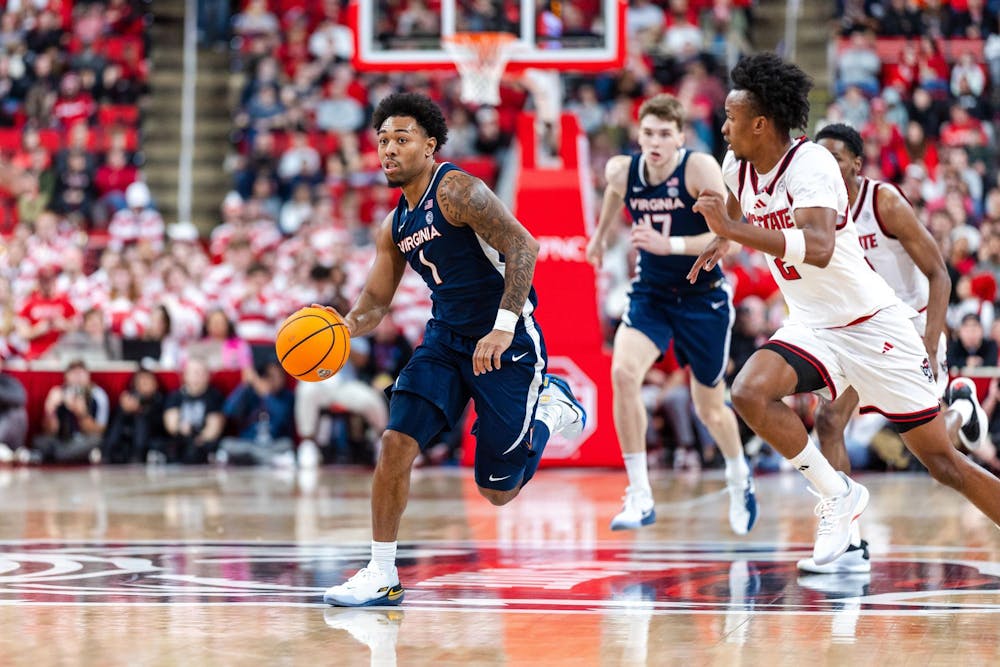
The first meeting between these teams Jan. 3 illustrated Virginia’s ceiling and NC State’s floor. The Cavaliers beat the Wolfpack 76-61, holding their hosts to just 20 first-half points. Junior guard Sam Lewis, who was restored to the starting lineup after a new rotation at Virginia Tech seriously backfired, shone in the first half and set the tone for what became a comprehensive road win. Virginia shot 50 percent from the field and hit 13 three-pointers, utilizing its interior size to erase the Wolfpack’s attempts at the rim.
NC State recorded season lows in points, field goal percentage and assists Jan. 3. Notably, the game at Virginia was the only contest all season in which the Wolfpack's field-goal percentage dipped lower than it did in the Georgia Tech defeat. In his postgame remarks, Wade pointed to organization as the defining issue — NC State was rushed in transition and failed to probe Virginia’s drop coverage the way Wade had planned.
Since that January meeting, the two sides have trended in different directions. The Cavaliers have won 10 of its 11 ACC matchups since, including victories over Pitt, Syracuse, Florida State and the aforementioned Georgia Tech — along with a neutral non-conference win over Ohio State — following its sole 2026 conference loss to North Carolina. Virginia now sits at 24-3 overall and 12-2 in ACC play, second only to Duke.
The Wolfpack will arrive in Charlottesville Tuesday after absorbing some painful lessons throughout February, even though their record and larger resume remain respectable. NC State sits at 19-8 and 10-4 in conference, recovered from the Louisville blowout and Miami collapse with an emphatic 82-58 dismantling of then-No. 16 North Carolina — the sole ACC team Virginia has fallen to in 2026.
But inconsistency remains a central problem for the Wolfpack — the Cavaliers boast a 6-2 Quad 1 record, while NC State sits at 5-5. Tuesday, Wade’s side will look to convert another Q1 opportunity, while Virginia will be looking to protect its postseason seeding at every turn.
Records aside, Odom and Wade’s teams have clear structural differences. NC State scores more — they rank No. 24 nationally at 84.9 points per game — but also concedes significantly more, allowing 73.8 per contest. Virginia is slightly lower-scoring at 82.0, but the Cavaliers are far stingier defensively at 68.0 points allowed.
Virginia’s offense starts with freshman forward Thijs De Ridder, who notched his eleventh 20-point game of the season against Georgia Tech — but the Cavaliers’ identity stems more from their multi-positional guards and wings, and elite rim protectors in freshman center Johann Grünloh and senior big man Ugonna Onyenso. That combination of perimeter versatility and enforcement in the paint has been one of the defining characteristics of Odom’s team all season.
NC State, by contrast, is driven by high-usage, high-energy guards and perimeter shooting by committee. Senior guard Quadir Copeland is ranked second in the ACC in assists at 6.8 per game and shoots 42.3 percent from three, while senior forward Darrion Williams paces the team in scoring. Senior forward Ven-Allen Lubin brings interior physicality, and sophomore guard Paul McNeil Jr. has become the Wolfpack’s sharpshooting spark off the bench — essentially NC State’s answer to Virginia’s graduate guard Jacari White.
“It's never easier [to scout] because while you are playing a team twice for the second time, neither teams are the same as we were back the first time we played them,” Odom said. “They're playing as well as anybody in the conference … They found their clear rotation that they're going with, and they've got guys that can score in and around the basket. They're an elite three point shooting team. They play well in transition and they steal the ball, and so that's a … pretty hefty combination there, and they can win on any court.”
Virginia will have to rely on Onyenso and Grünloh to mess with the Wolfpack’s shot map, but NC State possesses the spacing and perimeter volume to punish the Cavaliers’ drop coverage if Virginia’s guards fail to close out. If the Cavaliers can control the paint, pass cleanly and remain dominant on the glass, they should neutralize much of what the Wolfpack will aim to do — force closeouts and generate open threes to keep a demanding pace.
For Virginia, Tuesday’s 7 p.m. tipoff is a key one in its push towards the conference title, with a marquee road trip to Duke also looming Saturday. A win Tuesday — and at Cameron Indoor Stadium — would allow the Cavaliers to control their own destiny in their pursuit of the ACC regular-season championship and further solidify their case for a NCAA four seed or beyond.
For NC State, a road victory against a top-15 team would represent exactly the kind of Q1 result the Wolfpack needs to cement their place in March Madness — and would go some way toward exorcising the demons of a February stretch that has tested Wade's first-year project to its limits.
Read More

Virginia cruises by Norfolk State in first nonconference game with 59-3 victory
By Joe Schwiesow | 15 hours agoIn a game that saw a broken scoring record, two first-quarter interceptions and four different quarterbacks, Virginia found a way to get everyone a piece of the action against an in-state opponent.

After formidable non-conference play, No. 10 Virginia braces for an unforgiving ACC
By Sofie Keppler | 16 hours agoThe ACC slate opens against a defense that has hardly blinked all season, in a conference where dominant wins come at a premium.

Cusack impresses, Virginia sinks in ANNIKA Intercollegiate opener
By Sofie Keppler | YesterdayAs a team, the Cavaliers tied for sixth place at Lake Elmo, shooting a seven over par Wednesday to finish with a three-over 867 overall.


