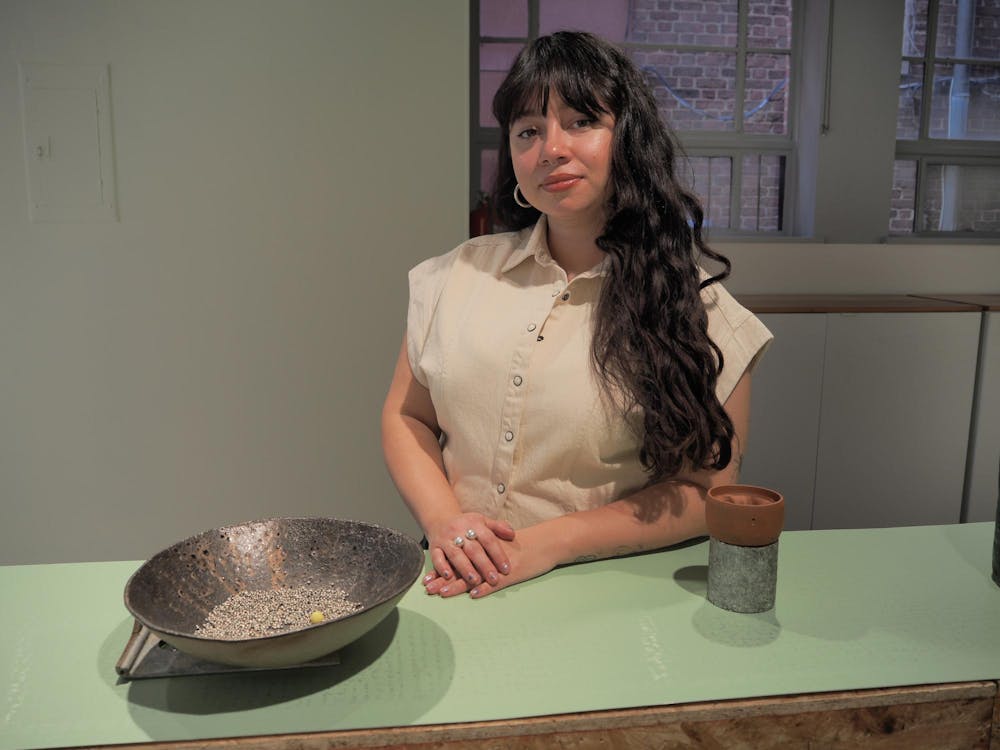
Stepping into an integral role within the University’s arts scene April 6, the artistic journey of Stephanie Germosen Salazar — the new Ruffin Gallery and Visiting Artist Program coordinator — has led her to Charlottesville. Her new position entails bringing entirely fresh art to the University — researching, inviting and coordinating exhibits with artists from across the country to house their works in the Ruffin Gallery for weeks at a time. Germosen Salazar has been immersed in artistic academia for over a decade, receiving her bachelor of fine arts from the School of the Art Institute of Chicago in 2018 and her master’s of fine arts from Virginia Commonwealth University in 2024.
The Ruffin Gallery has graced Grounds with contemporary art exhibitions open to the public and put together by students, faculty and visiting artists since 2008. Having similarly organized several of her own multimedia exhibits in both New York and Virginia, Germosen Salazar now has the opportunity to create moving experiences at the University for students, gallery visitors and visiting artists using her creative expertise.
Germosen Salazar said she was exposed to art from a very young age, often visiting the vast array of museums in New York City, where she grew up. She explained that she was able to explore her interests in different modes of visual art, such as metalwork and ceramics, through these early encounters.
“Interdisciplinary sculpture has always been my medium, and I've never wanted to limit myself with what I work with,” Germosen Salazar said. “I don't want to place my practice in a box because I'm always changing, even beyond my practice, what I think and what I believe.”
Even as she begins to curate the work of others, her deep-rooted personal artistry remains at heart, proven by her most recent exhibit at New City Arts on the Downtown Mall, titled “holding ground.” The exhibit ran from March 6 to April 15, using a mixture of sculpting, welding and printmaking to repurpose scrap materials and speak to the immigrant experience. Germosen Salazar said the display was inspired by these found and repurposed materials as well as Caribbean and Latin American culture.
“I’m very much into collecting found objects … and repurposing them into something new, something that encapsulates that moment in time for me,” Germosen Salazar said. “I take a lot of inspiration from Caribbean and Latin American diaspora … [There are] a lot of the heart symbols that you'll see specifically in Caribbean culture [and] Latin American culture.”
The exhibit also featured metal structures inspired by material from her grandmother’s house in the Dominican Republic and slabs of Dominican soap, which together frame pictures she took which depict moments of everyday life in Latin America. Germosen Salazar expressed that using perishable material highlights the impermanence that she displays in much of her art.
“You won’t be able to see the images eventually … That is something I really love or try to embed in my work, that it has its own life and will eventually look different,” Germosen Salazar said. “[The pieces are] kind of transient and can always be arranged in a different way.”
Her own efforts in curating multimodal experiences may directly enrich what Ruffin Gallery offers, informing her approach to the four to six exhibits it aims to showcase annually. Beyond creating her own work and immersing herself in the arts scene at the University, Germosen Salazar said that the outreach to other artists inherent to her new role will strengthen her connection to the world of art.
“I've always been drawn to working with artists … to see people make work and do what they're passionate about and conceive a show from a thought to something that's actually physical,” Germosen Salazar said. “When I heard about this role, I was like, ‘perfect.’ The access to resources, the kinds of artists that I could invite, it just was really exciting to me.”
Though Germosen Salazar said she is excited to work with other artists, collaborating with other departments at the University poses a new opportunity. Her cross-departmental plans are still in their early stages, but she said the opportunity to work with the Spanish or environmental studies departments, for example, would create equally academic and artistic showcases for visitors.
Alongside artistic and academic partnerships, listening to student voices when inviting artists and curating exhibits is an important part of Germosen Salazar’s position. Germosen Salazar said that she plans to arrange contemporary art that appeals to students because of their centrality to the gallery.
“It's been really important for me to see what [students] want … It's never great inviting an artist that maybe only the faculty is excited about,” Germosen Salazar said. “The show is for the students.”
Intertwining student perspectives, visiting artists, departmental collaborations and her own extensive art experience, Germosen Salazar has a bountiful term ahead of her at the Ruffin Gallery and within the University’s arts scene.
Read More

The Radio Music Society at U.Va. bridges contemporary pop music with classical instruments
By Carly Smith | YesterdayThe Radio Music Society combines a musical practice and genre on opposite sides of the spectrum — string quartets and pop music.

Season four of ‘Ted Lasso’ lands on a positive note, but still falls flat
By Catherine Ziegler | 2 days agoAlthough season four has elements of progressive character growth and touching themes, its execution comes off as superficial.

Troye Sivan’s ‘She’s the Best’ takes Sivan far from his best artistic self
By Alena Touve | 3 days agoWhile the album does contain powerful tracks which combine fresh sounds with Sivan’s familiar templates, certain songs get lost within their own musical experimentation.