Constructive conversation, ideological diversity and self-regulation skills — this simple three-step strategy serves as the foundation for the Karsh Institute of Democracy’s semester-long Civic Cornerstone Fellowship. In an effort to combat the hyper-partisan culture of modern-day American politics, the Civic Cornerstone Fellowship brings together University students from all walks of life in thoughtful discussions about controversial topics, fostering respectful engagement across Grounds.
Launched in fall 2024, the program is centered around three main components — a guided meditation, active listening exercises and small-group discussions. The Fellowship has historically met bi-monthly at the Contemplative Sciences Center — although this semester, its location has moved to Bond House. With each session totaling around two hours, there is ample time for icebreakers, reflective exercises and meaningful political conversation.
Last semester, the School of Education and Human Development expanded the sentiments of the program and created a class that functions as a continuation of the Fellowship. The class — EDLF 4085, “Civic Challenges Capstone” — builds on the skills students develop through the Fellowship and applies them to local civic issues.
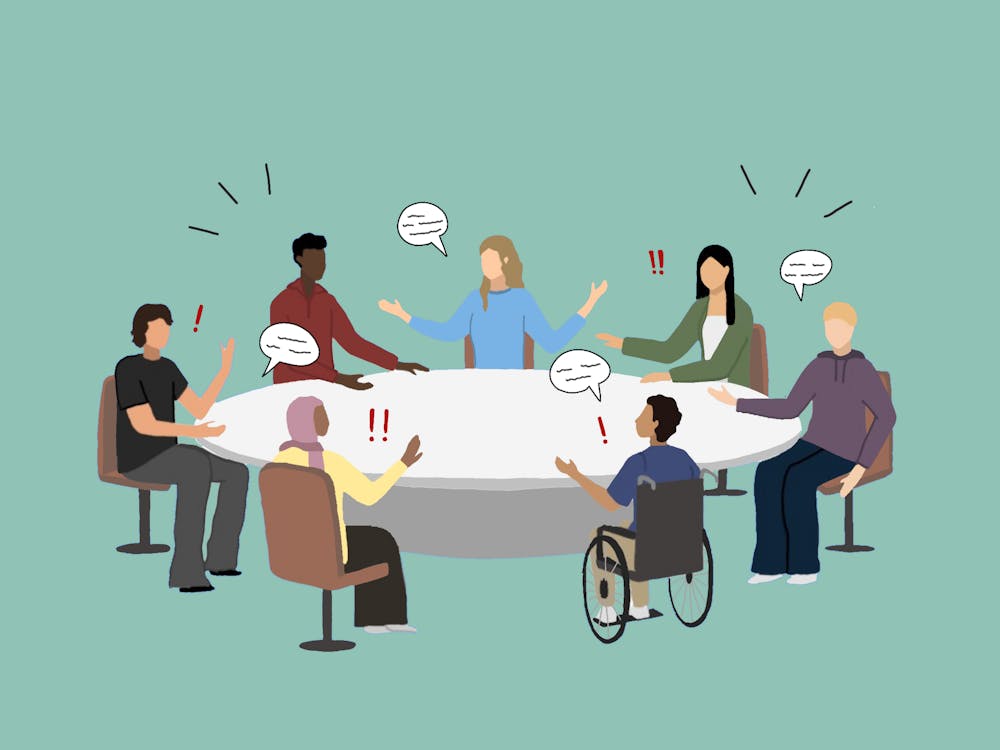
To apply for the Fellowship, students must complete a brief online application process, which accepts roughly 400 undergraduate and graduate students each cycle. Using information collected from the application regarding political preferences, participants are then split into “ideologically diverse” cohorts of approximately 50 students. Within these groups, students are then divided into eight- to 10-person discussion “pods” to encourage more personal conversations.
In a written statement to The Cavalier Daily, Nikki Kain, assistant director of programming for the Karsh Institute of Democracy, noted how the themes of these small-group conversations often mirror broader trends in American political discourse.
“In the Civic Cornerstone Fellowship, we hear many students talk about the ways political polarization shows up in their families,” Kain said. “Their experiences often echo the broader trends we see across the country, like deepening polarization, differing information sources and a growing sense that people are talking past one another.”
Jaden Kline, Civic Cornerstone Fellow and third-year College student, said he has always been interested in political discourse. When he joined the Civic Cornerstone Fellowship last fall in hopes of further enriching his interest in politics, Kline learned how to channel that passion into productive bipartisan conversations.
“[The Fellowship aims] to bring people from both sides together to understand how [we can] respect one another's opinions and engage in discourse that's beneficial for everyone [and] not [discourse that is] detrimental or trying to tear one side apart,” Kline said.
Ella Notis, Fall 2025 Civic Cornerstone Fellow, third-year College student and member of the Civic Challenges Capstone course, explains how her decision to join the Fellowship arose from a lifelong familiarity with ideological diversity. Growing up with family members who held a variety of beliefs, she embraced the opportunity to learn from others and further understand differences.
“I come from a family where we have a lot of fundamental disagreements around major political issues,” Notis said. “My parents are both very vocal and [from] a different political party than I am — my mom is Jewish, and my dad is Catholic, and [they are] both lawyers … They know how to argue very well, so I was surrounded by a lot of disagreement in my household growing up.”
Contrary to a formal class or any other intensive extracurricular, the bi-monthly nature of the Civic Cornerstone Fellowship provides a relatively low-commitment way to practice communication across differences. Third-year College student Rio Jones also served as a fellow last fall, noting that the program was easy to fit into her calendar and an engaging way to reset amidst her busy schedule.
“It’s very low-stakes … we didn't have to do any reading for it or come super prepared — it was just ‘Come as you are and have a conversation,’ which I really liked,” Jones said. “It’s two hours I built into my day to focus on myself and [to] think about my own thinking.”
To ensure that fellows entered dialogue sessions with a calm, focused mindset, program meetings began with 15-minute guided meditations. Notis recalled engaging in “box breathing” and other mindfulness techniques that grounded students before their discussions. Once the tone for the session was set, program coordinators progressed to active listening exercises.
These exercises aimed to center the discussion environment on inquiry rather than argumentation. In one instance, Notis described how Karsh Institute staff arranged fellows so that they could not see each other and instructed them to converse without cutting each other off. Forced to rely on verbal cues, the fellows augmented their active listening skills.
“There was no direct eye contact involved … we were sitting side by side with another person, and we had to fully listen to them and try not to interrupt,” Notis said. “[Not] being able to see the person made it an interesting way to practice actively listening, which is a hard skill, especially when you're discussing topics that you have strong opinions about.”
With clear minds and fortified listening skills, fellows then proceed to the third and final section of the meeting, small group discussions. Jones explained how every “pod” was given the freedom to select a topic of conversation for each meeting — encompassing everything from education policy to immigration and reproductive rights.
Small group conversations like these allowed fellows to learn about one another’s unique life experiences. For example, Notis spoke with her “pod” about growing up with a sister with intellectual and developmental disabilities, and how her sister’s challenges with the school system piqued her interest in education policy.
Regardless of the topic, these conversations are generalizable beyond the University, and, as Kain noted, can equip students with the tools necessary to communicate effectively across ideological and political differences.
While fellows’ backgrounds and personal stories about politics varied, Notis, Jones and Kline agreed that the program’s participants were not as ideologically diverse as the Karsh Institute may have intended.
“I think it was definitely skewed towards liberal ideology, just because I think that [viewpoint] is more common at U.Va. in general,” Notis said. “I think it's hard to truly get a heterogeneous body of students.”
Even though the viewpoints were mostly left-leaning, Notis said that she had several constructive conversations, and oftentimes fellows held a wide variety of beliefs on different issues. Jones, however, said the ideological imbalance was a key flaw of the program, and it limited the Fellowship’s ability to truly foster bipartisan collaboration.
“I think [the Fellowship] attempts to address the polarizing [political] climate … but that’s very difficult to do when you don't have people on opposite sides of the spectrum,” Jones said. “Conversations don't end up being very constructive when you all believe the same thing.”
Along with greater diversity of opinion, Jones said the Fellowship would benefit from providing participants with a bit of background information on issues up for discussion. According to Jones, in meetings when some fellows lacked prior knowledge on a particular subject, the deliberation suffered.
“If the goal is to navigate [complex] perspectives … [or] very taboo topics, there needs to be some sort of source material that people can pull from,” Jones said. “If I didn't have a very developed opinion about something, and someone else [in my group] did, I just kind of gained their opinion.”
Ultimately, the Fellowship is designed to help students navigate disagreements — whether with family, friends or strangers. With a new cohort that began last week, this semester’s Civic Cornerstone Fellows will continue to explore how differing perspectives can shape conversations and strengthen democracies.
“Disagreement is important in a democracy because disagreement means that people from different perspectives are being heard,” Kline said. “Everyone should not agree, because everyone's impacted differently based on [their] background … If you're always finding a consensus immediately, then that means you're not listening to everyone.”
Read More

Hoo Needs a Hug brings parents, treats and joy to Grounds
By Ingrid Gay and Luke Smiley | 4 days agoAptly named Hoo Needs a Hug, this once-a-semester pop-up event from University parents aims to help provide emotional support during stressful times for students.

Feeling the burn with Pilates Reformer at North Grounds Recreation Center
By Lily Notter | 4 days agoReformer Pilates is a full-body, low-impact workout that focuses on strength, flexibility, mindfulness and stabilization.

The world kept scrolling
By Aditi Burra | October 11, 2026I began to find a sense of peace in not knowing. I felt so much more at ease with myself and my life, all because I deleted a few apps on my phone.