
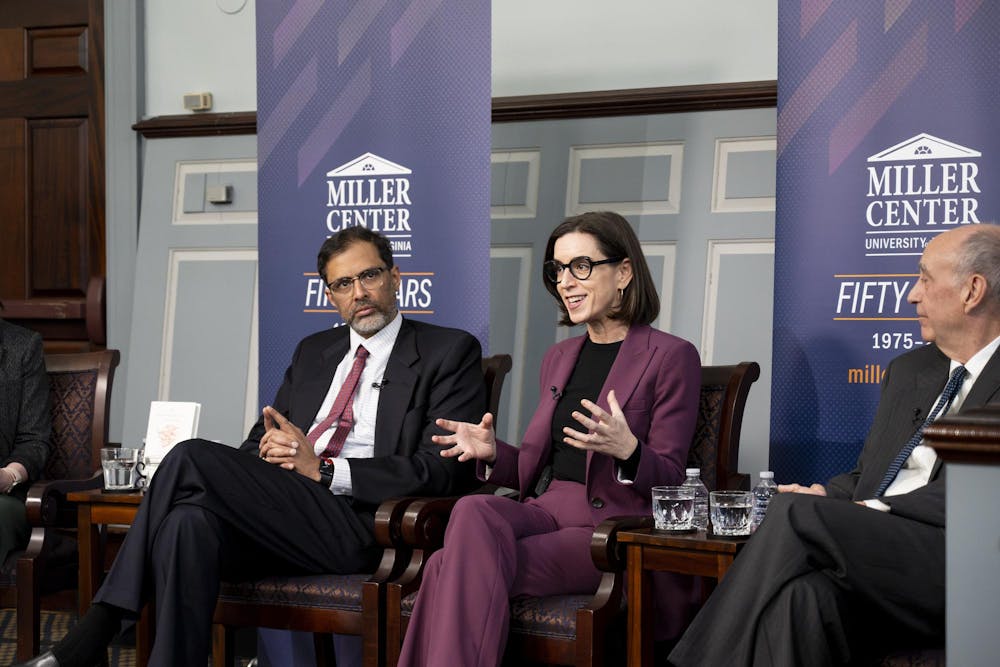
The Miller Center hosted an event Friday for the release of the book, The Presidential Pardon: The Short Clause with a Long, Troubled History by Law Prof. Saikrishna Prakash. The book examines the development of the Presidential pardon from a good-willed opportunity for forgiveness into a modern political weapon.
Prakash was joined on a panel by Neil Eggleston, former White House Counsel from 2014 to 2017, and Elizabeth Oyer, former United States Pardon Attorney from 2022 to 2025. The panel discussed the consequences of the broad scope of the Constitution’s language in Article II, Section 2, Clause 1, which grants the president the power to pardon, or legally forgive, any “offences against the United States, except in cases of impeachment.”
The event began with Oyer discussing the large amounts of letters her office in the Justice Department received each day, citing that about 80 percent of the thousands of letters that arrived were from currently incarcerated individuals seeking commutations — reduced sentences or punishments following criminal convictions. As a pardon attorney, she worked to review and make recommendations for the convicted criminals requesting commutation.
Oyer also outlined the process that her office followed to review those letters. She explained that her office would work with the U.S. Attorney as well as the prosecutor and judge of the original trial, and the selected cases would ultimately make it to the Oval Office after the Deputy Attorney General and the White House Counsel. She further explained how that process has been reregulated under the Trump administration, calling on the few weeks she spent in his Justice Department before her departure in March 2025.
“I served in the role of pardon attorney for about seven weeks before I was fired from the Justice Department by the Trump administration. During the seven weeks … there were dozens of pardons that were issued, and I was not consulted about a single one of them,” Oyer said. “The process just completely changed very quickly, vetting no applications, it all sort of went out the window.”
Earlier in the discussion, Prakash said that, while the shadier nature of how presidents exercise their pardon power has accelerated under former U.S. President Joe Biden and now-U.S. President Donald Trump, these misuses of constitutional guidelines are not a foreign concept. In fact, Prakash noted accusations of mistreatment of the pardon power can be dated back to the administrations of John Adams, Thomas Jefferson, Andrew Johnson and Gerald Ford.
Later in the discussion, Prakash explained how he sees the meaning of pardon power in current day, outlining his distaste for how the pardon power — the president’s ability to grant clemency — has become a political tool during elections and also during the years of present and past administrations.
Prakash also cited two further issues he sees with the way the presidential pardon power has been employed. He explained that the “policy pardon” allows the president to undercut existing policy that may be against their platform, or that they simply do not believe in, by pardoning all offenders, even when they would not qualify for it. Furthermore, the “pardon of allies” often shows an overt exchange of goods between the president and an ally in which they may issue a pardon in exchange for support — financial, political or for a personal objective.
“Obviously presidents want to get votes, but I think that is not a good look for the president to be using the pardon power for these sort of grass political purposes,” Prakash said. “I think it is a very attractive tool for the president because, again, this is one area where the presidents will will prevail.”
Oyer further cited examples from the current Trump administration in which she believes the pardon power has been exercised nefariously. Included in such examples are individuals who have contributed financially to Trump's business and political successes.
“No president has ever systematically enriched himself through the use of pardons in the way that Donald Trump has done,” Oyer said. “It is really hard to deny the sort of transactional aspect of what is going on here. He casually pardons people as favors to friends.”
Near the close of the panel, Eggleston touched on how he imagines the presidential pardon power developing in the future in potentially harmful ways. Discussing the pardons that Biden issued in the last moments before he departed from the White House, Eggleston explained that he now fears it may be likely that Trump will do the same on an even larger scale. Ultimately, Eggleston explained, this specific use of the pardon power may blur the boundaries of authority that Cabinet members and employees of the administration exercise during their term of service if they assume that all offenses will be federally forgiven by their boss.
“It might get to the point where the people acting are expecting [a pardon], and do not have to moderate their behavior quite as much,” Eggleston said. “The U.S. have immunized the president from any criminality related to official conduct, and I am just worried that we are going to continue to expand that.”
Prakash additionally explained two possibilities for making improvements to the present system. One would be establishing “temporal limits” that would enforce regulations around when presidents could actually issue pardons. A second would be establishing a House veto power that would allow for the House or Senate to issue a resolution protesting a pardon.
Oyer also explained that another possible way to improve the system would be to increase the number of ways a currently or formerly incarcerated individual may advocate for a pardon or commutation.
“I think we just need more channels for people to be considered for this type of relief without sacrificing the important vetting that goes into making sure that we're giving those second chances to the right people, people who truly have earned and deserve them,” Oyer said.
Read More

Buildings and Grounds Committee approves a U.Va. Health hospital renovation
By Grace Little | 2 hours agoThe Board of Visitors’ Buildings and Grounds Committee convened Thursday afternoon to approve the U.Va. Health Transitional Care Hospital renovation and the namings of 13 exterior spaces at Aggarwall Hall.
Ambassador of Thailand to the US speaks on Thai economy, conflict with Cambodia
By Edward Christopher | 3 hours agoChindawongse spoke about his home country’s history with the U.S., relations with other nations in Southeast Asia and Thailand’s economy and social progress.

Supreme Court Justice Amy Coney Barrett discusses legal doctrines, emergency docket
By Edward Christopher | 3 hours agoShe reflected on how the role of the Supreme Court Justice has evolved since she clerked for former Supreme Court Justice Antonin Scalia and how she approaches legal issues.


