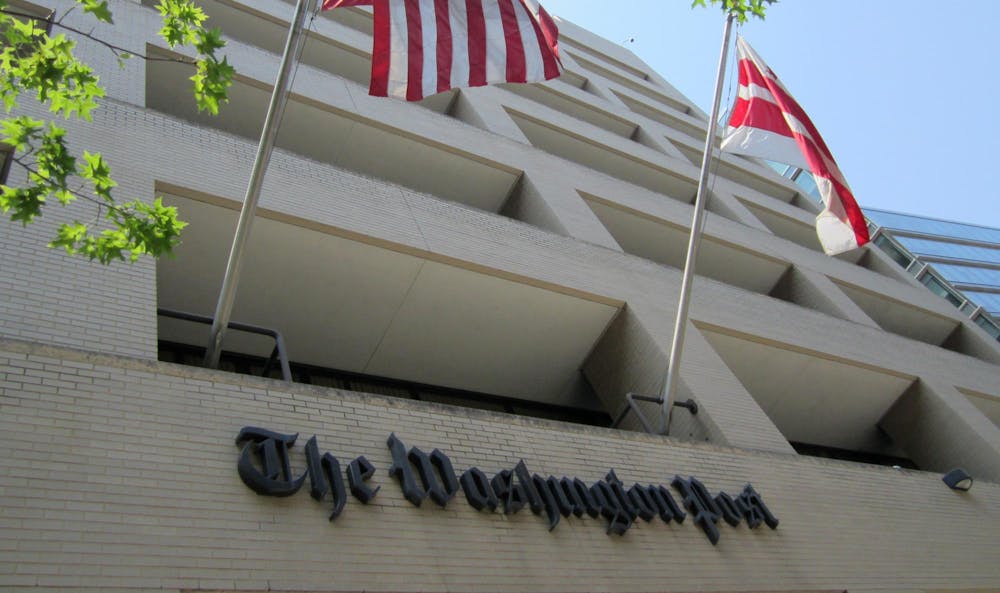
The Washington Post is a media giant, respected and admired across the country. But early this month, The Post has been more than a producer of news — it has become a subject of news.
Feb. 4, The Post shut down its sports department as part of a mass company-wide layoff of roughly 44 percent of its journalists. The biggest cuts were in the areas of sports, metro news and international reporting. Post leadership cited profitability and scoping concerns for the cuts — evoking strong negative reactions from the sports media industry and those adjacent, including many members of the University community.
As part of the shutdown announcement, a spokesperson for The Post offered a brief written statement that has been published in The New York Times and other outlets.
"The Washington Post is taking a number of difficult but decisive actions today for our future, in what amounts to a significant restructuring across the company," the spokesperson said. "These steps are designed to strengthen our footing and sharpen our focus on delivering the distinctive journalism that sets The Post apart and, most importantly, engages our customers."
Several University students grew up reading content from The Post’s lineup of award-winning writers, which once boasted stars such as Michael Wilbon, Tony Kornheiser and Sally Jenkins. A bevy of star journalists led The Post’s extensive coverage of professional sports, college sports — including the occasional foray into Virginia Athletics — and high school athletics.
Following recent updates, The Post’s former spread of game coverage and reporting on teams’ seasons are no more. However, The Post will not omit sports stories entirely.
Margaret Fleming, a news reporter at Front Office Sports, provided a clarification on The Post’s restructuring. Fleming reported that some Post writers will join the organization’s features team to cover sports in a limited capacity. Fleming also explained that among the overwhelming majority that was laid off, a select few writers will continue to work for The Post for its print content.
Fleming presented a newsroom memo written by Post Executive Editor Matt Murray that was shared with staff — which provided a glimpse into the rationale behind the dissolving of sports coverage. In his message, Murray cited concerns about breadth of coverage in combination with a dwindling audience.
“Our organic search has fallen by nearly half in the last three years,” Murray wrote. “Significantly, our daily story output has substantially fallen in the last five years. And even as we produce much excellent work, we too often write from one perspective, for one slice of the audience.”
While The Post’s restructuring is already set in stone, some University students continue to mourn the once-revered sports department in its previous form. Third-year College student Peter Kriebel, a sports content creator, is privy to the widespread media patterns that have led to these changes.
“This is a business-motivated move by a business,” Kriebel said. “It is probably too much to ask for The Post to hang on to a bleeding section on account of altruism. But the sports section’s failing is just one instance within a broader trend of American rejection of journalism. America is a knowledge economy, not reading the news is dumb.”
Fourth-year Batten student Eli Bardash was another frequent reader of The Post’s sports coverage. While he realizes that the cuts may have been inevitable, he explained in a written statement to The Cavalier Daily that without a fully-staffed sports section, The Post’s prestige has dwindled.
“Having grown up religiously reading The Washington Post Sports section, I’m dismayed to see the paper I knew and loved crumble in pursuit of money, even though the writing may already be on the wall, and The Post may be beyond saving,” Bardash said. “As a northern Virginian, I was always proud that my ‘local paper’ was a national stalwart, but with cuts … that’s not a justifiable claim anymore.”
According to some University students, one aspect that made The Post’s coverage special and celebrated was its commitment to reaching as many facets of the athletic community as possible, including high school athletics. A core component of that high school coverage was the All-Metropolitan Area Awards, which highlighted some of the top athletes in the Capital Beltway area of D.C., Southern Maryland and Northern Virginia.
First-year College student Asher Sedwick was one of the thousands of athletes who were highlighted by The Post, finding himself in the news when his tennis team at Sidwell Friends School won their 2023 conference championship.
“I think [cutting sports is] a total detriment to The Washington Post,” Sedwick said. “Especially for the high school spotlights in The Washington Post … Many athletes who might not get the recognition otherwise can find it [there] and also can reach a more global stage for recruiting … it is sad that others will not get to experience that.”
While students acknowledge the situation as unfortunate, several prominent figures in journalism have taken to social media to express their criticism of The Post’s current leadership. In particular, former Post owner Donald Graham — whose family owned The Post from 1933 to 2013 — spoke out against the cuts.
“It’s a bad day,” Graham said in a written statement posted on Facebook. “I will have to learn a new way to read the paper, since I have started with the sports page since the late 1940s.”
Current owner Jeffrey Bezos purchased The Post from the Graham family in 2013, which sold the paper in hopes of acquiring financial stability for The Post. Bezos has a net worth of over $200 billion and has been criticized in the wake of The Post cuts, with some critics attributing them to financial motivations. Feb. 7, CEO Will Lewis stepped down — Bardash offered his perspective on the recent CEO development.
“[Bezos] certainly should have foreseen the possible negative consequences of cost-cutting, and he may even be willingly killing the paper,” Bardash said. “For the sake of our country and the great institution that is the journalism industry, I hope not.”
Regardless of the exact circumstances that led to The Post’s sports dissolution, students agree that the way they consume sports coverage has fundamentally changed. However, according to fourth-year College student Daniel Brock, sports journalism remains ever-important, especially in a future without The Post’s sports section.
“I think folks in [D.C., Maryland and Virginia] should try to find their daily dose of sports news from more local sources instead of The Washington Post now,” Brock said. “It's always nice to support a local paper because if we support them more, that means they'll have more resources to put out better coverage.”
Nevertheless, from the perspective of students hoping to enter the sports media industry, The Post’s landmark layoffs signal a future that is all the more unclear. As these layoffs are reflective of broader patterns in the sports media climate, first-year College student Emmett Kliger forecasts a murky road ahead, and explained that The Post’s restructuring has weakened job security for sports journalists.
“Sports journalism is a weird phenomenon,” Kliger said. “It's the most trivial of fields but also has a deep and personal place in our hearts … [Sports] unites us in hard times, and makes us proud in the good times. It would be an honor to be a part of the profession that humanizes and delivers the emotion behind sports.
Read More
At season’s dawn, with an influx of newness, Virginia’s goals remain unchanged
By Xander Tilock | 5 hours agoThe Cavaliers appear confident under new leadership that 2026 will be the year to end the campaign with a win, not a loss.

No. 12 women’s lacrosse falls to Richmond in close contest
By Peter Kratz | 12 hours agoThe Cavaliers’ loss was characterized by lapses in defensive judgment.

How Tabitha Amanze rediscovered her love for basketball
By Jordan Zimm | YesterdayEvery chapter of her journey has added depth to the player Virginia now sees.