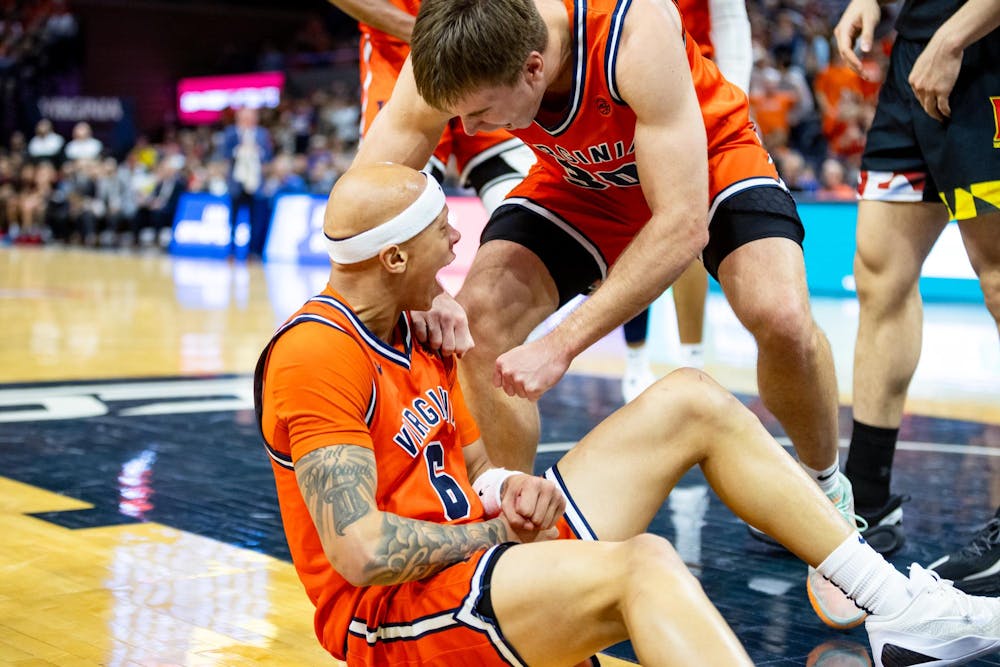
The first half of ACC play has been anything but dull for No. 15 Virginia. The Cavaliers (21-3, 10-2 ACC) opened conference play on New Year’s Eve in Blacksburg, falling in triple overtime in the first leg of this season’s Commonwealth Clash.
Since that nail-biter, Coach Ryan Odom’s squad has rebounded with wins in 10 of its 11 ACC matchups in 2026. Virginia now sits near the top of the conference standings, having navigated a gauntlet of close contests. The lone stumble of the new year came against then-No. 22 North Carolina, an 85-80 home loss in which a 16-point Cavalier lead evaporated amid stark defensive lapses and the Tar Heels’ famed transition offense.
Although the Cavaliers have climbed to third place in the ACC, a back-loaded schedule will determine if they stay in contention for an outright conference title. Virginia’s remaining slate features matchups with several fellow contenders — including a showdown with ACC first-place and NCAA championship contender Duke — so the Cavaliers’ toughest half of the schedule is debatably still to come.
Coming off of a recent stretch of wins in which Virginia seemingly played down to competition against bottom-of-conference opponents, it has been an up-and-down start to conference play, with just as many questions raised as answered. Three men’s basketball beat writers took some time to hash out some answers to the following big questions.
Who or what has been the biggest surprise through the first half of ACC play?
Aimee Crosbie, Sports Editor: I have been most impressed by how Virginia’s defense has held up — and surprisingly, even dominated at times, with added wrinkles, presses and traps. The Cavalier defense has even swung games in ACC play thus far — it stifled Stanford, forcing six shot-clock violations and held the Cardinal to a mere 55 points. Consider the recent win over Pitt, too. Despite shooting struggles, Virginia put on a defensive clinic, causing 17 turnovers and converting 23 points, allowing the Cavaliers to cruise by 20 despite scoring only 67. Even North Carolina, which eventually beat Virginia, was held to 35 percent shooting in the first half as the Cavaliers built a lead. We knew Virginia could score more this year, but to me, the team’s ability to win ugly defensive battles when needed has been a welcome surprise.
Thomas Baxter, Senior Associate: Senior center Ugonna Onyenso might be the biggest surprise of the season, but even more so through the first 12 games of conference play. On a minute-by-minute basis, he is the best shot-blocker in the conference — ranking second in blocks per game but playing almost 10 fewer minutes than the only player with more. His 15.9 block percentage on the season leads Division I, with the gap between his 15.5 percent in conference play and second place in the ACC being the same as the gap between second and 20th. Beyond shot-blocking, he is a consistent finisher in the paint and an adept rebounder. He has even found some success as a shot creator — finding the occasional hook shot or layup off of a pump-fake — becoming one of the most useful players on a team brimming with versatility and broad skillsets.
Jordan Zimm, Staff Writer: To my surprise, it’s been an extremely underwhelming season for graduate guard Malik Thomas. Coming off a season for San Francisco averaging nearly 20 points per game and shooting nearly 40 percent from behind the arc gave Virginia the impression that he was going to come in and become the team's go-to guy. While he is the team's second leading scorer, his efficiency and aggressiveness have clearly regressed. The one part of his game that has remained consistent is his rebounding. His ability to rebound at both ends of the floor has led to countless second-chance points and transition opportunities. If Thomas becomes a more consistent scorer heading into the final stretch of conference play, Virginia will be a dangerous team in March.
What is an important game for the Cavaliers in the second half of their conference slate?
AC: Virginia Tech, John Paul Jones Arena, March 7. The regular-season finale and the one conference matchup where Virginia gets a chance at redemption. That 95-85 triple-overtime conference opener in Blacksburg was decided at the line — the Hokies attempted 41 free throws to the Cavaliers’ 15, and outscored us by 10 at the charity stripe in the third overtime period alone. Two of Virginia's most frequent foul drawers, De Ridder and Grünloh, are only shooting 69.6 and 51.7 percent, respectively — the lowest percentages in Odom’s rotation. The Europeans need to either bump those numbers up, or the ball handlers need to get better at drawing late fouls. If Virginia wants to make a real push for an ACC championship, it can’t afford to drop this game — especially not at home, and especially not to a team sitting middle-of-the-pack in the conference.
TB: Saturday’s date in Nashville, Tenn. with Ohio State, though not technically on Virginia’s conference slate, is definitely worth mentioning. The Buckeyes are better than their 17-8 record suggests, boasting a top-of-the-line offense spearheaded by senior guard Bruce Thornton’s 19 points per game and sophomore guard John Mobley Jr.’s 15 on 40 percent shooting from deep. They rank No. 42 in net rating on KenPom and No. 25 in offense, competitive with the Cavaliers, who sit at No. 20 and No. 30 in those respective categories, making it one of the toughest remaining matchups on the schedule. A win would look very good for the Cavaliers, possibly making a difference when seeding talk is happening, but a loss would be equally, if not more, significant.
JZ: By far, the most anticipated game of the season takes place in Durham, N.C. Feb. 28. The Cavaliers will head to Cameron Indoor Stadium to take on No. 4 Duke in a long-standing ACC rivalry. The Blue Devils are the ACC’s top team with one loss in the ACC and just two losses on the season. All eyes will be on the ESPN-projected top three NBA draft pick Cameron Boozer, who averages 23 points and 10 rebounds per game. For Virginia, the challenge is as much about handling Cameron’s relentless atmosphere as it is slowing down Boozer — requiring discipline, poise and near-perfect execution to turn a statement opportunity into the team’s signature win.
What will be the key for Virginia to make a serious run in the postseason?
AC: Virginia needs to procure a successful half-court offense against more physical defenses, and erase the public blueprint for Cavalier frustration used by Virginia Tech and North Carolina. The Hokies forced Virginia into tough shots late in the clock, while the Tar Heels switched defenses and sped up the tempo in the second half — both meant the Cavalier offense struggled to get clean looks, and made consistent runs nearly impossible. When Virginia isn’t scoring in transition or off set plays, do they have a go-to creator who can get a bucket in isolation? Freshman guard Chance Mallory has shown flashes, but he can be neutralized by his size at times. Junior guard Sam Lewis hit a miracle acrobatic three-pointer for overtime at Notre Dame — but relying on late-game heroics can get dicey. The Cavaliers are currently dealing with scoring by committee, but in crunch time, who can get the ball and consistently create when the offense stalls?
TB: The Cavaliers have looked good down the stretch in a handful of way-too-close games against opponents nestled towards the bottom of the conference standings. The question that we should be asking is not whether or not this team can perform in the clutch, but why it keeps ending up in those situations. Notre Dame, Boston College, Syracuse and Florida State should have all been easy wins, but it took until the back end of the second half for Virginia to look like a top-20 team against any of them. If anything is vital to Virginia’s chances of cutting down nets or even making a deep run in the national tournament, it is figuring out how to keep lesser opponents out of the game from the jump.
JZ: For Virginia to make a serious run in the postseason, the margin between solid and special will come down to timing, depth and adaptability. In other words, the Cavaliers’ success will rely on getting hot as a team at the right time, particularly on the offensive end, where execution can swing games quickly. All teams that succeed in March have that aspect. In their most recent conference games, Virginia has tended to let lesser ACC opponents hang around, turning what should be comfortable wins into nail-biters down the stretch — a formula for disaster in March, let alone in conference play. In March, even against lower-seeded teams, execution cannot be lackadaisical — if higher-seeded teams play down to the level of competition, upsets will happen. If the Cavaliers can sharpen their offensive execution and get consistent contributions from everyone in the rotation, they become far more difficult to prepare for in a one-and-done environment.
Read More

Relentless Cavaliers ride seven-run inning to opening win of the Chris Pollard era
By Xander Tilock | 14 minutes agoFriday, Pollard’s Cavaliers displayed resilience and tantalizing offense in the face of adversity — factors which could come to define this 2026 Virginia team.

For Virginia swimming, their toughest ACC opponent may just be the rulebook
By Aimee Crosbie | 4 hours agoAs Virginia heads to Atlanta, it is primarily navigating the limits of its own excellence.

After 20 runs in two innings, No. 25 Virginia extends win streak to five at home opener
By Ben McNiff | 5 hours agoThe first pitch of the season in Palmer Park was thrown around 1:00 p.m. Friday. The third inning in Virginia softball’s home opener finished up not long after 2:30 p.m. What occurred in that hour and a half can only be described as pure domination.