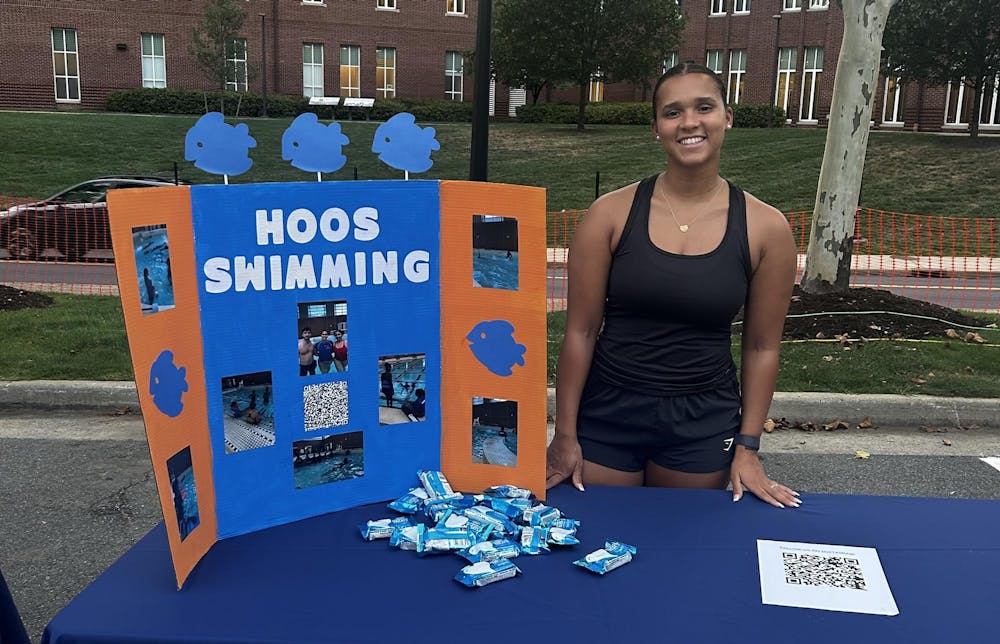
The pool at the University’s Aquatic and Fitness Center is the place to be, whether it is to watch the six-time national championship-winning team or relax in the hot tub with peers. But something less well-known about the aquatics program is that they offer free student swim lessons through a program called Hoo’s Swimming, created and run by Chloe Anderson.
Anderson, a fourth-year Education student, is the founder and current leader of the program. Her time in the pool began when her family signed her up for lessons at six months old so she could get early experience learning to swim safely. Neither of her parents could swim as kids, so they wanted to make sure their daughter did not experience the same fate.
After years of training throughout her childhood, Anderson went from taking mommy-and-me classes to competing at the national club level at the University. Prior to Hoo’s Swimming, Anderson began her career as a swimming instructor at the age of 11.
Through her many other aquatic involvements at the University, including lifeguarding and lifeguard coordinating with U.Va. Recreation, she observed a gap between the levels of many University students’ water safety abilities during other swim lessons with U.Va. Recreation. Ultimately, this inspired her to create her own program. As a lifelong swimmer, Anderson wanted to focus on making swimming a widely-accessible skill and help to dissipate many new swimmers’ pre-existing anxiety about the water.
“I just saw a gap in our lessons here, and I really wanted to fill that gap, because water safety is really important,” Anderson said.
This element of helping students overcome the fear factor of being in the water for the first time — especially at an adult age — has led Anderson to structure her lessons with a uniquely comprehensive approach. Beyond her program’s focus on stroke work and deconstructing mental blocks, she educates participants on broader water safety outside of the pool setting.
“In my program here, I talk about tides, currents [and] all that stuff. How do you get out of those?” Anderson said. “Also, just thinking about the depth of open water and [how] sometimes there are drop off points, so it can be a little scary. Those are things … to think about.”
Since being proposed in late 2024, the program consists of three beginner lessons per week, which is what Anderson considers the minimum to be effective. For University students, it is completely free to sign up through U.Va. Recreation, with lessons taking place at the AFC.
Anderson’s original vision was to create a more inclusive and diverse swimming community. With the zero-dollar cost and active advertising of Hoo’s Swimming as a program for “students from diverse backgrounds,” Anderson hopes that Hoo’s Swimming is more inclusive than what U.Va. Recreation has offered before, with their $20 student lessons. Her marketing and outreach strategy reflects this.
“The design of the program was to create a student program that was completely free ... It was … a diverse program as well,” Anderson said. “The people [and] organizations that we reached out to for funding — and then also to put our information out for the program — [were offices] like the Office of African-American Affairs and the [Diversity, Equity and Inclusion] office, when it was here.”
For Anderson, OAAA has been especially helpful with promotion for Hoo’s Swimming through weekly newsletters and emails. Their support began early on when Anderson brought up the idea to her OAAA mentor, Darren Kelly, dean of OAAA. Though the office does not contribute financially, Anderson credits OAAA for a lot of the engagement that has been brought into her program.
“[OAAA] was just like, ‘we would love for our students to learn how to swim. That's a new life skill that they could have,’” Anderson said. “It may seem like such a small thing for some people who have been [given] the opportunity early in life to learn how to swim, but a lot of people, a lot of African Americans, especially in the U.S., are not afforded that opportunity.”
In addition to OAAA, Anderson is also supported by her supervisor. Jackie Cothren, director of aquatics for U.Va. Recreation, helps to oversee the Hoo’s Swimming program, handling some of its financial aspects and helping Anderson with logistics. She was supportive of Anderson’s endeavor to teach students from the get-go.
“[Anderson] has identified students in different areas that need to or [haven’t] had the opportunity to take some lessons … Just like learning how to ride a bike [and] learning how to speak a language as an adult is a lot harder than it is as a kid, [learning to swim] is also an uncomfortable feeling,” Cothren said. “And there's typically a reason why someone never learned.”
Anderson shared a previous experience with one student who harbored a lot of anxieties about getting into the water for the first time, but through dedication and consistency, became very capable throughout her time in the program. For Anderson, the progress this swimmer made emphasized why she pushed for this program — to give students the opportunity and resources to work hard at a new skill and grow confident in it.
“[She] started in a really fearful spot [and] would not put [her] face in the water at all, and then she just grew into such a good swimmer,” Anderson said. “She was exceeding and so it was great to see her expand her skills ... which is part of the reason why I wanted to create the program, too, since I was afforded the opportunity to grow up in the swimming world.”
Anderson said she hopes to replace traumatic experiences participants may have with positive memories of being in the water. This means creating excitement for students who gain new skills, such as jumping into deep water for the first time or learning to kick with a kickboard.
“I want to [create] positive experiences … It's kind of cool to see all their growth and to create that more positive space in swimming, rather than a traumatic experience for them,” Anderson said.
On the participant side, graduate Art & Sciences student Yanbo Pan came into Hoo’s Swimming with some basic swimming experience, but no systematic training. He heard about this program through Anderson herself at the RecFest.
Pan has not only gained greater swimming skills and experience through Hoo’s Swimming, but he also cited meeting people from different backgrounds as a principal reward of taking lessons — a materialization of Anderson’s initial vision and goal.
Regardless of the experience participants have, there will always be barriers to overcome. One of Pan’s larger challenges was learning to float on his back. Never having tried this, it was difficult, but he ultimately gained a new skill in the pool, as well as mental strength by trying something new and uncomfortable.
“It's very good for one's mentality … [when] something is very hard to do, but you achieve it,” Pan said. “This gives people confidence that they can also achieve other things.”
Though they may be challenging, Pan recommends these lessons to others because they lead to learning that can be applied to other parts of life.
Besides helping University students who want to gain confidence in the water, Anderson said that with the program, she hopes to foster a new generation of swimmers. She stressed that people who know how to swim are more likely to put their children into lessons later in life, leading to an overall increase in swim ability.
“[We provide] the space for people to … put [their kids] in the water early … [to] break the cycle that we’ve gotten into,” Anderson said.
Outside of teaching, Anderson said she is grateful for all that she has learned throughout the creation of Hoo’s Swimming. As for the program’s immediate longevity, after her graduation this spring, one of her co-instructors will be stepping in to lead the program.
“I can give back in any capacity, I'm always willing to be there and take the time,” Anderson said. “This program has been near and dear to my heart, and I definitely want to see it continue.”

Lily Notter is a staff writer on the life desk. She is a third-year College student, majoring in Media Studies. Lily is from Richmond and enjoys writing about University organizations and student life. Outside of The Cavalier Daily, she is involved in Club Gymnastics and Reformed University Fellowship.
Read More

Hoo Needs a Hug brings parents, treats and joy to Grounds
By Ingrid Gay and Luke Smiley | 2 days agoAptly named Hoo Needs a Hug, this once-a-semester pop-up event from University parents aims to help provide emotional support during stressful times for students.

Feeling the burn with Pilates Reformer at North Grounds Recreation Center
By Lily Notter | 3 days agoReformer Pilates is a full-body, low-impact workout that focuses on strength, flexibility, mindfulness and stabilization.

The world kept scrolling
By Aditi Burra | 6 days agoI began to find a sense of peace in not knowing. I felt so much more at ease with myself and my life, all because I deleted a few apps on my phone.