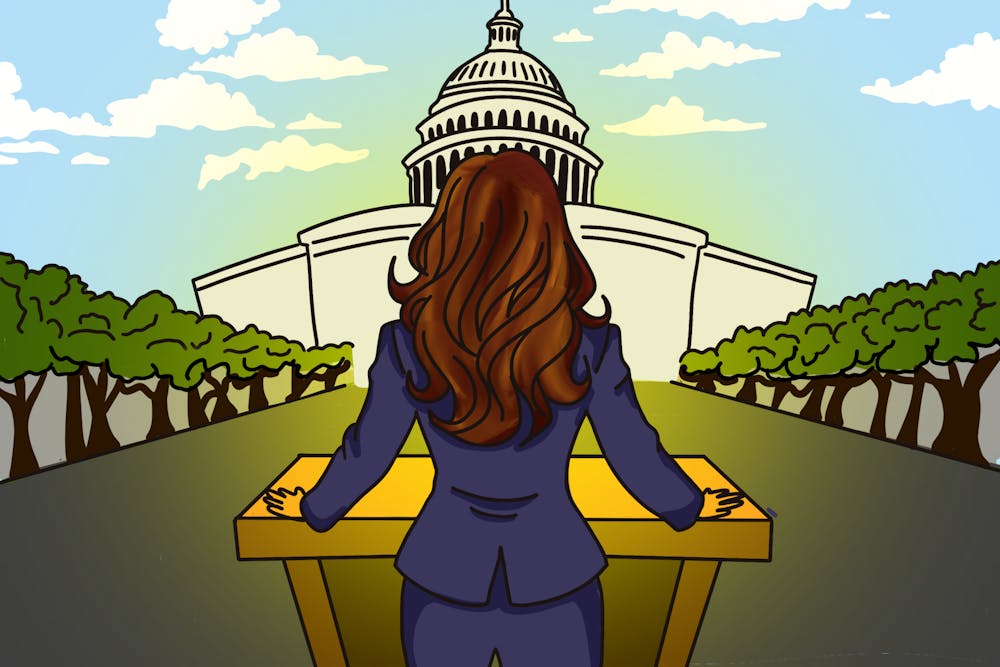
Many of the United States’ elite colleges did not admit women on a relatively equal basis until the 1960s — indeed, the University did not have its first fully coeducated class until 1970, after facing intense legal pressure from the American Civil Liberties Union. However, by 1982, women already made up over 50 percent of university students nationally, and today, they make up an even greater majority of undergraduate, doctoral and professional degree recipients. In electoral politics, they have made considerable strides across the country, with Virginia electing University alumna Gov. Abigail Spanberger, its first female governor, last November. There is much to celebrate, but for all of women’s progress, one statistic has been relatively static — that of political ambition.
Jennifer Lawless, professor of politics and public policy, alongside Richard L. Fox, professor of political science at Loyola Marymount University, has done significant research on the origins of the gap in desire to seek political office between men and women and possible solutions to closing that gap. Even though women are more likely to vote, Lawless and Fox note that women report lower interest and confidence in their ability to run for office, even with similar credentials to men. These discrepancies are likely a product of political socialization and widespread stigma about female leadership. That is, the gender gap in political office is not because women do not win elections — it is because they are far less likely to consider politics as a vocation. This gap begins in childhood, but widens in adulthood in a problematic way.
Education is among the most influential factors in political socialization, alongside family and friends — academic ecosystems undoubtedly play a role in career ambitions. While changes in education are unlikely to correct this discrepancy altogether, it is feasible they could begin to chip away at its origins. Indeed, Virginia’s education system should work towards bridging this gap by amplifying women’s history, encouraging early participation in activities that support political ambition and expanding opportunities for women’s and girls’ leadership and competition.
While local efforts have been made to implement more women into history curricula, men are still disproportionately represented, with three men discussed for every woman — a statistic even bleaker for women of color. Exposure to women in political roles is, therefore, limited, and young girls often lack role models who affirm their political agency and challenge notions of politics as a man’s realm. Curricular attention to women’s history could help to normalize female potential in social change long before careers are meaningfully considered — they too may be presidents, senators, activists and congresspeople. Patricia Schroeder, Colorado’s first female representative in Congress, famously remarked that more women would run for office if they learned their history. Representation can be transformative, as history shows women not merely as observers of political and social life, but as actors in it, and our curricula must reflect that.
But representation alone is insufficient. Classrooms will also need to address bias in risk-taking and classroom engagement to tackle discrepancies in political interest. Research indicates that girls are more risk-averse, not because of innate ability, but because of greater perceived consequences. Boys are rewarded for risk, while girls are conditioned to avoid the danger of public failure, leading to a confidence gap in political efficacy. Education can reinforce or disrupt this pattern. In Virginia, where only about 42 percent of high school athletes are girls, participation in competitive spaces remains uneven. According to Lawless and Fox, educational environments that normalize risk-taking and encourage girls to actively compete — from debate to student government and athletics — can increase resilience against loss and comfort with high-stakes competition. These qualities create the efficacy necessary for political ambition.
To further build up this efficacy, young women must be given meaningful experiences that make political involvement feel tangible and accessible at earlier stages of development. The creation of women’s leadership organizations and workshops to hone — or be exposed to — skills necessary for holding political office will be crucial. Programs like Virginia Girls State, which provide female-only environments to learn how state and federal governments operate, are essential yet incomplete. Expanding access to such programs, introducing similar opportunities at earlier stages and embedding civic leadership development more fully into school environments would help transform abstract interest into sustained ambition. Access alone is not enough, but without it, ambition rarely has the chance to take root.
Far from innate, the gap in political ambition is a complex result of socialization at home, school, among friends and via media. And women’s involvement in politics matters beyond egalitarian concerns — their presence is linked to lasting peace agreements, increased emphasis on social programs and wellbeing and lessened corruption. Their presence is crucial for a healthy and thriving representative democracy.
There is hope for change. Virginia’s gubernatorial election was historic, with Spanberger being both the first female governor of Virginia and one of just 53 in American history. We are increasingly finding role models in the present, too. But correcting the gap will be complex, and it will likely be a while before the effects of our efforts are felt. Education is, and has always been, a crucial investment in advancing equity. If Virginia is serious about equity, it should work on cultivating girls’ ambition in perhaps the most transformative location it has to offer — the classroom.
Grace Clippinger is an opinion columnist who writes about politics for The Cavalier Daily. She can be reached at opinion@cavalierdaily.com.
The opinions represented in this column are not necessarily those of The Cavalier Daily. Columns represent the views of the authors alone.
Read More

EDITORIAL: U.Va.’s chance to resolve institutional distrust
By Editorial Board | 2 days agoAffordability, AI use and free speech — these are all issues critical to ensuring that our University is accessible to all and that its culture is rigorous, rational and accepting.

HAWKINS: SJP’s animosity toward Darden’s new dean is patently absurd
By Joshua Hawkins | 4 days agoNo, Grushka-Cockayne should not be forced to resign before Darden even opens its doors for the fall, and SJP should seriously reconsider suggesting such a dramatic step.

ELJAZZAR: The University’s growing lobbying budget should worry you
By Farah Eljazzar | 6 days agoA public research university having to negotiate for its independence is, on its face, an indictment of the system it operates within.