
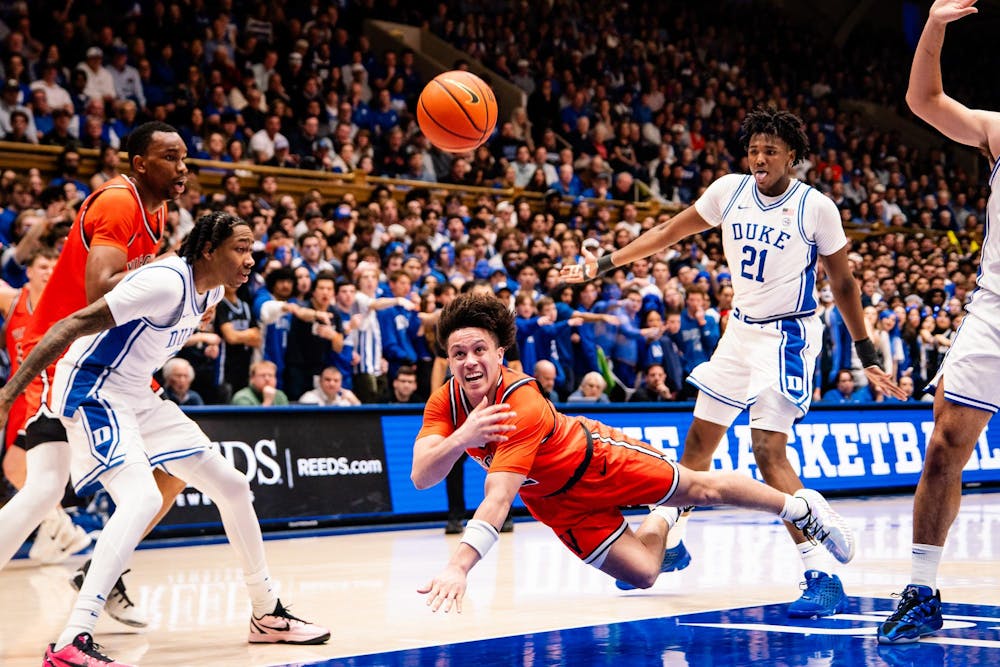
Losing to the No. 1 team in the country, on its home court, inside one of the most hostile environments in college basketball, is not necessarily cause for panic. Duke is currently touted as the best team in America for a reason. The Blue Devils have just clinched the ACC regular-season title and boast what might be one of the most complete rosters in college basketball — plenty of good teams have walked into Cameron Indoor Arena, and this season every single one has walked out with a loss.
But when discussing Saturday’s 77-51 defeat, the bigger issue at hand is how the Cavaliers lost this game. Virginia’s 26-point loss delivered a 40-minute inversion of everything the Cavaliers believe themselves to be.
For then-No. 11 Virginia, Saturday’s trip to Durham, N.C. was supposed to be a proving ground. A chance to walk into the most inhospitable environment in college basketball and show that the identity Coach Ryan Odom's group has built in year one — toughness, physicality and connectivity — could hold up against the best team in the country.
But that identity had not yet played the arbiter against an opponent of this caliber. No. 1 Duke was the first team currently ranked in the top 15 that the Cavaliers had faced all season. Virginia entered the game having won nine straight, riding one of the most propitious stretches in Odom’s first season at the helm.
Instead, No. 1 Duke dismantled the Cavaliers' winning aspirations with clinical efficiency, rolling to a victory that never once saw Virginia hold a lead. On a day that could have solidified the Cavaliers’ newfound identity, Cameron Indoor Arena and the Blue Devils found a way to ensure that Virginia did everything but.
The team that prides itself on offensive rebounding grabbed just 23 percent of available boards in the first half. The team that hangs its hat on physicality got pushed around in the paint. The team that has found ways to win tight games all season, engineering eight second-half comebacks through sheer competitive obstinance, never led for a single second.
The Cavaliers’ two previous losses to ranked opponents hinted at this vulnerability, but nothing illustrated it as trenchantly as 40 minutes in Cameron Indoor.
“I think we were just not ready today,” freshman forward Thijs De Ridder said. “Some of our guys were maybe shocked with the fans, maybe shocked with their physicality … I mean the coaches, we did a great job with the scouting, we knew everything and just didn’t execute.”
De Ridder’s blunt analysis is telling. This was not a case of being outschemed. The coaching staff had the right game plan, the players knew the assignments. The players just did not do them — and there is something unsettling about that distinction.
Odom’s scheme is designed around controlled aggression — crashing the offensive glass, pressing full-court, gambling for turnovers, leaking out for transition opportunities — and Virginia had executed it with enough conviction to amass the most wins by a first-year coach in program history.
The Cavaliers shot season lows at just 29.1 percent from the field and 20 percent from deep, taking 35 attempts from beyond the arc as Duke's interior defense collapsed the paint and dared Virginia to beat it from distance. Even when there were open looks, they simply did not fall.
De Ridder was the lone Cavalier in double figures with 16 points, but even he was hampered by early foul trouble that limited his first-half minutes. Graduate guard Malik Thomas went 0-for-8 from the field — the first time in his Virginia career he failed to record a field goal. Junior guard Sam Lewis was held scoreless.
But the paucity of made baskets was only part of the problem, and perhaps the lesser part at that.
Duke’s defense — ranked first nationally in adjusted efficiency — was arguably the real force at work Saturday. The Blue Devils, who entered the game having won nine of their 10 matchups against ranked opponents, suffocated Virginia’s half-court with a level of length and athleticism that the Cavaliers have simply not encountered. Odom conceded this point plainly.
“Their defense is really good,” Odom said. “They did a nice job of getting out and, you know, protecting their paint … When you're playing a team like this that does such a good job of protecting the twos, you're going to have to make some threes in order to have a really, really good chance.”
But Virginia could not. And when the threes did not fall, there was no fallback, no second-chance opportunities to compensate. A cruel irony, as the Cavaliers rank second nationally in blocks per game and first in the ACC in offensive rebounding rate — yet Duke’s meticulous box-outs held Virginia to just two second-chance points in the first half.
The bulk of the Cavaliers’ nine offensive rebounds came in garbage time, long after the outcome had been decided. For a team whose entire offensive philosophy is predicated on extending possessions and creating extra chances, those numbers suggest something more than just a bad shooting night.
There were moments, albeit brief and ultimately inconsequential, where the gap felt reducible. De Ridder and graduate guard Dallin Hall each hit threes early in the second half to trim the deficit to 14. But a quick Isaiah Evans three and a Caleb Foster-to-Patrick Ngongba alley-oop restored order, effectively ending the contest with 14 minutes still on the clock.
Virginia went scoreless for over five minutes in the second half, making just two field goals in the game’s final 10 minutes. For graduate forward Devin Tillis, he acknowledged that the loss stung precisely because it undermined what the Cavaliers have spent all year constructing.
“We dominate,” Tillis said. “That's what we pride ourselves on, offensive rebounding, being a more physical team. So when we're not doing that, that's not really our identity.”
The question now is what Virginia will do with the lessons Cameron Indoor thrust upon it. Hall, another one of the Cavaliers’ self-identified spirit leaders, framed the loss as instructive rather than definitive.
“There was a couple key things that we really wanted to lock in on,” Hall said. “... some of the scout things with some of their guys, so cleanable things, which is a good thing. It's frustrating, but it gives us a lot of confidence going forward, if we can fix those up.”
“Cleanable” is the operative word — and whether it proves true will determine how deep this team can go in March. The tournament will have teams with Duke’s length — and there is certainly a chance that Virginia finds itself up against Duke in the ACC Tournament as well.
The Cavaliers, for all their success this season, have shown a tendency to capitulate when an opponent matches or exceeds its physicality. This is not the first time — the triple-overtime loss at Virginia Tech carried similar hallmarks — a team built on bully ball discovered what happens when it is no longer the bully.
Again, losing to the best team in the NCAA is not a crisis. But there is a difference between losing to Duke and being unrecognizable against Duke — and Saturday was the latter.
The questions Cameron Indoor posed will follow them into the postseason — when the opposition matches Virginia’s toughness and when the crowd overwhelms its on-court communication, what remains?
For a first-year team still making a name for itself, the answer matters more than any nine-game win streak could.
Read More

Off an early bye week, Virginia to face second test of season against Norfolk State
By Drew Dillman | 7 hours agoIn the Cavaliers’ first contest under the Friday night lights since the trajectory-altering win against Florida State last season, Virginia faces the FCS-level Spartans (1-1, 0-0 MEAC) of the Mid-Eastern Athletic Conference.

Why — and why not — to overreact after a Week Zero win
By Drew Dillman | YesterdayWhile there is some evidence to believe the hype may be warranted, there are also reasons to cool one’s jets in favor of a more measured response.

Virginia men’s soccer claws back for draw against No. 23 Oregon State
By Noah Cinel | Yesterday“It’s progress,” Virginia Coach George Gelnovatch said.


