Last Women’s History Month provoked discussion of Drew Hancock’s “Companion,” a lens through which to view men’s wrongdoings in the female exploitation subgenre of horror. Such dialogue felt, briefly, like the start of a broader commitment to women in cinema — one that might even survive into April — but what followed instead was a year remarkably unified in its focus, because 2025 was a year for the man.
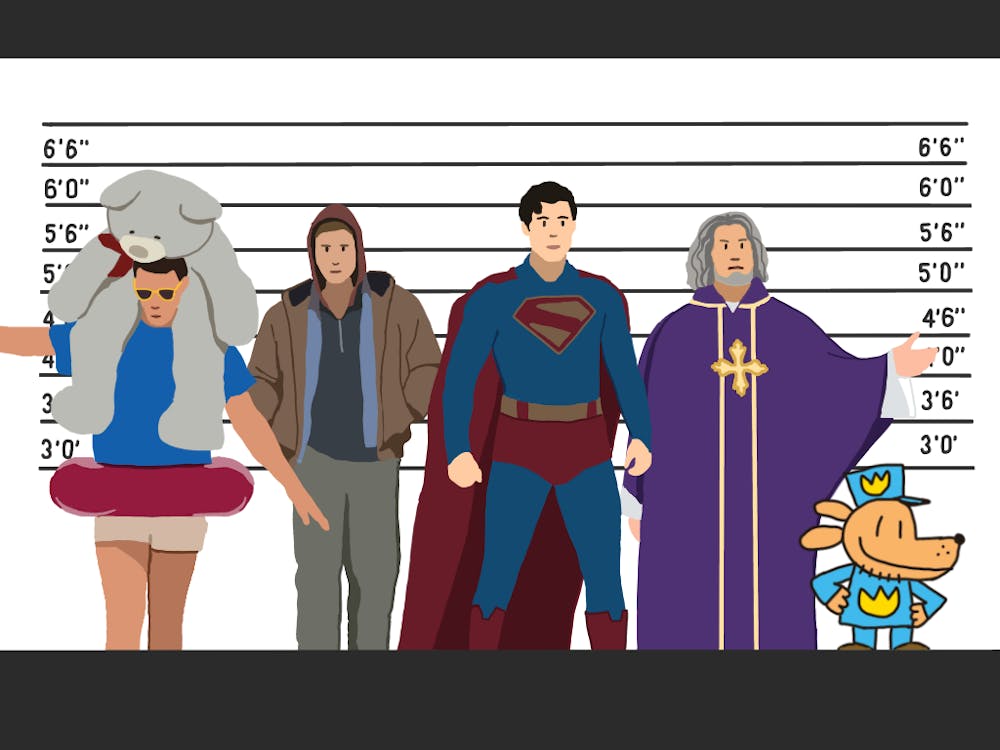
January started off strong with a double feature for the canine community in “Wolf Man” and “Dog Man.” Then in March, Jason Statham starred as “A Working Man,” and in April Paul Walter Hauser became “The Luckiest Man in America” — both men hard at work being men. Never to be outdone, July had “Superman,” because such a superlative male clearly required a twelfth installment to relay the extent of his masculinity.
Q3 brought with it a strategic pivot into the housing market, exploring property ownership from the ground up with September’s “The Man in My Basement” setting the foundation for October's “Roofman.” November carried this expansion strategy to its logical culmination, as men evolved from fleeing death in “The Running Man” to cheating it entirely with “Wake Up Dead Man,” reaffirming the sequel logic of male immortality.
It would be easy to dismiss this parade of men as coincidence, a cosmic joke in retribution for the disaster of “Ella McCay.” But cinema has long treated masculinity not as a gendered category, but as a narrative standard. A nominal man is not a representation of an individual figure so much as a stand-in for personhood itself. A woman, on the other hand, is always a woman.
Take Barbenheimer, the dual-release-turned-cultural phenomenon that defined the second half of 2023. “Oppenheimer” was a film about a man, and so it was a film about humanity. “Barbie” was a film about a woman, and so it was — or felt it had to be — a film for all of feminism. That dispute has been litigated elsewhere, but the double standard it exposes remains all too relevant, even against a seemingly revisionist backdrop.
The good news, however, is that if 2025 was a year for the man, 2026 is taking on a more diversified portfolio, with plenty of women in the coming months’ titles. This March, not only is the future female — with “The Bride!” so ecstatic at its woman protagonist as to punctuate itself with an exclamation point — but men are in the past, their only existence relegated to “Reminders of Him.”
April offers a double feature of Anne Hathaway on opposite ends of the biblical spectrum, in “Mother Mary” and “The Devil Wears Prada 2.” Spring will then blossom into hot girl summer with the dual release of “Girls Like Girls” and “Supergirl” in June. An opportunity to cool down, however, will come with a live-action remake of “Moana” scheduled for July.
What the release calendar does not show, however, is a persistent double standard. None of these films will be permitted the luxury of anonymity that any movie with “man” in the title is afforded. “Supergirl” will never just be a film — it will be a point of comparison, a competitor to “Superman,” robbed of the ability to succeed or fail in its own right.
“Superman,” meanwhile, carried no such burden, with its title treated as neutral or even universal. In fact, across the male-titled roster of 2025, that neutrality becomes a norm. The man’s gender dissolves into default, the man himself becoming a blank canvas. He runs without running anywhere. He works without working for anyone. He wakes up dead without having lived for anything at all.
This nominal trend is not so much to do with inflection as grammar. In the dictionary of Hollywood, “man” functions as a noun, where “woman” functions as an adjective. Where a noun may stand alone, an adjective must always be attached to something else. If “Barbie” failed, it failed because it was forced to serve as a referendum on feminism. No film about a man has ever been asked to do the same.
Perhaps this is all coincidence. Perhaps studios find comfort in the invisible man and stability in his perpetual motion. Or perhaps 2026 will finally deliver “The Woman” — no exclamation point, no qualifier, no franchise potential, just a noun. Until then, the man will keep running, keep working, keep waking up dead and coming out alive.
Read More

Virginia Film Festival unveils full lineup for 39th rendition
By Matthew Wang | YesterdayThe Festival’s 39th rendition, which will run for five days from Oct. 21 to Oct. 25, will feature a myriad of films from Virginia and across the world, as well as live discussions and panels with celebrated filmmakers and industry professionals.

‘Digger’ digs deeper than its absurd premise
By Victor-Jenay Cortijo Lopez | Yesterday“Digger” takes audiences through a surreal, confusing, hilarious and dark rabbit hole.

An essential guide to the Charlottesville music scene
By CC West | 5 days agoWhether someone is a composer, a dedicated listener or looking to grow their music knowledge, here are some ways to find new harmonies throughout a student's years on Grounds.