
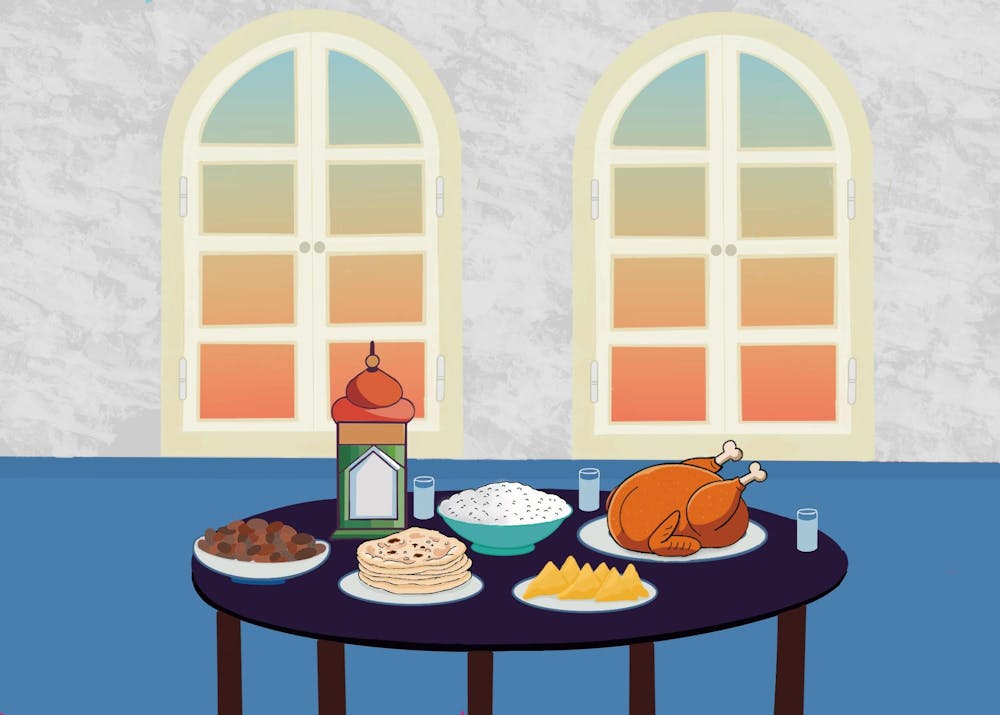
In observance of Ramadan, the month in which the Quran, the holy book of Islam, was revealed, many Muslim students on Grounds honor the holy practice of fasting from dawn until sunset. Fasting is often a deeply personal practice, and breaking the fast provides an opportunity to communally celebrate the Islamic faith and practices. Being based on the lunar Islamic calendar, the month of Ramadan begins with a crescent moon phase. In Charlottesville, this year’s Ramadan began the evening of Feb. 17 and concluded the evening of March 19.
For the duration of the month, observers practice many forms of self-restraint, including forgoing food and water, as well as maintaining marital abstinence during daylight hours.
Fasting begins after suhoor — a pre-dawn meal eaten before Fajr, the first prayer of the day — and lasts until sunset. The breaking of the fast begins at sunset, with the beginning of mealtime marked by Adhan, a call to prayer. Those who celebrate Ramadan often gather daily with loved ones to break the day’s fast together in a practice known as iftar. The fourth daily prayer, Maghrib, is prayed right after iftar, marking the end of day and the start of a new one.
For many Muslim students, before coming to the University, iftars were often held with friends, family and communities in their hometown mosques — Islamic places of worship. Away from home, though, traditions that were commonplace are hard to replicate on Grounds during the month of Ramadan. The Muslim Student Association, along with several other student organizations, hosted several iftars weekly to provide community and space for Muslim students to join in shared meals each night of Ramadan.
Founded in 1985, MSA is a Contracted Independent Organization whose mission is to serve as a community space for Muslim students at the University. Open to all regardless of religious background, MSA hosts events throughout the year, from community-oriented potlucks to discussions on Islam.
This year, MSA organized the Ramadan iftars event calendar — a responsibility that previously fell under University jurisdiction. According to Saad Fayyaz, MSA outreach chair and third-year Engineering student, 15 days of iftar dinners were organized and held by students this past Ramadan. MSA hosted six of those, either independently or in partnership with other organizations.
Partnerships with other organizations involved cultural, academic and social organizations, including the Moroccan Cultural Society, Islamic Finance Collective and Muslim Institute for Leadership, among others. March 17, MSA held an interfaith iftar and Lenten dinner with Muslim Life at U.Va. and the Wesley Foundation.
Organizing, planning and hosting iftar dinners requires a significant amount of coordination between MSA executive leadership, CIOs, University departments and local catering companies and restaurants. Fayyaz highlighted the role MSA takes in crafting the iftar calendar so that organizations can collaborate and plan iftar dinners efficiently.
“It [was] definitely an honor to, you know, bring all this together,” Fayyaz said. “These iftars … they pull a lot of people … the first one we did on the first day of Ramadan had 200 [or] 300 people come, and not just Muslims. It's a time for everyone to come together, enjoy dinner, learn about Ramadan [and] build community.”
According to Fayyaz, MSA contacted various University departments and CIOs — most of which had previously hosted iftar events — and coordinated with organizations that were interested in participating. Fayyaz said that while some organizations opted to collaborate with MSA, others preferred to host their own iftars and advertised them on the MSA calendar.
Beyond uniting groups across the University, these student-led iftars brought the chance for attendees to pause, reflect and celebrate both Ramadan and their commitment to their faith.
While the University offered an array of initiatives to accommodate students during the month of Ramadan — such as expanding dining hall food options and hours and remaining open during spring break — many Muslim students, including Hafsah Zaman, MSA publicity chair and second-year Batten student, attended student-led iftars through MSA. Zaman highlighted the sense of community, cultural-specific programming and improved food offerings as part of her decision to attend MSA dinners rather than those offered by the University.
“In so many cultures, food is such a communal activity, but I think it's the fact [that] everyone here has not been eating for the full day, and then we come together,” Zaman said.
Before commencing the meal, dates and bottles of water were often passed around the room. Following the tradition of the Prophet Muhammad, dates are often used to break the fast before evening prayers begin.
For one iftar meal Feb. 22 — in partnership with Student Council, Moroccan Cultural Society and the Sudanese Student Organization — several students filled the Multicultural Student Center. At this iftar, Milan Indian Restaurant catered the meal, and plates were piled high with rice, samosas, bread, dates and cake. According to Zaman, the food was reminiscent of home and of traditional iftar dishes such as shorbat adas — a red lentil soup — and yogurt rice.
“We got Milan [Indian Restaurant] here today,” Zaman said. “It’s a little bit of food that reminds me of my mom’s food. I remember last year, my first year, I was a little bit nervous because I was like, ‘What’s [iftar] going to be like? Am I going to be feeling lonely without my family?’ And it’s actually really not. It [was] different, but [was] a good difference. Instead of being with family, now you’re with friends and all these people that are still trying to intentionally celebrate Ramadan.”
Similarly, first-year College student Fatima Zikria explained her preference for attending these student-led iftars over eating at a University dining hall. Despite the Ramadan-specific offerings, she said that the connection student-led iftars facilitated between fellow Muslim students was invaluable.
“If you eat at O-hill, it just feels like a regular day. If you’re eating with other [Muslim] people, all praying at the same time, and you come back and eat with each other, you’re all breaking the fast together. It’s a strong sense of community that you find,” Zikria said.
Additionally, first-year College student Afrah Sohail and first-year Engineering student Zara Malik both frequently opted to attend student-led iftars, noting frustration with the poorer quality and cultural inaccuracies of food offered by University dining services. Specifically, Malik recounted an incident in which the University advertised serving biryani — a South Asian rice that is eaten in many Muslim cultures — but failed to properly prepare the dish.
“Biryani is supposed to be a rice and chicken curry [dish] mixed together,” Malik said. “It's made in layers. It’s supposed to be a dish where you layer it up and add food coloring. It’s so colorful and good, and you can taste all the masalas. But over here, what they had was white rice separated from chicken and it was so weird.”
While Zaman acknowledged the shortcomings of the University’s efforts and her preference for attending student-led iftars, she also expressed gratitude for University efforts and accommodations during Ramadan, such as offering extended dining hall hours.
“I am so appreciative [of] U.Va. for opening up the dining halls at the hours that they do and [for] the staff and everything that they do … These staff members are waking up early for us … and they always have a smile on their faces. It’s amazing,” Zaman said.
Malik and Sohail said that they are often caught by surprise by the vibrancy and extensiveness of the Muslim student network on Grounds — a means of encouragement for those celebrating the month away from home.
“I didn’t think the community would be as big as it was when I first got here. It was really nice to see how many events [there are] and how all the different organizations and clubs work together to have iftars,” Sohail said.
Sharing Sohail’s appreciation for the University’s Muslim community, Zaman said that the gratitude that underscores each iftar is one of the most important aspects of Ramadan.
“At least for me, I [reflected] on how did this food come into my hands? Who brought it here? How lucky [was] I to be able to have this whole plate in front of me?” Zaman said.
With MSA’s collaborative and student-led iftars, students had a space for these moments of reflection, allowing them to connect through faith on Grounds.
“I [feel] so excited to have iftars over here. It’s been interesting, honestly, coming out and seeing so many Muslims around,” Malik said. “I feel like on a daily basis, you see a few [Muslims] but you don’t see everyone together. This is pretty cool.”
Read More

The Ozempidemic — is social media telling the full story?
By Dana Douglas | 19 hours agoTo strain the surplus of information about GLP-1 medication circulating on social media, The Cavalier Daily spoke to those on the frontlines of the phenomenon — University medical professionals and a student prescribed GLP-1 — to uncover what this development actually looks like for the future of weight management, diabetes treatment and American healthcare as a whole.

One poke bowl, endless possibilities
By Astrid Cheng | 2 days agoThough this version is my personal favorite, this recipe is meant as a starting point, not a rulebook.
Learning from the land at the University’s Morven Sustainability Lab
By Kendra Mickle | 3 days agoSpread across nearly 3,000 acres of rolling hills, luscious forests and farm lands, the property has become a hub for sustainability education and experiential learning for the University community.


