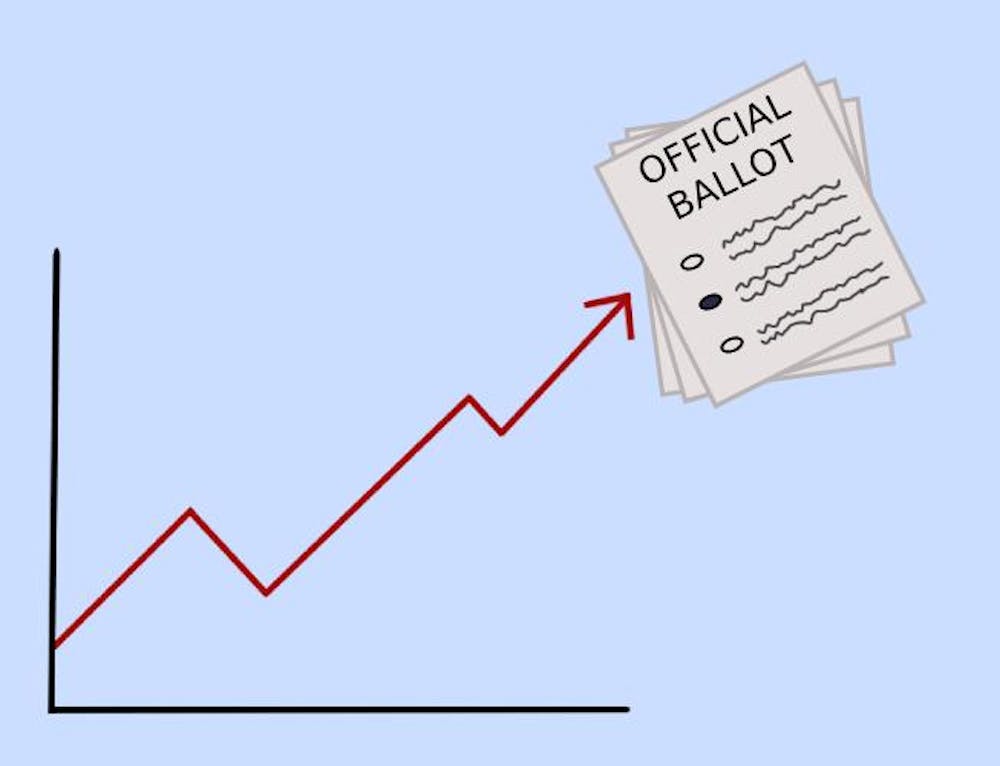
The University’s Spring 2026 student elections drew the largest voter turnout for the Student Council presidential race in recent years, with 6,924 students casting ballots in that election. According to the official results reported Feb. 26, 25.62 percent of the eligible student body cast a vote, and the race resulted in the election of third-year Commerce student Michael Mitchell as Student Council president.
This figure marks a dramatic increase from previous cycles. In 2025, Student Council presidential race turnout was reported at 11.99 percent, a drop from the 2024 cycle’s 17.68 percent and the 2023 cycle’s 19.27 percent. The Student Council presidential race has historically had the highest participation compared to other Spring University Board of Elections races, such as for representatives of student self-governance organizations.
UBE is a student-run Special Status Organization, meaning it acts on behalf of the University to perform certain delegated duties. UBE is responsible for administering the University’s elections, which took place from Feb. 24-26 this year. This year's ballot included races for over 80 positions, which included elections for Student Council executives and representatives, Honor Committee representatives, University Judiciary Committee representatives and School Council positions.
In this year’s Student Council presidential race, Mitchell defeated third-year College student Micah Andrews by a margin of 234 votes, 3,579 to 3,345. He was elected under the ranked-choice system with 51.6 percent of the final vote. The Student Council vice president for administrations and vice president for organizations races garnered slightly less attention, and received votes from 24.61 and 24.67 percent of the student body, respectively.
Abby Nickelson, UBE Chair and fourth-year College student, attributed the increased participation rate in the Student Council elections in part to external factors.
“While UBE strives to raise awareness of student elections through various marketing efforts, we believe that engagement is driven largely by candidates’ platforms, broader University dynamics and national political trends,” Nickelson said.
Beyond Student Council elections for president, VPO and VPA, turnout varied widely across the ballot. Second-year students voted at a rate of 44.61 percent in their class council presidential race, while Frank Batten School of Leadership and Public Policy undergraduates recorded the highest participation of any group on Grounds at 70.85 percent for the Batten Undergraduate Council positions. At the other end of the spectrum, the Graduate Continuing and Professional Studies Student Council representative race drew just 2.95 percent of eligible voters.
This year’s elections were situated within a time of institutional turbulence at the University. Former University President Jim Ryan resigned June 27 under pressure from the Justice Department, Student Council passed a vote of no confidence in the University Board of Visitors in August over concerns that University stakeholders’ voices were not being considered in the search for the next president and the Faculty Senate did the same in July. Gov. Abigail Spanberger (D) requested five Board members to resign and appointed 10 new members Jan. 17. Additionally, just days before voting opened for student elections, 191 faculty members called for the presidential search to restart and the Board elected a rector and vice rector.
Nickelson noted that the absence of referenda, which has driven voter turnout in the past, might have also contributed to concentrated student attention on the elections. Relevant University-wide referenda are typically included in Spring elections, and a referendum is a measure which looks to change some aspect of the University’s organization, by allowing the student body, or specific schools, to vote.
“For the first time in several years, there were no referenda on the ballot. Recent referenda have captured significant student attention — [for example] Honor multi-sanction [and] Apartheid Divest,” Nickelson said. “Thus, the absence of referenda may have focused students’ attention on contested races, particularly the Student Council presidential race.”
According to Nickelson, voter turnout is an important part of the organization’s ongoing work.
“Increasing voter turnout will always remain an essential component of our delegated function within the University, regardless of the benchmark,” Nickelson said. “Our goal each year is to maximize participation through administrative practices that make the election process as accessible and straightforward as possible for both voters and candidates.”
This year’s initiatives included in-person tabling, social media engagement, partnerships with Contracted Independent Organizations on Grounds and partnerships with local businesses, according to Nickleson. She stated that UBE intends to continue the successful programming in future election cycles.
In a statement to The Cavalier Daily, University Spokesperson Bethanie Glover encouraged student engagement with self-governance following the Spring elections.
“The University is firmly committed to student self-governance, which has long been a defining feature of the U.Va. experience,” Glover said. “We’re grateful for the continued work of the University Board of Elections and all their peers in encouraging discussion, driving voter participation and promoting self-governance as students prepare to become the next generation of leaders.”
The Spring elections filled dozens of Student Council, year-specific, school-specific, Honor and UJC positions. Full results, and past year results, are available on the UBE website.

Naren Senthilkumar is a staff writer on the news desk. He is a third-year College student majoring in philosophy and economics.
Read More

Student Technology Council aims to represent students on technological issues
By Solomon Ross-Milligan | 6 hours agoSTC is currently a 20-member council and includes students from across schools and organizations within the University.

Woodruff and Bouie discuss freedom of the press, emphasize need for nonpartisan news
By Robert Head | 6 hours agoAfter an introduction by Jane Kamensky, president and chief executive officer of Monticello, Woodruff answered Bouie’s prompts on topics such as modern threats to the press, the objectivity of the press and Americans’ declining trust in news outlets.
With midterm elections approaching, Miller Center experts share foresight
By Reilly Auld and Luca Bailey | YesterdayThese midterm Congressional elections are generally viewed as an opportunity for voters to evaluate the incumbent President’s performance in their first two years in office.