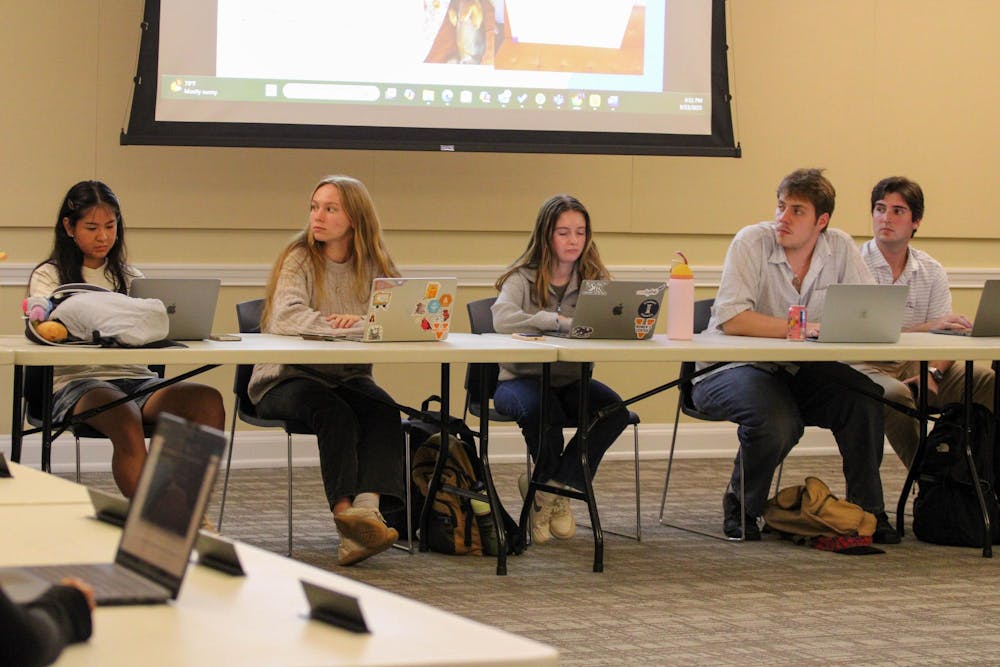
Student Council met Tuesday for their weekly general body meeting and announced that the Executive Board voted prior to the meeting to postpone its leadership transition as the Student Council presidential election remains under review. This choice followed a recent decision by the Judicial Review Board to return an appeal to the University Board of Elections for further consideration. Representatives also passed a bylaw amendment addressing ethics enforcement procedures.
Clay Dickerson, Student Council president and fourth-year College student, announced that the Executive Board had voted earlier that day to delay the transition timeline, pending the final results of the appeal. According to Dickerson, the decision to postpone the transition is intended to ensure the transition timeline does not serve as a factor in the decision-making by either the UBE or the JRB.
“I hope that the UBE is making their decision based off of the facts presented to them, not to a timeline that we have for ourselves,” Dickerson said. “Our transition will be postponed until [the UBE decision is] final, and it's up to the UBE now to do their job.”
Under the Student Council Constitution, the Executive Board has discretion to set the transition date between 30 to 60 days following the conclusion of spring elections. This year, elections took place Feb. 24-26 and the transition ceremony to inaugurate new Council executive members was originally set for Sunday. As the presidential race remains unresolved, the Executive Board moved the transition of the upcoming term to an unspecified date within that window.
Dickerson added that he initiated the vote to postpone the transition indeterminately within the 30- to 60-day timeline. Dickerson, Princess Wuraola Olubuse-Omisore, Student Council vice president for administration and graduate Medicine student, and Imane Akhanous, chair of the representative body and fourth-year College student, voted in favor of the delay. Michael Mitchell, Student Council vice president for organizations and third-year Commerce student, recused himself from the vote to avoid a conflict of interest, given his involvement as Student Council president-elect.
The delay comes amidst a multi-stage appeals process tied to the Student Council presidential election. The case originated from a complaint filed by Micah Andrews, Student Council chief of Support and Access Services, 2026 Student Council presidential candidate and third-year College student, before election results had been certified. UBE initially ruled that no violation had occurred — a decision that was subsequently appealed by Andrews.
During the general body meeting, Benvin Lozada, Student Council chair of the Rules and Ethics Board and Law and doctoral student, provided a brief overview of the case, explaining that the presidential election complaint is currently under reconsideration by the UBE after being returned by the JRB. This follows the JRB’s determination that the UBE had not performed a thorough enough investigation to determine no violations had occurred during the presidential election. The UBE now has until Friday to develop the factual record based on additional evidence parties submit.
Lozada added that, under his current interpretation of the Constitution, all Student Council officers and current Student Council representatives will remain in their roles until a final decision is reached regarding the UBE investigation or 60 days after the end of spring elections — whichever of these comes first.
The postponement prompted concern among representatives about continuity of the upcoming term. Ian Travis, Student Council chair of community concerns and third-year College student, questioned whether the legislative body could transition independently of the Executive Board, citing frustration with delays and uncertainty for representatives. Travis raised the possibility of separating the transition timelines through a bylaw change, arguing that representatives had been elected, certified and should be able to assume office independently.
Based on the Student Council Constitution, Lozada noted that the document refers to the “term of office” in the singular — which he said suggests that the governing documents contemplate a single, unified transition rather than separate timelines for different parts of the organization.
Dickerson said he believes the transition should happen collectively rather than in separate stages for different parts of Student Council, emphasizing the importance of unity as the transition process continues to unfold.
“I think transitioning as an entire organization … is what we need to do. We are stronger together, not divided,” Dickerson said. “Our powers in each other become more powerful because we are together, because we are united.”
Student Council will continue normal operations as the appeals process continues. According to both Lozada and Dickerson, the Executive Board has deferred the transition to occur either upon the upcoming UBE decision or at the end of the 60-day period. Dickerson said that the transition delay should not go beyond 60 days, as UBE must collect further evidence by the March 27 deadline.
In addition to the postponement, representatives passed an amendment to the Student Council bylaws that would change how alleged violations of the Code of Ethics are handled. The amendment — which was tabled during the last Student Council general body meeting — would require filed complaints to be formally reviewed by the Rules and Ethics Board before suspension, rather than triggering automatic suspension upon the discovery of a violation. The Board would then review the case and any suspension must be recommended by the Chair and approved by a majority vote of the Board.
Before voting on the amendment, representatives raised concerns about consistency and fairness in how violations are handled. Brian Ng, Student Council representative and third-year College student, questioned whether Student Council should vote in favor of the amendment. He pointed to the Honor Committee’s system where individuals facing allegations are often temporarily removed from their roles to avoid conflicts of interest, even while presumed innocent.
In response, Andrews said that the current bylaw discourages individuals from coming forward with potential violations of Student Council’s bylaws. Andrews explained that under these existing rules, because she raised concerns about violations made by Mitchell during the endorsement and campaigning processes of the presidential election, the only immediate remedy would have been removing Mitchell from office. She said that this consequence can create hesitation in reporting violations — especially when personal relationships are involved.
“I think it makes people scared to bring forth information that might be violations of the bylaws,” Andrews said. “[This amendment] only changes [the bylaws] so that you can bring forth a formal complaint, and then the Rules and Ethics Board can decide to remove somebody.”
Several members acknowledged that while the intent of the amendment would improve clarity and fairness, the amendment’s introduction amid the ongoing election dispute could raise concerns about optics. Graduate Batten Rep. Jack Malo said that he received constituent feedback about the timing of the amendment and said that it may be more productive to wait until the leadership transition has occurred.
While expressing support for the amendment’s intent, Malo added that now may not be the right time for the passage of the amendment, suggesting that Student Council wait until after the leadership transition.
Lozada noted that situations involving the interpretation and enforcement of bylaws — such as potential removal from office — are uncommon but require careful deliberation. He said that even if the impacts of these amendments are not always immediate, it is important to make the correct decisions.
“When you're faced with a situation where you're not quite sure what to do [and] when decisions do have a really significant magnitude, clarity in the governing documents is what allows us to function and what allows us to come to a resolution that people … can understand,” Lozada said.
Lozada added that Student Council has established mechanisms to revise its governing documents. He pointed to the Constitution and Bylaws Review Committee — a body tasked with evaluating Student Council’s governing documents and recommending changes — and noted that it has not convened in several years. He encouraged representatives interested in structural changes to pursue revisions through the existing structure moving forward.
The proposed bylaw amendment passed 25-0 amongst representatives with one abstention.
Lozada said Student Council will likely reconvene Tuesday at 6:30 p.m. for a regularly scheduled general body meeting.

Jaylynn Perez is a third-year College student from Chesapeake, Va., majoring in government and Public Policy and Leadership. She currently serves as a news senior writer and video staffer, after previously serving as senior associate editor for the news desk. She enjoys covering topics such as University governance and local politics.
Read More
Jefferson Trust awards $812,064 in Fall Major Cycle Grants
By Charlotte Gabriel | 15 hours agoThe Jefferson Trust awards both Flash Grants and Major Cycle Grants on a monthly and biannual basis, respectively.
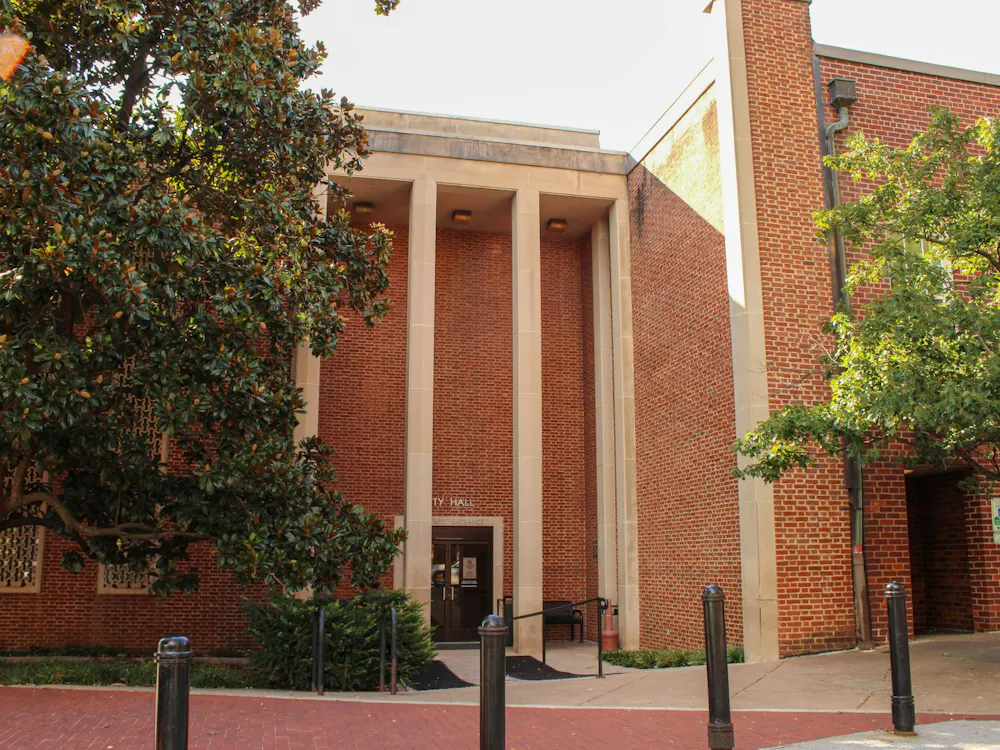
At City Council meeting, staff preview snow removal efforts for anticipated winter weather
By Luca Bailey | 15 hours agoThey also heard from a Charlottesville community member who argued for the importance of large-scale development by-right, received updates on the new emergency homeless shelter at 2000 Holiday Drive and invested in several new affordable housing projects.
From the Archives: Fashion on Grounds
By CD Archive Staff | 16 hours agoMerchants found that many students also opt to blend traditional, preppy basics with punk elements.