From reclaiming the power of boredom to embracing aging in the marketplace, this year’s TEDxU.Va. Spring 2026 Professional Speakers Conference took place in Newcomb Theater Sunday at 2 p.m. For over two hours, around 100 attendees from the University and Charlottesville community listened to eight speakers who explored the theme of “UNBOUND,” highlighting the importance of dismantling self-imposed boundaries and exploring uncharted paths.
Founded in 2013, TEDxU.Va. is one of thousands of independent TEDx events held worldwide each year. Traditionally, TEDxU.Va. hosts a Student Speaker Conference each fall and a Professional Speaker Conference each spring, but Ella Murphy, President of TEDxU.Va. and fourth-year Architecture student, had something different in mind. While she remains committed to TEDxU.Va.’s mission, she decided to take logistical challenges into account.
“[Having] two conferences a year is the worst ever, because [of] the logistical things that you have to go through for months,” Murphy said. “They require so much planning.”
Instead, Murphy decided to focus her team’s energy on perfecting one sole conference this year. A TEDx enthusiast who has seen real change in her social and academic life after she viewed Brené Brown’s “The Power of Vulnerability,” Murphy applauded the power of speaker events and aimed to maximize impact by making the Spring Conference the best that it could be.
Reeya Verma, TEDxU.Va.’s curator and fourth-year College student, created a lineup that included one student speaker and seven professionals, all of whom are affiliated with the University as faculty or graduates.
Adam Cohn, a 2007 Engineering and Commerce graduate and Executive Vice President and Chief Financial Officer for CNN Worldwide, reflected on how his non-linear academic and career path has taught him the value of unusual experiences. After earning a bachelor’s degree in mechanical engineering, Cohn worked at J.P. Morgan and HBO before taking on his current position at CNN. Cohn argued that to be “unbound” often requires intentionally saying ‘yes’ to the unusual and leaning into the awkwardness that comes with trying something new.
“Break from your routine,” Cohn said. “It doesn’t matter what this looks like, big or small. It doesn’t matter whether you start and stop. The idea is to get comfortable with being uncomfortable.”
This theme of breaking away from a settled space was echoed by Paul Vann, a 2023 Engineering graduate. Vann decided to reshape his artificial intelligence startup, Validia, after realizing the demand for deepfake detection, the technology his company specialized in, was lower than anticipated, as it was not used as widely as forecasted. Now, Validia focuses on the larger issue of AI security. Drawing on his experiences, Vann reframed the idea of a pivot as a necessary act of growth rather than a failure, suggesting that clinging to a dead idea is the true mistake.
“A pivot can oftentimes be interpreted as failure, as ‘we failed at this one thing, and now we’re going to go do something else,’” Vann said. “I actually like to think it’s different than that. I’d like to say that a pivot is more like paying attention.”
Fourth-year Commerce student Peter Mildrew attended the event, and found Vann’s talk especially relevant. Like Vann was just a few years ago, Mildrew said he is standing at the proverbial career ‘fork in the road.’ According to Mildrew, while he continues to consider his planned career in digital marketing post-graduation, the profound personal growth he witnessed in a close friend’s service journey has also inspired him to consider whether a less-traditional path might be right for him.
“[I’m] deciding … whether to stick with my original plan or pursue something that feels more aligned,” Mildrew said in an email statement to The Cavalier Daily.
While Vann spoke to the internal mindset required to pivot, Rajan Chidambaram, speaker and 2025 Commerce graduate, addressed the external fear that often keeps people bound to their comfort zones — the fear of looking “cringe.” After creating a successful shoe-selling business and earning a bachelor of science in Commerce, Chidambaram became a co-founder of Royal Oak Retreat, a development property for luxury short term rentals. Throughout the whole process, Chidambaram has taken to documenting his life and real estate experiences through social media.
“[Many people] have an idea, they have something that they want to do,” Chidambaram said. “But they’re held back, not because they don’t know how to do it, but [because] they’re scared about what other people are going to think.”
Chidambaram argued, however, that the concept of “cringe” is an essential ingredient in success. Drawing on his experience as a content creator and an up-and-coming rental business owner, Chidambaram shared how braving the fear of external perception has allowed him to find mastery and authenticity.
“I just kept wobbling and I kept documenting the [real estate] journey from start to finish,” Chidambaram said. “And what happened? Those tricks turned into a show that millions of people watched. I couldn't believe it. At one point, we had 100 million people in one month watch our cabin [being constructed] and ... we had an Airbnb that was fully booked out.”
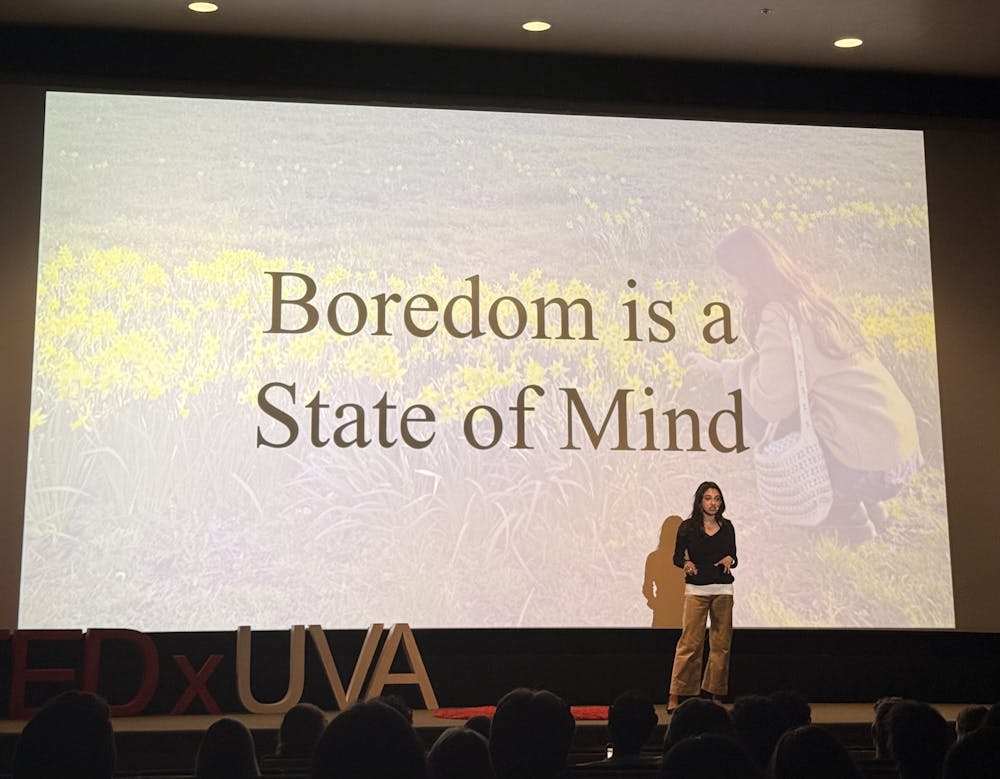
Diya Gupta, fourth-year Commerce and College student, was selected as the sole student speaker after an audition process in the fall. Gupta proposed boredom as another route to authenticity, and spoke on the necessity of reclaiming boredom, suggesting that society’s constant need for digital stimulation keeps minds bound and stifles creativity. Spending her childhood summers tech-free in Sundar Nagar, a small town in India, Gupta has seen how boredom has shaped her into a creative and innovative thinker.
“[I want] to reshape what that word [boredom] means and to highlight the fact that it can be something that’s positive,” Gupta said. “You should be encouraged to let yourself be bored and let yourself have this time with yourself where you’re not stimulated … and to make an active effort to be present and be able to engage with creativity.”
Other speakers demonstrated the impact of these ideas in modern communities. Erin Clabough, Professor of Psychology at the University, and Christine Gyovai, Principal of Dialogue + Design Associates and 2005 masters of arts in Urban and Environment planning graduate, both addressed one’s inability to sit alone in silence and reframe discomfort as a gateway to personal transformation.
Clabough highlighted the lengths to which individuals will go to avoid being subject to their own thoughts. Gyovai urged the audience to utilize the RAIN technique — Recognize, Allow, Investigate and Nurture — to better understand oneself and change how one responds to the world around them. This internal work of understanding one’s own triggers and responses often serves as the necessary foundation for professional resilience, according to Gyovai.
Applying this growth mindset to entrepreneurship, Joseph Linzon, co-founder of Roots Natural Kitchen and Corner Juice and 2015 Commerce graduate, emphasized that the path to success, far from being linear, requires a willingness to view setbacks as the foundation for future projects. He also shared his belief that the food industry must be rooted in health and accessibility.
“One of my businesses that failed taught me a lot,” Linzon said in an interview with The Cavalier Daily. “It was a shoe company that actually didn’t end up working at all. But from that, I learned how to start a business, how to create an LLC, how to raise money, how to pitch a business, how to create a business plan. So even though it didn’t work, it was an invaluable learning lesson.”
Multiple speakers emphasized that true innovation also requires entrepreneurs to understand the needs of those their businesses are designed to serve. While Linzon focused on serving the Charlottesville community, Abby Mandell, the Director of the Galant Center for Innovation and Entrepreneurship at the McIntire School of Commerce, advocated for a much larger, overlooked segment of the population. She pointed out that the market currently favors products designed for younger consumers and advocated for innovation and product design suited to the needs of older adults.
“How we think about aging tells us a lot about how we think about living,” Mandell said. “Why do we design products for 28-year-olds and not older adults? Is it because, on some fundamental level, we find older adults not worthwhile, that we associate productivity and output with worth? I think that in doing so, we not only ignore more than half of the global marketplace, but we diminish our own humanity.”
Mandell’s call for society to reclaim humanity through inclusive design was a powerful reminder that innovation is most effective when rooted in empathy. The purpose of entrepreneurship, according to Mandell, is not just profit, but to design a future that people want to grow old in.
While Mandell’s perspective is distinct in its focus on aging, it complemented the event’s broader exploration of resilience and growth. Mandell’s emphasis on empathetic design mirrors the internal work advocated by Clabough and Gyovai, while her determination to view aging in a positive light echoes the mindsets of Vann and Linzon — who both reframed apparent failures as necessary for growth.
The interaction between these seemingly disparate topics transformed a series of individual talks into a unified narrative, speaking to TEDxU.Va.’s ability to channel the wisdom of speakers from different professional and academic experiences on Grounds into a singular vision.
“The diversity of voices really stood out this year,” Mildrew said after the event. “A one-word theme can sometimes make an event feel either disjointed or overly forced, but TEDxU.Va. managed to draw a clear common thread across very distinct talks. It’s not every day you hear from professors, the CFO of CNN Worldwide and a fellow student in the same program and have it all feel cohesive.”

Astrid Cheng is a senior writer on the life desk. She is a second-year College student, majoring in English and cognitive science. She enjoys covering University events and writing the occasional column. Outside of The Cavalier Daily, Astrid is involved in the Honor Committee, Humanitas Journal of Human Rights and Epsilon Eta.
Read More

Bebe Stockwell’s sunny disposition shined at The Southern
By CC West | 4 days agoFor the third show of her first headlined tour, Bebe Stockwell graced The Southern Café and Music Hall Saturday with her upbeat attitude and optimistic lyricism.

Delicious on a dime: Charlottesville’s best restaurant deals
By Lucy Larsen | 5 days agoFrom wraps and wings on the Corner to imported wine and tapas on the Downtown Mall, these are the perfect spots to treat both your taste buds and your wallet for under $25.

Play the organ
By Elizabeth Adams | September 25, 2026The college side quest does not need to be the multi-semester jaunt that my organ adventure has become, and it certainly doesn’t have to make sense.