Drinking tea is one of the most common practices in the world, with Americans alone consuming 3.9 billion gallons in 2021. With instant tea bags and cafe matcha lattes becoming more prevalent around the world, it can be easy to forget the cultural significance that tea drinking has in the ease and convenience that these products provide. The Fralin Museum of Art’s latest exhibition, entitled “Crafted for Tea: Connecting Cultures with Teaware and Traditions,” highlights the skill, artistry and history behind the making of this common drink.
“Crafted for Tea,” which opened Feb. 7, was curated by graduate Architecture student Catherine Fan. Fan said she was inspired to curate this collection from a program funded by a grant from the Center for Global Inquiry and Innovation at the University called “Global Tea Culture & Science: Current Research,” organized by Art Prof. Dorothy Wong.
“The idea for an exhibition about tea was initially proposed in conjunction with a larger academic program on Grounds,” Fan said. “I was inspired by the conference program and the wide range of scholarly topics represented, including teapots, tea architecture and tea production.”
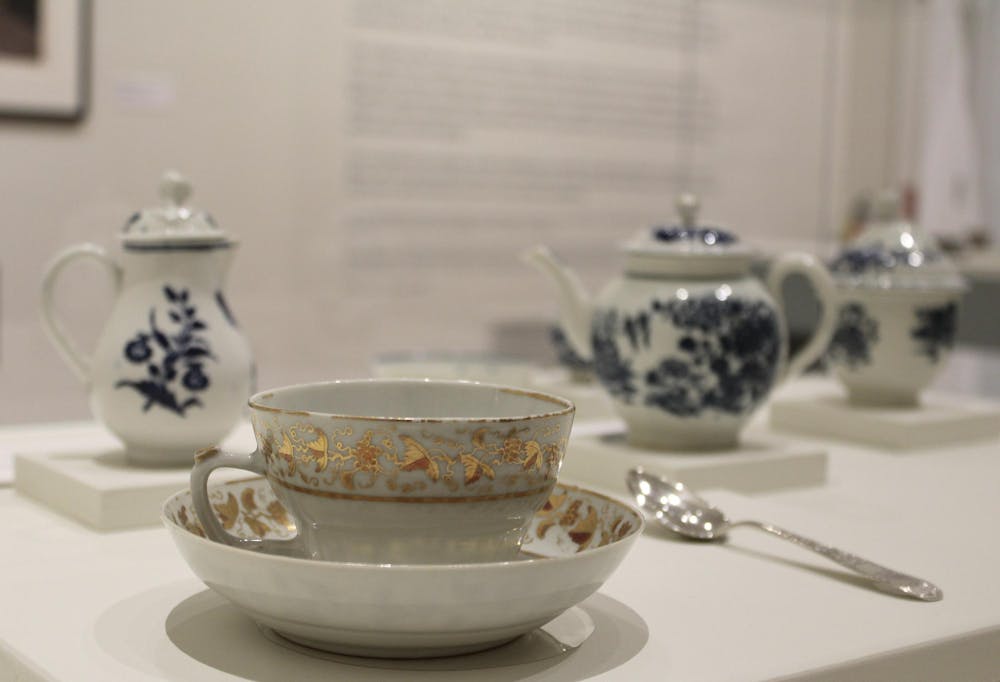
The chief focus of “Crafted for Tea” is the role of tea making and consumption in society. The exhibition explores how the importance of tea has remained consistent across countries, from China and Japan to Great Britain and the United States. One display shows teaware created by the Royal Worcester porcelain factory in Worcester, England, which adapts the iconic blue-and-white design of Chinese porcelain with imagery such as roses and fences. In another display, Yixing teapots — unglazed stoneware from Jiangsu, China — are contrasted with English teapots that emulate the Yixing style while also including ancient Egyptian motifs. Through this juxtaposition, “Crafted for Tea” shows how teaware can illustrate cultural and historical similarities despite geographic distances.
Juxtaposition is also used to explore tea’s importance across social classes and hierarchies. A wood print by Utagawa Hiroshige, made in Tokyo cica 1833-1834, depicts travelers stopping at an unassuming roadside teahouse. Next to it, an ornate spherical jar by Okamoto Ryozan, made in Kyoto in the 19th century, depicts aristocrats enjoying tea while lounging in a garden. The exhibition exemplifies the idea that, despite their differences, people of all classes are still connected by tea.
“This exhibition presents how diverse tea cultures are — across regions, time periods and social settings,” Fan said. “It also highlights tea as a cultural and social practice that can foster hospitality and connection, while also revealing hierarchy.”
Beyond the cultural and historical contexts of the art, the exhibit also showcases the artistry of teaware itself. Several objects in the exhibition show how the color, shape and material of teaware can affect the tea drinking process and convey ideas about how the tea should be consumed. A porcelain cup adorned with plum blossoms evokes the image of spring, and its small shape allows the drinker to focus on each sip. By contrast, an all-black Raku tea bowl by Raku Sonyū in 1700 is meant to instill tranquility within the drinker through its simple design, according to the section’s accompanying label.
Later works in the exhibition distort the conventions of teaware, expanding the medium beyond traditional ideas of teapots and teacups. A teapot called “Fossil Teapot,” created by Virginia ceramic artist Michelle Erickson, consists of a gasoline pump fused with a skull, comparing the pouring of tea to the extraction of fossil fuels. Despite its unusual form, the piece is still a teapot, and it represents how teaware can be used as a form of artistic expression.
The process of making tea itself requires labor, and “Crafted for Tea” highlights the oft underrepresented laborers that create both tea and teaware. An 1879 Virginia housekeeping manual by Marion Cabell Tyree displays recipes for several forms of tea, and a panel on the side mentions the African American cooks whose work in formulating the recipes was often taken without acknowledgement. Similarly, despite depicting a scene thousands of miles away, two Japanese paintings depict women working in a teahouse, showcasing the history and ceremony of Japanese tea drinking. Another display features both a Chinese tea bowl from the 1700s and a modern abstract teacup, accompanied by a label explaining the craftsmanship involved in creating porcelain teaware. With these items, the exhibition highlights the effort involved in the making of tea — effort that is often taken for granted.
According to Fan, curating the exhibition was a laborious process, one that involved countless hours of finding and selecting artifacts from around the world. Fan, who worked with the Fralin through its Barringer-Lindner Curatorial Fellowship, pulled from the museum’s collection, sorting through objects related to tea making and consumption. Fan recalled the setbacks she faced when creating “Crafted for Tea,” and the evolution the exhibit went through during the curation process.
“Curating an exhibition involves a great deal of decision-making and negotiating within practical limitations,” Fan said. “Sometimes, you discover more surprising materials than anticipated … At other times, there are last-minute decisions to add or remove objects.”
However, Fan did not select all of the objects in the exhibition from the Fralin’s permanent collections. Several objects on display are on loan from other Virginia museums, such as the Virginia Museum of Fine Arts in Richmond and the Museums at Washington and Lee University. Fan talked about how, with access to a greater number of items, she was able to better showcase certain themes in the exhibit. This theme was especially prominent in a gallery that directly compared teapots from the Fralin to those loaned from other museums.
“That case would not have been as visually and conceptually compelling without the contributions from each institution,” Fan said. “For me, this process really highlights the collaborative nature of museum work and the value of partnerships across collections and curatorial teams.”
Ultimately, “Crafted for Tea” underscores the significant role that tea has had in society, both historically and culturally. It demonstrates how tea has served as a bridge between worlds, and how the same product can illustrate the similarities and differences between people through shared practices and traditions. Fan said she hopes that this exhibition will inspire visitors to think more carefully about their consumption of tea, no matter what context it is in.
“I hope that the next time visitors enjoy a tea moment — whether it’s a more formal tea service or even boba — they’ll see their own experience as part of a much larger story, shaped by histories of making, exchange and human relationships around tea,” Fan said.
The exhibition will be on display at the Fralin Museum of Art until May 31.
Read More

A&E Book Club: Three books to turn back time before summer slips away
By Preet Manukonda | 2 days agoWhile time travel is still out of reach for humankind, these books offer their own imaginative spins on the concept, inviting readers to consider what could be possible if they had a little more time before the summer season fades into fall.

‘Tony’ sincerely builds an unlikable Anthony Bourdain worth rooting for
By Cecilia Sherman | August 16, 2026“Tony” is a tasteful standout that gracefully foreshadows Bourdain’s complicated life of adventure and discovery.

On Repeat: Nostalgic songs to celebrate the waning of summer
By Kelsey McIntyre | August 11, 2026With less than a month until students return to Grounds, this soundtrack can be used to rest and relax before the stressful semester by reminiscing on familiar times.