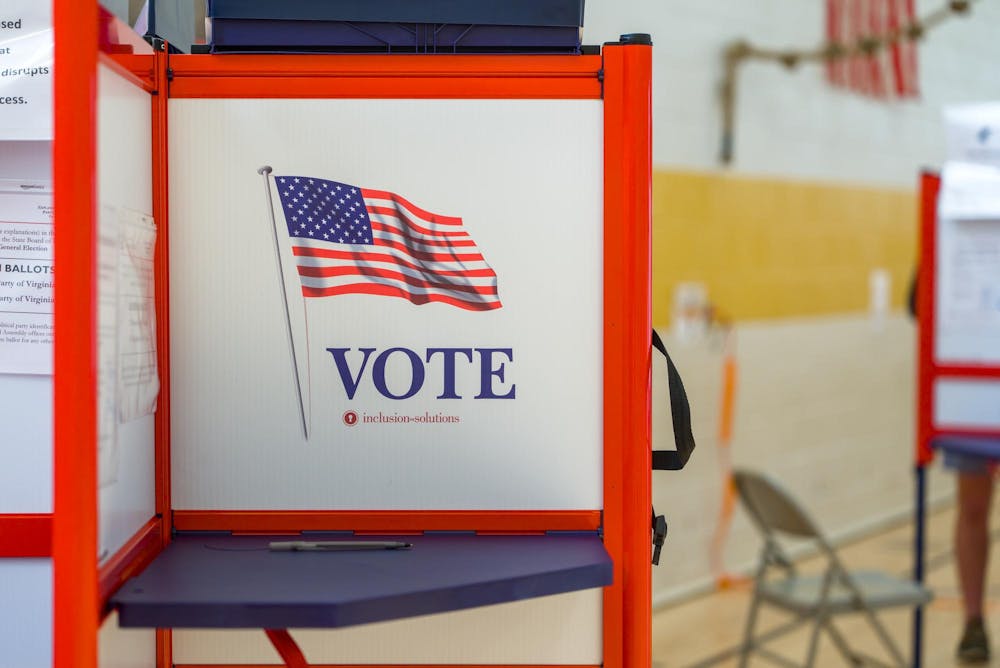
On April 21, Virginia will become the latest state to consider a measure to redraw its congressional district in the middle of the typical decade-long redistricting cycle. The referendum, supported by the Democratic-controlled Virginia General Assembly and Gov. Abigail Spanberger (D), follows on the heels of other states either attempting to redraw or actually redrawing their district maps. States such as Texas, California, Missouri, North Carolina and Ohio have already redrawn their maps, while others have initiated the process to do so. By no means has this been a smooth process, either. Rather than this issue producing a reasoned, democratic discussion on the merits and drawbacks of mid-decade redistricting, voters have been inundated with hyperpartisan language that sometimes intentionally misrepresents the redistricting issue. This environment of invective is unproductive and risks simplifying an issue of grave consequence for Virginia’s political influence.
The amendment Virginians will vote on purports to “restore fairness in the upcoming elections” by bypassing the non-partisan Virginia Redistricting Commission established in 2020. The General Assembly would be permitted to redraw Virginia’s congressional map in the event any other state redraws its own map for reasons other than the typical decennial redistricting process. Authority to redistrict would revert to the VRC Oct. 31, 2030. Though the language is simple enough, the legal environment surrounding debate on the amendment has been anything but. Multiple Virginia courts have considered whether the amendment may legally appear on the ballot and have ruled differently. Currently, the Virginia Supreme Court is allowing the amendment to appear on the ballot, but is scheduled to ultimately rule on the legality of the measure after the vote.
This amendment would bypass a VRC established by wide, bipartisan majorities in the General Assembly. Though such a reversal is temporary, the initial bipartisanship in establishing the VRC requires that any measure to bypass it is preceded by serious discourse. Unfortunately, it is clear that neither side of the redistricting issue is interested in any such dialogue.
Activists urging voters to reject the amendment have misleadingly used past statements of Democratic politicians to insinuate they do not support the current ballot measure. Figures such as former President Barack Obama and Spanberger have appeared on campaign material opposing the amendment alongside their past statements condemning gerrymandering in general. These materials, however, are not merely claiming to point out the hypocrisy of Democratic politicians. Rather, they are intentionally designed to convince voters that these Democratic politicians have spoken out against the proposed amendment. Specifically highlighting past statements of politicians is a legitimate debate method, but only when campaigners are honest in doing so. Intentionally trying to deceive voters, on the other hand, must be condemned as a pathetic method of democratic discourse.
Proponents of the amendment have not demonstrated that they are any more committed to a reasoned discussion of the measure. Spanberger has refused to debate former Virginia Gov. George Allen on the redistricting measure despite her own views on the subject being anything but consistent. Indeed, Spanberger’s own party has furnished an example of the sort of reasoned debate that should precede voting on the amendment — Delegate Marcus Simon and Democratic voting rights activist Brian Cannon participated in a debate on the redistricting measure April 2 at William & Mary, with Simon supporting the amendment and Cannon opposing. This event demonstrates that Virginians can and should expect more of their governor, exhorting her to critically engage with the hefty political issues of the day.
This need for informative debate, moreover, is heightened due to the method by which the amendment would be enacted. Unlike states such as Texas, Virginia’s maps will only be changed after its citizens directly weigh in on the matter — a procedure necessitating that voters be properly informed on the amendment they will be voting on. Yet, so far, debate on the issue has simplified the issue to one of pure partisanship, attempting to sort voters into political camps rather than encouraging them to debate the issue on its own merits.
Unlike the normal legislative process, however, this referendum gives every Virginian a direct voice on their state’s destiny. This political reality necessitates a clear, open dialogue on the arguments for and against the redistricting amendment, in contrast to the cloudy, hyperpartisan rhetoric that has so far been provided. Instead of being presorted by party affiliation, voters must look past the purely partisan rhetoric being peddled. Grappling with these prickly issues individually — though perhaps uncomfortable — is essential to ensuring the result is not merely the product of the loudest voice.
Virginians are presented with a unique opportunity to exercise their voice on state policy directly rather than through their representatives. With this opportunity, however, comes the responsibility to be well-informed on the matter at hand. This responsibility covers not just that of voters to research for themselves the merits of the redistricting amendment, but also for political pundits and elites to provide an environment in which voters can conduct such research. If done right, Virginia can stand as an exemplar of civil discourse even on the thorniest of issues. Yet, with time running out to correct the currently-deficient political discussion, activists must start faithfully engaging on the issue lest Virginia become the next state to fall into the trap of hyperpartisanship.
The Cavalier Daily Editorial Board is composed of the Executive Editor, the Editor-in-Chief, the two Opinion Editors, two Senior Associates and an Opinion Columnist. The board can be reached at eb@cavalierdaily.com.
Read More

ELJAZZAR: Do not be fooled by the Vanderbilt Report
By Farah Eljazzar | 20 hours agoA report chaired by a philosopher that aims to invoke objective inquiry is hypocritically holding itself to a lower evidentiary standard than it criticizes.

GARVIE: Fighting the sustainability fight requires an army
By Adeline Garvie | YesterdayIn order for these students’ sustainability actions to reach a broader sphere of attention, green practices need to be encouraged and attainable, both of which can be achieved with increased advocacy.

HASNAIN: Virginia must be for all lovers
By Zehra Hasnain | 2 days agoAccording to various bumper stickers, t-shirts and other state gift-shop paraphernalia, Virginia is for lovers — yet the state constitution begs to differ.