The School of Nursing is changing its curriculum beginning this August, according to Sara Hallowell, associate dean of undergraduate nursing programs. Required clinical hours — time spent in real healthcare settings — are set to decrease from 700 to 658, a 6 percent decrease. Simulation lab hours — time spent in a controlled environment where healthcare situations are simulated — are set to increase from 84 to 105, or a 25 percent increase. The change will impact current second-year Nursing students, first-year Nursing students and future classes.
Hallowell said that the School of Nursing builds its curriculum around three key areas of study — didactic learning in the classroom, lab-based skills development and clinical learning. She emphasized that the future changes will not change the overall structure of the program, but rather the distribution of credit hours.
According to Hallowell, the School of Nursing made the change based on a national trend in nursing education to ensure that upon graduation, nurses are “practice-ready” with skills to deal with a range of clinical circumstances. Nursing students at the University have expressed mixed reactions to the curriculum change.
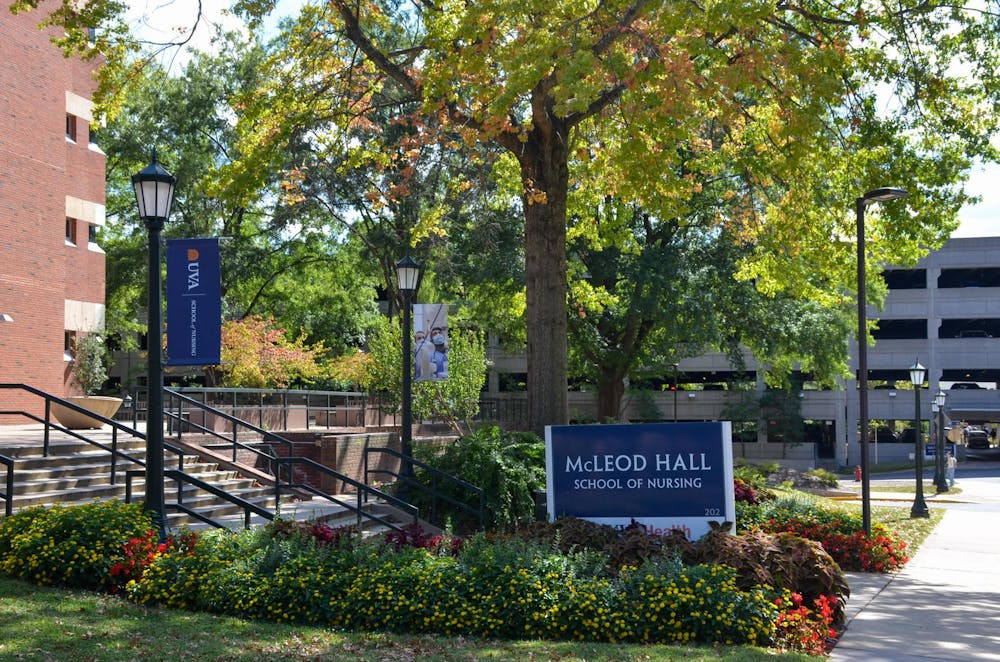
Hallowell said that at the University’s simulation lab, which is located in McLeod Hall, hours consist of simulations with patient actors and high-fidelity mannequins that can exhibit patient symptoms and events such as childbirth. On the other hand, clinical hours are supervised hands-on training experiences in different real world healthcare settings, such as pediatrics, psychology or labor and delivery. Significant time spent in both settings is mandated by the Commonwealth for pre-licensure Bachelor of Science in Nursing programs.
School of Nursing Dean Marianne Baernholdt explained that in the lab setting, the staff can control the simulation mannequins to demonstrate whatever healthcare situation they need, and she contrasted this ability with clinical hours that she said can sometimes be uneventful.
“If you go into labor and delivery [clinical hours], you may never see a delivery, because there was nobody that went into labor while you were there for those eight hours,” Baernholdt said. “Versus if you do things in the simulation lab … you will, because that's what it's all about.”
According to Hallowell, the curricular changes are based on a national shift in nursing education to a more competency-based education over purely hours in healthcare settings. Hallowell explained that this national shift has occurred across healthcare, in areas such as medical education and physical therapy, and is in response to a healthcare trend in which the patients that are cared for in hospitals are more complexly sick than ever before. She said that because a greater degree of at-home care is now possible, if patients are in the hospital, they are so sick that they can only be cared for in a hospital setting.
Baernholdt said that the decision to add more simulation lab hours to the curriculum was made in part to better provide opportunities for students to be able to learn to care for these complexly ill patients.
“Today, most [patients] in acute care settings, they are really, really sick. So when you come out [of nursing school], you have to be able to have basic knowledge,” Baernholdt said. “Because you can take a licensure exam … that's your knowledge base, but in terms of the actual skills, that's the competency piece.”
Some students have said they are concerned about losing the “real life” exposure of clinical hours, and others have said that they appreciate that the simulation lab provides consistent opportunities for practice.
A second-year Nursing student, who wished to remain anonymous because she criticized the school, echoed Baernholdt’s sentiment about some clinical placements being uneventful, specifically citing the labor and delivery placement as an example. She said she appreciates that it is guaranteed in the simulation lab that a mannequin will “give birth.” However, the Nursing student said that the uneventful labor and delivery rotation is the exception, not the rule. She said that Nursing students consider other rotations to be much more active and allow for students to come into contact with more clinical settings, including “medical-surgical” and pediatrics.
A third-year Nursing student who also preferred to remain anonymous for the same reason as the second-year student, said that she believed one of the appeals of the University’s nursing program is the higher number of clinical hours in the curriculum — which is currently 700 hours — as compared to programs at other schools. She said she believed this higher amount of hours helps students get jobs after graduating and gain more exposure to the “real-world” and specialty areas of nursing.
Hallowell said that the Virginia Board of Nursing mandates 500 direct patient care hours over the course of the degree, and that even in the new planned distribution, the School of Nursing will exceed that mandate by approximately 31 percent.
Hallowell also emphasized the dual importance of clinical hours and lab time as critical parts of the curriculum. She said that competency could be built in ways other than in clinical hours.
“Clinical hours are clearly an essential part of nursing education. They provide real-world experience for our students,” Hallowell said. “At the same time, we know that quantity of hours does not necessarily equal quality and does not ensure readiness to practice.”
The third-year Nursing student also said she was surprised that the School of Nursing had not officially informed the students of the planned changes. She said that she and others first found out about the changes from looking at the “plans of study” page on the School of Nursing website, where they noticed the amount of clinical hours required for the class of 2028 are now fewer than for the classes of 2026 and 2027.
The third-year Nursing student said that in her experience, nursing students who have heard of the news have largely not been happy to hear about a decrease in hours — students have especially expressed discontent if decreases occur in specialties in which nursing students are most interested in gaining experience.
Hallowell said that changes to clinical hours have been made across the board to a variety of placements, with no particular specialty areas being targeted. The curriculum requirement for clinical hours can be split across various specialties, including medical-surgical, pediatrics, obstetrics/labor and delivery, community/public health and psychiatric-mental health.
The third-year Nursing student discussed the general excitement among nursing students to participate in clinicals and to interact with patients in a real-life setting. She said clinical hours allow students to gain both practical skills and hone patient communication.
“Everybody is so excited to be there [getting clinical experience],” the third-year Nursing student said. “It's the perfect opportunity to … learn what life is like in the real world on a unit, and get to practice … hands on skills, both physically … and also your … ‘soft nursing skills’ of patient communication and getting comfortable having difficult conversations.”
The second-year Nursing student described a similar conviction about the importance of clinical hours in building confidence in interacting with patients. She emphasized her belief that the confidence built in clinicals is especially important in helping nurses navigate their first year working post-graduation — a time she said she has heard is incredibly difficult.
“That first year [working after college] … it's a really big learning curve, it's really important to have … a baseline level of some confidence in your ability to interact with real patients … before you go out into the real world,” the second-year Nursing student said.
The second-year Nursing student explained that because of her belief that simulation lab hours do not necessarily translate to confidence in performing technical skills on patients, she would like the curriculum to include more clinical hours and fewer simulation lab hours. She said that the 6 percent decrease in clinical hours does not concern her as much as the 25 percent increase in simulation lab hours. She said that in her experience, her Nursing student peers express more excitement for clinical hours, and more boredom over time spent in the simulation lab.
“People generally don't love [simulation] lab … it's long and it's just one room and you have to wait for everybody in your clinical group to go, and there's a lot of sitting,” the second-year Nursing student said. “[Simulation] lab gets [boring] because it's a lot of watching other people.”
A different second-year Nursing student, who wished to remain anonymous for the same reason as the first two students, provided a contrasting perspective on the simulation lab requirement, saying that the required simulation hours provided foundational experience. However, this student still expressed a similar appreciation for the unique practice acquired from clinical hours.
“I think nursing students like lab simulations because it builds those foundational skills. There's … always open lab times, which are really great for reinforcing practice and building confidence,” the other second-year Nursing student said. “But … across the board, everyone agrees that being in the hospital is … a whole new field … there's so many things that we've seen inside of the hospital that we never would have imagined.”
Changes to the curriculum will be implemented this August, and the current second-year Nursing class will be the first class to experience these changes.

Abigail Larkin is a staff writer on the news desk. She is a third-year student in the Batten School of Public Policy, majoring in public policy and foreign affairs. Abigail is from Norfolk, Va., and she enjoys writing about state and national politics.
Read More

U.Va. reports increases in rape, aggravated assault and liquor law violations in 2025
By Jaylynn Perez | 12 hours agoThe report has been published annually since 1991 under the federal Jeanne Clery Campus Safety Act.

Yael Grushka-Cockayne discusses artificial intelligence and future of business education
By Jaylynn Perez | 14 hours agoThe webinar — titled “Why Darden? Our Next Chapter” — brought together prospective, admitted and deferred students across Darden’s Master of Business Administration programs.

At rare three-way meeting, City, County and University officials discuss regional coordination
By Luca Bailey | YesterdayThe meeting also gave City, County and University officials an opportunity to discuss areas of mutual concern.