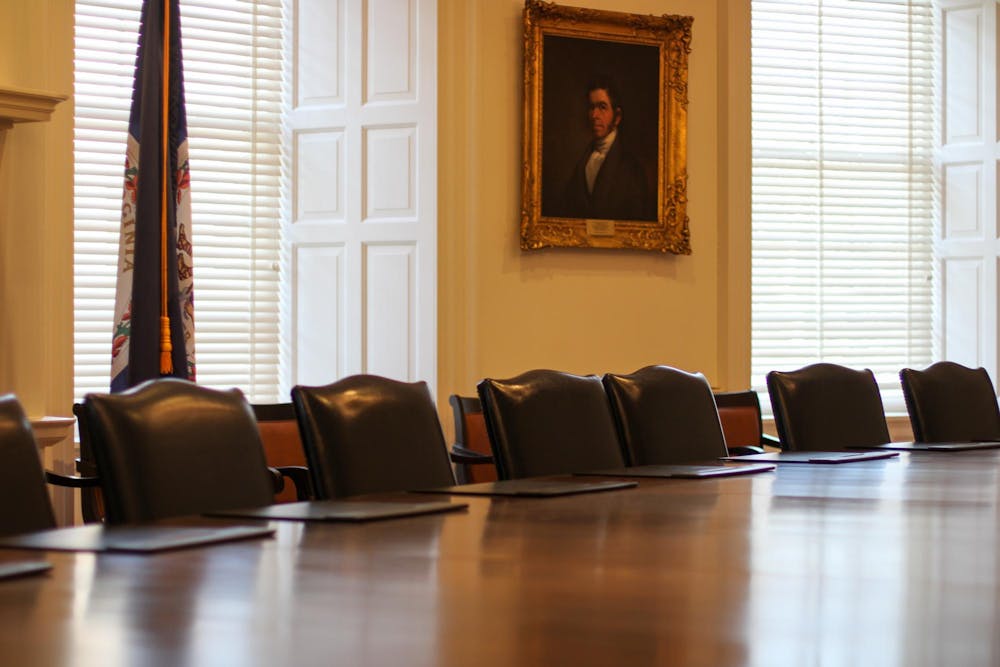
Over the past year, trust in the Board of Visitors has been strained. Student and faculty frustrations regarding a lack of transparency, proper governance and political partisanship have run rampant since the Justice Department forced former University President Jim Ryan to resign last summer. In the months that followed, the Faculty Senate, nine University deans, 181 faculty members and numerous student groups, including the Student Council, spoke out, entreating the Board to pause their search for the University’s next president until community concerns could be addressed. The Board’s decision to move forward despite these protests suggests that the existing student and faculty advisory roles on the Board are not sufficient in ensuring community representation and priorities are met. To correct this, student and faculty representatives on the Board must be given voting rights.
Since 1983, the student member role has existed on the Board to serve as the voice for its respective communities across Grounds. The faculty member role was created in 2015. However, neither of these positions holds a vote on the Board, and should the Board wish to exclude either representative from discussions, regardless of subject matter, they are within their rights to do so at any time. Furthermore, despite the current precedent of doing so, the Board is not required to elect a faculty representative at all. In these ways, the current structure of the Board allows it to claim inclusivity while retaining full control over outcomes, regardless of representative opposition. This is a significant failure at a University that prides itself on student self-governance and empowering students to participate meaningfully in decisions that affect their lives.
Students and faculty form the centerpiece of what makes this University great. Without them, there would be no world-class research to advance, classes to teach, intellectual community to sustain, traditions to protect or even athletic records to break. They are the stakeholders most affected by Board decisions — decisions that shape everything from tuition and housing rates to safety policies, environmental sustainability and allocating funding across all University schools.
But when students and faculty lose that trust, they have no recourse. The current structure of University governance does not require that their voices be given consideration, even as they invest their labor, tuition and their futures in the institution. Students and faculty should have a real voice and power in the room where the most consequential decisions are being made. Currently, however, the Board is made up of individuals who do not necessarily have to experience the consequences of their decisions. Students and faculty do. Their perspectives should carry weight in governance precisely when they are most disruptive to a room of Board members who are insulated from the outcomes they determine.
Making the faculty representative role permanent and providing both student and faculty representatives with voting power would improve confidence that the Board meaningfully considers community interests in its decisions. Voting power would transform student and faculty input from optional consultation into a formal contribution that must be addressed — when disagreements arise, the Board would be required to either persuade these representatives or justify overruling them. Either way, this would prevent community concerns from being dismissed without acknowledgement or discourse. These reforms would represent a substantial investment in the University’s self-governance structure at the highest level, but they would also foster greater community support and a sense of shared ownership over the institution itself.
In February, a proposal — that would have done just that — was removed from a Virginia Senate bill. Groups such as the University’s chapter of the American Association of University Professors and Student Council expressed support for the proposal because of how it would advance shared governance. However, others, such as the president of the Association of Governing Boards of Universities and Colleges, “expressed legal and confidentiality concerns with allowing students and faculty to vote” on matters like personnel decisions and legal issues.
Critics may argue that adding voting student and faculty members would dilute the expertise of gubernatorial appointees or undermine the governor’s appointment power. However, the Board consists of 17 voting members, meaning two additional votes would maintain the governor’s appointees as an overwhelming majority while ensuring that community perspectives are heard and considered in the decision-making process. Rather than undermining the Board’s expertise, student and faculty votes would complement it, providing insight into how policies actually affect those living and working under them.
The past year demonstrated that the University’s commitment to self-governance remains incomplete. Students and faculty can speak up, but the Board is not required to listen. The former proposal in the Virginia Senate offered a clear path to move forward. Granting student and faculty representatives voting power would ensure that the Board must genuinely engage with community perspectives rather than simply dismissing them.
Felicity Franklin is an opinion columnist who writes about student self-governance for The Cavalier Daily. She can be reached at opinion@cavalierdaily.com.
The opinions expressed in this column are not necessarily those of The Cavalier Daily. Columns represent the views of the author alone.
Read More
TAYLOR: Amid lacking accountability, Virginia must fight back against ICE
By Nat Taylor | 4 days agoIt is imperative that state governments push back against this federal invasion — like some of the measures Virginia has recently implemented regarding non-cooperation with ICE — to protect their citizens and end agents’ impunity.

ANDERSON: The U.Va. Cemetery’s Confederate monument must be taken down
By Beckett Anderson | 6 days agoThis monument is not teaching anyone about history — the statue is not even depicting any particular soldier — but rather is a trite corruption of it.
EDITORIAL: The review of the presidential search can bring clarity if done right
By Editorial Board | March 29, 2026When the Audit Committee conducts its review, it should prioritize addressing many unresolved concerns over the process.