In January of 2026, within the span of 17 days, Immigration and Customs Enforcement agents murdered two defenseless American citizens in Minnesota. Renee Good was a kind mother of three who was shot to death in her car while fleeing a terrifying scene of masked agents surrounding her with guns. Alex Pretti was an intensive care nurse who was helping a woman who had been pepper-sprayed when he was brutally subdued and shot, despite posing no threat and being disarmed after agents removed a gun from his waistband. No one has been arrested for these two crimes.
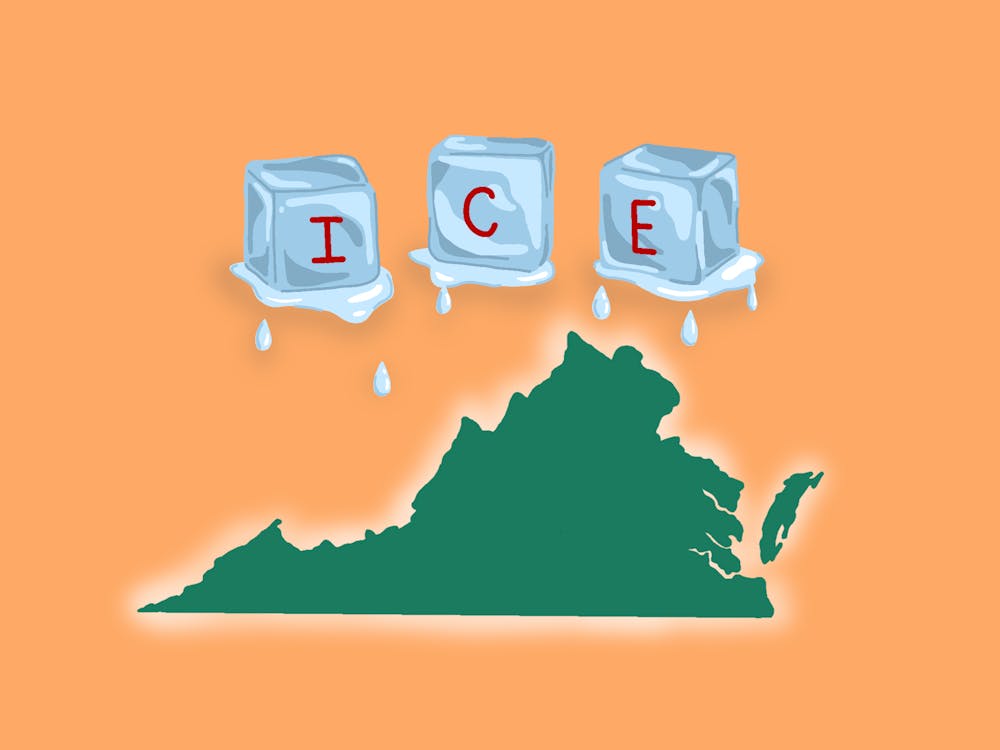
These incidents are examples of a much larger trend sweeping across the United States. Under the direction of the Trump administration, ICE has been deployed in many cities, including in Washington DC and Virginia, under the guise of cracking down on crime, leading to a surge of armed personnel, surveillance and arrests in American cities. These agents have violated dozens of federal and state laws by charging into homes without warrants, detaining observers and protesters, employing excessive force and a host of other dubious activities. As the agency’s operations have ramped up, accountability for agent misconduct has failed to keep up, threatening state populations where ICE has been stationed. It is imperative that state governments push back against this federal invasion — like some of the measures Virginia has recently implemented regarding non-cooperation with ICE — to protect their citizens and end agents’ impunity.
A key aspect of ICE is the air of legal invincibility under which the group works, emboldening the aggressive tendencies of its agents. Although later retracted, the Trump administration initially advocated for “absolute immunity” for ICE officers and has repeatedly attempted to protect them from violating clear laws regarding excessive force outlined in the Fourth Amendment. A similarly problematic doctrine of qualified immunity has long been used to protect law enforcement personnel from lawsuits unless they break a “clearly established” statute. It is clear that federal officials intend to use this as a shield from legal liability, but Virginia legislators have acknowledged and seek to regulate such behavior.
Additionally, to bypass the process of having to obtain a warrant from a judge before invading a citizen’s house, ICE has increasingly used administrative rather than judicial warrants. The key difference is that the Department of Homeland Security, ICE’s parent department, issues administrative warrants rather than courts. One agency now has the unprecedented power of authorization and enforcement, allowing ICE agents to obtain permission whenever they please, with some cases of the warrants arriving after the arrest was made. This is a clear violation of our federal government’s system of checks and balances against one branch having both these powers and infringes on citizens’ Fourth Amendment protection against unreasonable search and seizure. In the absence of federal protection, it is up to states like Virginia to shield their residents from these abuses, and it is imperative that state law enforcement not be involved in these unconstitutional power grabs.
These constitutional issues become even more concerning when reckoned with the fact that the Trump administration has started to bypass immigration courts. The administration has begun authorizing officers to fast-track deporting individuals who meet certain criteria without any chance to contest the case or consult with counsel in a hearing. This clearly transgresses on many immigrants’ right to a fair trial and has been met with little federal check from Congress. Thus, more states must intervene by ending cooperation with ICE and instituting stricter standards with the organization in the face of insufficient pushback from other national branches.
This fight has already begun for many state and local governments — Virginia itself has become a champion of resistance. Gov. Abigail Spanberger ended the partnership between the agency, Virginia State Police and corrections officers, that was instituted under former Gov. Glenn Youngkin, pointing it out as a “misuse” of resources. Furthermore, a variety of bills restricting ICE practices are expected to be signed into law by Spanberger. SB 783 limits local collaboration with agents, while SB 352 punishes their common tactic of not clearly identifying themselves while on duty as law enforcement officers. Even locally, DHS’s plan to convert a Hanover, Va. building into a new ICE facility was canceled after the company owning it, Jim Pattison Developments, refused to sell the building amid massive protests.
Even Charlottesville has joined the fight, unanimously passing a resolution Feb. 2 condemning the agency and establishing a policy of non-cooperation. Although small steps still fail to address the larger issues of the agency’s impunity and violence, public dissent is essential to pressuring the administration for new policies and curtailing the effects of this lawlessness. It is imperative that states continue to resist ICE and that more local governments join the fight in weathering this danger to citizens’ rights.
ICE is not a police force. It is not just an arm of the DHS. It has become an extralegal group of militant soldiers enforcing the will of Trump and terrorizing his opponents. ICE undermines American democracy by acting as a bully without measures to hold its officers responsible for their actions. History tells us that any armed group acting without legal accountability or a government disillusioning its people of basic facts is a major threat to all citizens. It is not just a right, but a duty, for state and local governments to stand up to this agency and prevent it from strangling the delicate voice of democracy, and Virginia provides a prime example of how to do precisely that.
Nat Taylor is an opinion columnist who writes about politics for The Cavalier Daily. He can be reached at opinion@cavalierdaily.com.
The opinions expressed in this column are not necessarily those of The Cavalier Daily. Columns represent the views of the author alone.
Read More

EDITORIAL: U.Va.’s chance to resolve institutional distrust
By Editorial Board | 2 days agoAffordability, AI use and free speech — these are all issues critical to ensuring that our University is accessible to all and that its culture is rigorous, rational and accepting.

HAWKINS: SJP’s animosity toward Darden’s new dean is patently absurd
By Joshua Hawkins | 4 days agoNo, Grushka-Cockayne should not be forced to resign before Darden even opens its doors for the fall, and SJP should seriously reconsider suggesting such a dramatic step.

ELJAZZAR: The University’s growing lobbying budget should worry you
By Farah Eljazzar | 6 days agoA public research university having to negotiate for its independence is, on its face, an indictment of the system it operates within.