
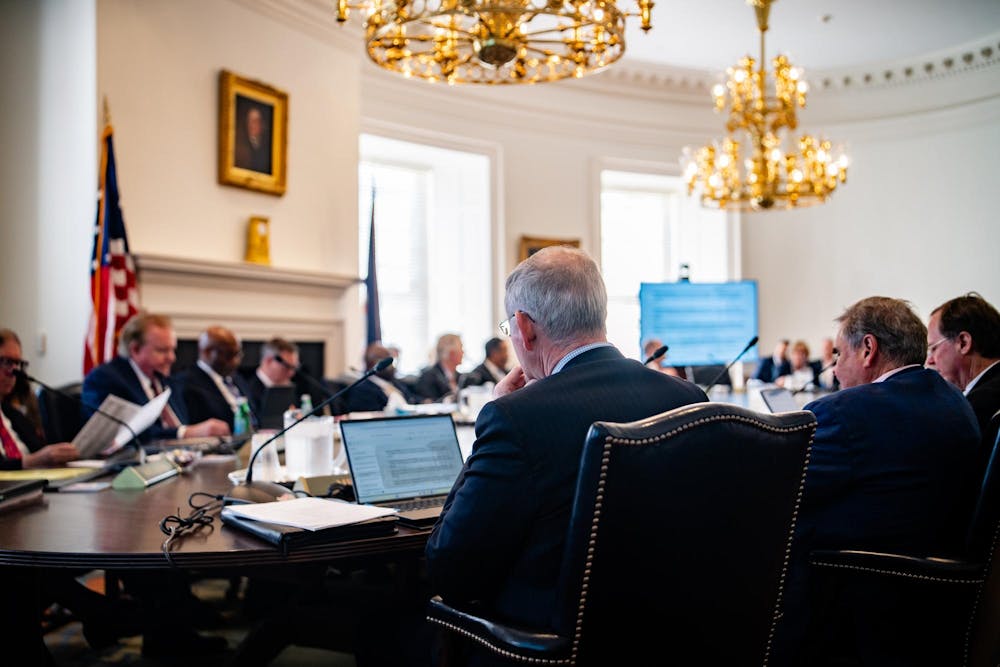
The University’s full Board of Visitors convened Friday afternoon to hear remarks from University President Scott Beardsley — who outlined preliminary priorities for the University’s next strategic plan — and remarks from the chair and vice chair of the Health System Board. The full Board also heard an update on potential changes to U.Va. Health’s governance structure from Dr. Mitch Rosner, U.Va. Health chief executive officer and executive vice president for health affairs, and Dr. David Okonkwo, Board member and professor of neurological surgery at the University of Pittsburgh.
The Board also approved a resolution honoring James Lambert, outgoing faculty representative to the Board and professor of engineering, appointed five new members to the Miller Center Governing Council and reviewed a written Gifts and Grants Report showing nearly $449 million raised in fundraising donations toward the University’s FY26 goals.
During his report to the Board, Beardsley reflected on his first six months as president and discussed plans to launch a University-wide strategic planning process over the coming year. Beardsley emphasized his remarks were not a strategic plan itself, but rather a set of initial observations gathered from “Grounds for Conversation” — an initiative focused on listening and creating structured dialogue with various University stakeholders. He said that these discussions will inform a broader planning effort that will begin this summer.
Beardsley said that a strategic planning committee to “represent a broad cross section of the University” community will be appointed in the coming months, with the goal of presenting a completed strategic plan to the Board within approximately one year.
The University’s current strategic framework — The 2030 Plan — was approved in 2019 and outlines four goals and 10 initiatives aimed at establishing the University as the nation’s leading public university. Projects tied to the plan include the ongoing development of the Emmet Ivy Corridor — which will add academic space and upperclassmen housing — and the Paul and Diane Manning Institute of Biotechnology — a research hub focused on advancing biomedical discovery and treatment. Both projects are expected to be completed by 2027.
According to Beardsley, the University is entering a period of significant change across higher education, healthcare and athletics that will require a more integrated approach to long-term planning. He described the University as a projected $7.1 billion enterprise by FY27, consisting of “one mission, two engines and three drivers.” The two engines that he named are the University’s academic enterprise and healthcare system, while the drivers are asset management, institutional reputation and the broader University community.
Beardsley said that the University’s strategy should not be viewed as a collection of individual projects, but as “an integrated set of actions and choices, with resource plans designed to fulfill the mission and vision.”
“The integration between the engines and the drivers … need to work together,” Beardsley said. “Our strategy has to be a cohesive blueprint in which each choice is thoughtfully considered and how it affects the other choices as well.”
Beardsley emphasized that the University must adapt to changing conditions in higher education, healthcare and athletics while remaining focused on its core mission of teaching, research, patient care and public service. Among the priorities he identified were maintaining AccessU.Va. and affordability, strengthening the University’s research enterprise, expanding artificial intelligence initiatives, addressing capacity constraints within U.Va. Health and developing a sustainable financial model for athletics.
“Higher [education] … is navigating an unprecedented compression of financial, technological [and] cultural — including political — pressures,” Beardsley said. “In a volatile environment like this, what it means to me is that we have to focus on the fundamentals, that means we have to make sure that each engine and driver meets the full potential of the mission.”
Board members discussed a range of ideas for the strategic plan, including the future impact of AI on higher education, the sustainability of college athletics, biotechnology and cybersecurity opportunities, undergraduate advising, healthcare access and the affordability of a University education. The Board also noted the importance of strengthening transfer pathways, career advising and partnerships with the Commonwealth.
Beardsley also highlighted several recent accomplishments, including a $43.4 million gift from alumni David and Kathleen LaCross to the School of Education and Human Development to establish an early childhood learning center.
Another recent accomplishment, according to Beardsley, is the University’s Fitch Ratings, which reaffirmed the University’s AAA credit rating — the highest possible rating. The rating cited the University's strong financial profile, steady enrollment and growing research enterprise.
Board members also heard a brief presentation from Okonkwo and Rosner regarding potential changes to the governance structure of U.Va. Health. According to Okonkwo, HSB leadership has spent the past several months studying governance models at peer academic medical centers as U.Va. Health continues to expand. Okonkwo further noted that U.Va. Health has experienced a rapid growth in recent years and is projected to become a roughly $4.5 billion enterprise within the next year — up from approximately $3.5 billion a year ago.
Okonkwo outlined three primary governance structures used at academic medical centers nationwide, noting that the University operates under a consolidated single-credit model in which the Medical Center and University are financially integrated and ultimately accountable to the Board and the Commonwealth. He said that the HSB intends to maintain that structure even as the health system grows and emphasized the importance of fiscal responsibility.
“It is vitally important that we remain fiscally responsible while simultaneously restructuring the governance of the health system to meet its future, its present, frankly and future demands,” Okonkwo said.
Okonkwo also said that U.Va. Health has shifted from a period in which its growth was driven largely by acquisitions to one in which growth is increasingly driven by patient demand and the quality of care provided by the health system. He added that this growth has prompted HSB leaders to consider whether U.Va. Health’s current governance structure is equipped to meet the health system’s needs.
Regarding potential changes to U.Va. Health, Rosner said that its current structure provides limited opportunities for detailed discussion of complex issues facing the health system. He discussed the potential addition of committees or subcommittees to HSB that could improve transparency, strengthen decision-making and allow members to contribute more directly.
“I think there's a huge opportunity for us to think about how do we get decision making transparency, [and] honesty at the level of the health system as it grows that brings confidence to the Board, brings confidence that we're making the best decisions [and] bringing the best minds together,” Rosner said.
Michael Bisceglia, Board member and vice chair of HSB, echoed those concerns, saying that the HSB has not fully utilized the expertise of its non-voting members. He said a revised structure could transform members from “watching the presentation” into becoming “players on the field” by involving them more directly in discussions and decision-making.
No action was taken during Friday’s meeting regarding HSB. However, Okonkwo said the HSB plans to continue developing recommendations over the summer and hope to return with a formal proposal at the Board’s September meeting.
During Board Rector Carlos Brown’s remarks to the Board, he discussed meeting schedules, regulatory requirements and Virginia’s Freedom of Information Act impact on Board operations. While he noted that the Board has at times taken a more “conservative” approach to public meeting requirements than other boards on which he has served, Brown said there are opportunities to create more space for substantive discussions on the University’s strategic priorities through changes to the Board’s meeting structure.
“We want to have frank conversations, but we ought to say what needs to be said in the public settings,” Brown said. “I had a colleague … that [said] efficiency sometimes is an enemy of constructive candid conversation, and when you're forced to do things very efficiently under time constraints, you can't always really get all the dust out of the rug.”
Brown suggested restructuring committee meetings to allow greater flexibility in the Board’s agenda, including the possibility of holding some meetings concurrently rather than as committees of the whole. He also noted a strong interest among Board members in topics such as athletics, accessibility and the health system.
The Board’s expanded meeting schedule this weekend reflected those priorities. The four special sessions scheduled Saturday were not meetings of official Board committees, but instead focused on four priorities Brown identified during the Board’s March meeting. Priorities include accountability and aligned governance, affordability and accessibility, athletic competitiveness and advancing patient care and saving lives at U.Va. Health.
In addition to numerous remarks, the Board approved a commendation recognizing Lambert for his service to the University and Board. Lambert — who has served in the School of Engineering and Applied Science for more than three decades — has held numerous leadership roles, including chair of the Faculty Senate during the 2024-25 academic year, director of the Center for Risk Management of Engineering Systems and director of the University’s site within the National Science Foundation Center for Hardware and Embedded Systems Security and Trust.
As faculty representative to the Board since July 2025, according to the commendation, Lambert served alongside four University presidents, three Board rectors and 30 Board members. The resolution described him as a “valuable resource” and “trusted confidant and advisor” who consistently advocated for dialogue between faculty, administrators and Board members.
Lambert will conclude his term as faculty representative to the Board June 30.
The Board also received a written Gifts and Grants Report summarizing fundraising activity through April 30. According to the report, total fundraising progress for the University and its affiliated foundations during this time reached approximately $448.9 million.
Several schools and programs within the University reported increases in fundraising compared to the previous FY25, including the School of Education, McIntire School of Commerce, Batten School of Leadership and Public Policy, University Libraries and the Jefferson Scholars Foundation.
Among the largest recent gifts was a $3.17 million contribution from the Jack Miller Center to establish the John S. Lillard Jefferson Scholar Foundation Distinguished Professorship in American Constitutionalism and Politics. The School of Nursing received $2.81 million from the Bedford Falls Foundation to support the Clinical Nurse Leader Program Conway Fund and doctoral scholarships.
The report also highlighted major pledges, including a $23.4 million commitment from David and Kathleen LaCross to support the creation of the LaCross Early Learning Center within the School of Education and Human Development. Other significant contributions included $11.7 million from Philip F. duPont Trust and $6 million in anonymous contributions to the Darden School of Business.
The Board additionally approved five appointments to the Governing Council of the Miller Center of Public Affairs. The appointments — each for three-year terms beginning July 1 — include Lynn Dengel, alumnus Kevin Fromer, Vann Graves, John B. Harris Jr., School of Law Class of 1979 alumnus, and Ted Mathas, School of Law Class of 1992 alumnus.
Following remarks and Board approvals, the Board then voted to enter into closed session to discuss legal and regulatory matters, including actual and potential litigation. According to Vice Rector Victoria Harker, the Board also went into closed session for personnel matters involving the election, appointment, performance, promotion, compensation, resignation and retirement of specific officers and employment, including the evaluation of University President Scott Beardsley. The Board then returned to open session before adjourning the full Board meeting.
The full Board is scheduled to reconvene during the next Board meetings, which will take place Sept. 16-19.

Jaylynn Perez is a third-year College student from Chesapeake, Va., majoring in government and Public Policy and Leadership. She currently serves as a news senior writer and video staffer, after previously serving as senior associate editor for the news desk. She enjoys covering topics such as University governance and local politics.
Read More

U.Va. and United Way of Greater Charlottesville launch ‘Give Where You Live’ donation partnership
By Vrinda Vashisht | 6 hours agoThe program is set to run through Dec. 18, and its start date coincided with United Way’s 35th annual Laurence E. Richardson Day of Caring.

Student Council passes bill to create ad hoc committee to review UBE proceedings
By Edward Christopher and Anna Ivanov | 6 hours agoThe Commission will craft a report on the University Board of Elections’ current structure and governance practices, putting forth proposals for corrective action based on its findings.
Board of Visitors discusses the implementation of AI in research and academics
By Jaylynn Perez | 16 hours agoThe Board also received an orientation on changes to NCAA athletics, completed its annual Atlantic Coast Conference certification, heard a report from Aaron Bloomfield, Faculty Senate chair and engineering professor, and discussed the University’s ongoing searches for a provost and several deans.


