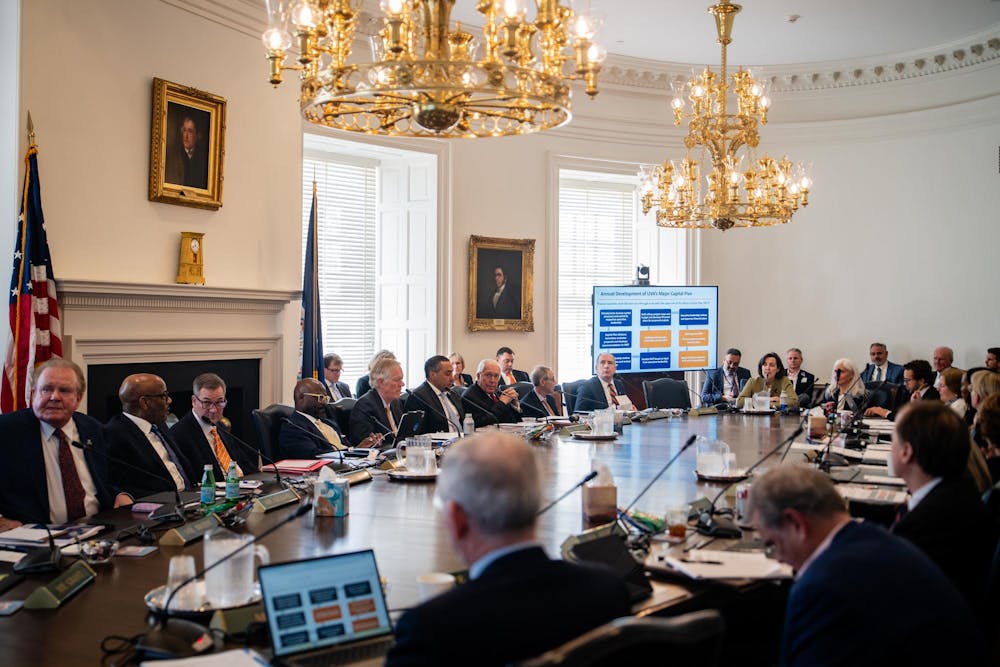
The Board of Visitors’ Buildings and Grounds Committee met Thursday afternoon to approve the designs for both the School of Data Science and Entrepreneurship building and the Main Heat Plant Fuel Conversion. The Committee also amended the Capital Project Procurement Process and approved the fiscal year 2027 Major Capital Plan.
The Committee also approved the demolition of the Ivy Road Police Building, heard a report by Lois Stanley, senior vice president for operations, and Donald Sundgren, vice president and chief facilities officer, and received a written report on sustainability efforts at the University.
The Buildings and Grounds Committee oversees the University’s land use planning and the care, maintenance and security of buildings across Grounds. Committee responsibilities span selecting architects and engineers, naming buildings and approving siting and design of new buildings.
Board member John Nau III serves as chair of the Committee, working alongside eight other voting Board members, outgoing Faculty Representative James Lambert and Student Representative Jackson Sleadd. Both Lambert and Sleadd hold non-voting roles. Robert Byron, Board member and Buildings and Grounds vice chair, stood in the place of Nau as chair for Thursday’s meeting.
With a project budget of $77 million, the Committee approved the schematic design for the School of Data Science and Entrepreneurship building developed by Payette Architects and VMDO Architects. The Committee first approved a long-term framework for the Ivy Road Corridor in 2016, and the addition of the Entrepreneurship building “is envisioned to create a new interdisciplinary computational research environment,” according to the meeting agenda.
University Architect Alice Raucher described intentions behind the design of the building, including a transparent ground floor, a material palette that matches the existing SDS and other buildings on Grounds and a bridge connecting to other buildings within the Ivy Corridor.
“This project will have a transparent ground floor that will allow the activity of the Entrepreneurship Center to be on full display, connecting not only with the public-facing program in the School of Data Science, but also with [other Ivy Corridor buildings],” Raucher said. “The material of the bridge not only fits in with … surrounding buildings, but it marks it as an important public portal connecting Ivy Road to the landscape.”
Sleadd inquired about the design for the ground floor of the project, and Raucher said that the floor, with its pitch room with moveable glass partitions, makes the space flexible for student use.
Following the vote, the project may now proceed with further development and construction.
Set to completely replace the heat plant’s coal heat input with natural gas and field oil, the Main Heat Plan Fuel Conversion Project involves demolishing the four existing coal silos stationed near the University’s Medical Center. With a $38 million budget, the project will optimize the systems for a new fuel mix of gas and oil instead of coal.
The Committee approved the project, which is expected to eliminate risks associated with coal sourcing and combustion while reducing carbon and sulfur emissions. Operating costs are also set to decrease by over $2.2 million annually. The project may now continue with development and construction after receiving the Committee’s approval.
J.J. Wagner Davis, executive vice president and chief operating officer, expressed her support for the project, and she commended Raucher and Paul Zmick, University director of Energy and Utilities.
“This team is amazing, and it's taken many, many years,” Davis said. “[The infrastructure project] is long overdue for the hospital and for our overall sustainability plan, plus it saves money too. So I just applaud this team.”
Each year, the Committee reviews the revised multi-year capital plan to determine potential projects to be added, removed or revised, and these adjustments then go before the Finance Committee for approval.
Stanley brought project proposals to the Committee for the capital plan, including the Athletics Multipurpose Practice Field, the planning and design of the Copeley Connector Road and three U.Va. Health projects — the University Hospital Image Guided Surgery Suite, the Cardiac PET/CT Suite and planning for Clinical Core Laboratory renovations. The Committee approved all proposed projects, and no recommendations were made by the University to remove any projects from the plan.
The meeting agenda contains a breakdown of the financials for the FY27 plan, including total authorization amounts, gifts, debt and institutional funds for each project.
Towards the start of the meeting, the committee approved the former University Police Building’s demolition — the building has stood since its construction in the 1950s as a diner, later facing renovations for office use. According to the meeting agenda, the “current condition” of the building necessitated its demolition — water infiltration, insufficient bathrooms and structural concerns prohibit the continuation of the building.
After demolition, plans are in place to plant a meadow mix — a mix of seeds to grow a natural grassland area. After the Committee’s approval, the decision now awaits approval from the Art and Architectural Review Board and the Department of Historic Resources.
Sundgren updated the Committee on capital projects, including Fontaine Research Park and the Ivy Corridor projects. At the close of the meeting, Stanley touched on the University’s sustainability efforts.
Attached to the meeting’s agenda, more sustainability efforts are listed, including a grant to reduce food waste, the January launch of the Staff Sustainability Leadership Program, HooHacks — an annual hackathon hosted by the University in which 38 student teams competed on the Sustainability Track — and waste diversion in research labs.
In regards to procedure for future building planning, Byron walked through proposed changes to the University’s capital procurement process. There are three primary methods for construction procurement — “design-bid-build,” “design/build” and “construction manager at-risk,” according to the meeting agenda.
Prior to 2024, the University had to seek approval from Virginia’s Department of General Services for feedback on its choice of procurement method, with certain choices lending towards larger projects. However, the University could still move forward with its procurement choice even if DGS disagreed.
After the establishment of a law in 2024, the University now needs extra approval if it wants to use either the “design/build” or the “construction manager at-risk” procurement methods if DGS says no. For larger projects or projects that do not receive state general funds, the University needs approval by the Board to continue, and for state-funded projects under $65 million, the University needs approval from legislative budget leaders and DGS.
After a vote, the Committee approved changes to the University’s procurement practices to align with Commonwealth law.
Lastly, the Committee viewed a video featuring the recently opened Virginia Guesthouse — the University’s hotel and conference center.
The Committee will meet next during the meetings of the Board Sept. 16-19.

Grace Little is a news editor for the 137th term. She is a third-year student from Dallas majoring in neuroscience and the interdisciplinary major in public policy, politics and media studies. She enjoys writing about the shifting landscape of higher education, and you can reach her at g.little@cavalierdaily.com.
Read More

U.Va. and United Way of Greater Charlottesville launch ‘Give Where You Live’ donation partnership
By Vrinda Vashisht | 5 hours agoThe program is set to run through Dec. 18, and its start date coincided with United Way’s 35th annual Laurence E. Richardson Day of Caring.

Student Council passes bill to create ad hoc committee to review UBE proceedings
By Edward Christopher and Anna Ivanov | 5 hours agoThe Commission will craft a report on the University Board of Elections’ current structure and governance practices, putting forth proposals for corrective action based on its findings.
Board of Visitors discusses the implementation of AI in research and academics
By Jaylynn Perez | 15 hours agoThe Board also received an orientation on changes to NCAA athletics, completed its annual Atlantic Coast Conference certification, heard a report from Aaron Bloomfield, Faculty Senate chair and engineering professor, and discussed the University’s ongoing searches for a provost and several deans.