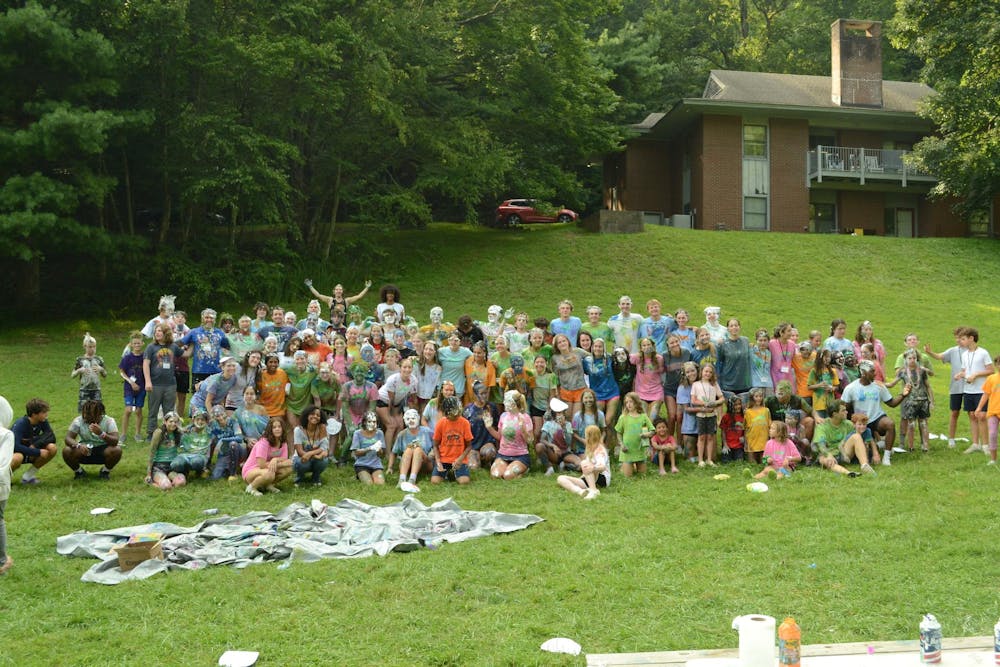
Every summer, a group of University students head to Camp Kesem to make — in the words of many campers and volunteers — “Kesem Magic.” Kesem, a nationwide nonprofit organization, supports children ages six to 18 who have a parent impacted by cancer. With over 115 chapters at colleges in 41 states, the organization is run by passionate college-aged volunteers, providing year-round peer support, a welcoming community and free summer camps.
For the University, Camp Kesem takes place during one week each summer at Crossroads Camp, located about an hour outside of Charlottesville in Lowesville. For many counselors, volunteering at Camp Kesem is a way to make a positive difference in the community for a cause that is often near to their hearts.
In many aspects, Camp Kesem is a traditional sleepaway camp. Campers spend a week in cabins, unplugged from technology and immersed in outdoor activities — such as making s’mores, playing Gaga Ball, swimming and putting on talent shows.
Despite offering typical summer camp activities, the camp's core mission centers on building systems of emotional support and community. Ryan Allbee, one of Kesem’s operations coordinators and rising third-year College student, explained that this underlying mission — which is present in each and every activity — is what makes Kesem unique.
“Kesem’s whole purpose is to improve the lives of children who are affected by parents' cancer,” Allbee said. “[Kesem gives] kids a space where they can just completely forget about … their struggles in their home life … they can just be a kid, and not … worry about all the stuff going on that's out of their control.”
To ensure Kesem is accessible to families in various financial situations, Kesem is entirely free of cost — providing meals, lodging, activities and transportation for camp participants. University students work all year to fundraise for Camp Kesem, putting on two main fundraisers — Make the Magic Gala and Giving Tuesday, a 24-hour event primarily hosted on social media that raised around $80,000 last year. For Alka Link, a volunteer counselor and rising fourth-year College student, providing accessibility through fundraising is one of the most meaningful aspects of the program.
“[The] reason why I really wanted to join [Kesem] is because I could really see [my impact]. I'm fundraising all of this money, and I'm devoting all of my time … to give these kids who have been through so much at such a young age such a carefree week [where] they can be a kid again,” Link said. “We talk about Kesem magic, and [while] it sounds so cliche, it is truly such a magical week.”
Kesem is also distinguished by its “Challenge by Choice” philosophy, ensuring no child is forced to participate in any activity. For some campers, Kesem is a space where they can be emotionally open with peers who share similar experiences during nightly small-group sharing opportunities. For others, it is merely a place where they can set their worries aside and enjoy simply being a kid.
Annika Larsen, Kesem volunteer coordinator and 2025 School of Education and Human Development alumna, explained this mantra, describing how campers decide how much they are open to share their personal experiences.
“Sometimes we do talk more about cancer and the reason that we're all here at camp,” Larsen said. “It really is kind of whatever direction the kids want to take it … It's really important that kids feel comfortable doing whatever they would like to.”
According to Larsen, this flexibility creates a unique sense of community at Camp Kesem. Echoing this sentiment, Malcolm Woollett, volunteer coordinator and rising third-year College student, noted that while campers come from different backgrounds, locations and circumstances, their shared experience of a parent’s cancer diagnosis can create a tacit sense of understanding and solidarity.
“I think that [cancer is] a really exhausting thing to be constantly treated differently for. At camp, they're all different kids, but they all share that one thing in common, and they're not treated any differently by any of us or any of them for it,” Woollett said.
According to Allbee, when campers know others have faced similar challenges, they often feel more comfortable when it comes to opening up.
“Having someone that's on the same page as you … definitely makes kids feel more at home,” Allbee said. “[It] makes kids feel more comfortable when [they] have someone else who's gone through a similar situation.”
An unconventional aspect of Kesem is that these relationships are created without campers actually knowing the given names of other campers and counselors. Sarah Brennan, co-director of the University’s Kesem chapter and Class of 2026 alumna, shared that both Kesem participants and counselors get to adopt a new name of their choosing, allowing them to shed their at-home identities and assume a new one of their choosing.
“We have kids who pick a name of someone that they really value in their life — [maybe] their best friend — anything that they want to go by for that week to maybe help them feel a little bit more powerful, a little bit more strong and a little bit more free,” Brennan — who goes by ‘Polo’ at camp — said.
Even though the alternative camp names end when the week ends, Larsen noted that the bonds created at Camp Kesem do not. She explained that many campers return year after year, eager to reunite with their friends and counselors whom they have not seen in between.
These enduring friendships are further strengthened each night during “Cabin Chats,” nightly small-group meetings led by campers. Discussion topics can range from day recaps to deeper dialogues about life at home and complex emotions. According to Larsen, as bonds between campers flourish over the course of the week, the conversations can often become more vulnerable.
Similarly, openness and vulnerability are encouraged at “Empowerment,” an activity held halfway through the week. According to Brennan, unlike “Cabin Chats,” “Empowerment” brings together campers of all ages, offering a collective moment of discussion to acknowledge how cancer has touched every life there.
“[Empowerment is] kind of the first time the word ‘cancer’ is officially said at camp,” Brennan said. “You just see kids who might be hesitant and haven't really spoken up in front of a large group before have the ability to say, ‘I love Kesem because it makes me feel happy,’ ‘I love Kesem because I feel like I have a family.’”
Still, Larsen noted that not every camper chooses to talk about their experience with cancer. For those who may be more reluctant to share their deeply personal sentiments, in Link’s perspective, the camp’s greatest value lies in its ability to provide a place where children can set aside the challenges they face at home and enjoy being kids.
Whether campers spend their time sharing personal experiences or simply enjoying a week of games, friendships and outdoor activities, Camp Kesem provides an environment where having a parent affected by cancer is a common experience rather than one of isolation.
“Some kids just love summer camp, and they just love having that really supportive community of people who truly understand them without them needing to say anything,” Larsen said. “They feel like at Kesem, that they can be themselves entirely and feel completely understood without even really needing to try.”
For first-year students interested in becoming a part of the “Kesem magic,” the next chapter begins at the University’s Fall Activities Fair, which usually occurs during the first week of the fall semester.

Sadie Adams is a senior associate on the life desk. She is a second-year College student, planning on majoring in Public Policy and Leadership. Sadie is from Crozet, Va., and she enjoys writing about local restaurants and community organizations. Outside of The Cavalier Daily, Sadie is involved in the Civic Cornerstone Fellowship, Undergraduate Women and Law and is a workout coach at Formula Complete Fitness.
Read More

Play the organ
By Elizabeth Adams | YesterdayThe college side quest does not need to be the multi-semester jaunt that my organ adventure has become, and it certainly doesn’t have to make sense.

Girls Who Lift brings gender inclusivity to the gym
By Sadie Adams | 3 days agoBy providing this safe space in the gym, Girls Who Lift encourages more women to take up weightlifting as a hobby.

Cville Sabroso Festival brings a taste of Latin American cultures to the Ting Pavilion
By Summer Hoffman | 5 days agoInside the Ting Pavilion, a sea of Latin American artisans, food vendors and performers greeted festivalgoers.