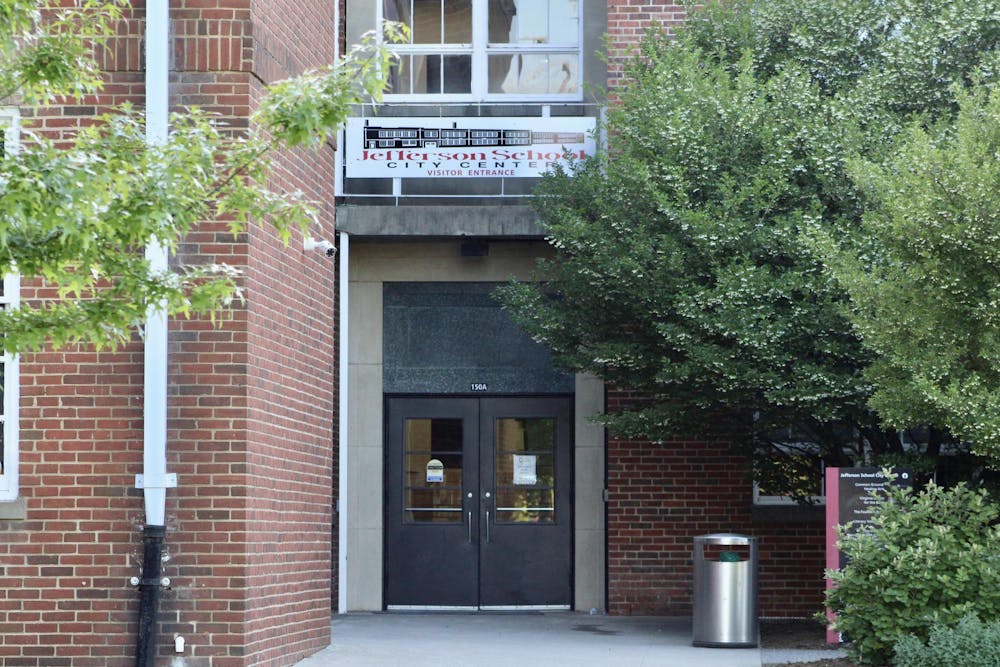
This year, Charlottesville celebrates the centennial of the Jefferson School, the City’s first high school to serve the African American community.
Established in 1926, the Jefferson School became the first high school for African Americans in Charlottesville. Now a century later, the building on Fourth Street has been transformed into the Jefferson School City Center, home to several Charlottesville nonprofits providing diverse services for the community.
Before 1926, there were no schooling options for African American students beyond eighth grade. After community members petitioned the City School Board and superintendent for a secondary school for the City’s African American youth, the Jefferson School was opened as the City’s only all-African American high school. Prior to the Jefferson High School, the Jefferson Colored Elementary School — a primary school for African American children in Charlottesville — was founded in 1865 with only one class until 1869.
The Jefferson School remained an active secondary school until 1951 when the segregated Jackson P. Burley High School opened and the Jefferson School transitioned back to an elementary school. Charlottesville schools did not begin to integrate until after an NAACP lawsuit representing 12 African American students from Jefferson Elementary and Burley High School wanting to transfer to all-white schools in the City made it to the U.S. District Court. On Sept. 8, 1959, these students — colloquially known as the “Charlottesville 12” — began desegregating Charlottesville’s schools.
Now, the Jefferson School building is a community hub that preserves the rich legacy of the Jefferson School by providing vital services and opportunities to the City. The space is owned and maintained by the Jefferson School Foundation, a local nonprofit organization dedicated to continuing the school’s community-oriented legacy. The Foundation leases space in the building to eight local nonprofits, including economic assistance for formerly incarcerated individuals, English-language education for adults and more.
To further explore the Jefferson School's legacy, The Cavalier Daily spoke to community members and the Jefferson School Foundation.
Kimberly Sheffield, Jefferson School Foundation executive director, was appointed in January 2026 following her role as the organization’s community engagement director. In her role as executive director, Sheffield communicates with tenants that use the space of the building, the Jefferson School Foundation’s board of directors and the larger Charlottesville community.
When asked about the Jefferson School’s significance to the community, Sheffield noted the building’s historic legacy when it was a high school, which extended far beyond the classroom itself.
“The school was a hub,” Sheffield said. “It was in the heart of the city, and it was a gathering place for children. And from my conversations with alumni, this building was more than a school. It was a safe haven.”
Sheffield joined the Foundation three years ago as the director of community engagement, and through this role, she said she wanted to become part of the Foundation’s mission in a larger capacity.
“I fell in love with the impact and the community service that gets done here,” Sheffield said. “And it's real people doing real things and making a real difference in the world.”
The Cavalier Daily also received written statements from Elizabeth Knutsen, the chief financial officer for the Foundation, whose role includes allocating money that the Foundation makes from renting space to tenant organizations to projects that help the community, ensuring that the Foundation ends at zero-profit at the end of each year. When asked about what drew her to working at the Foundation, Knutsen said that the school has positively impacted generations of Charlottesville citizens which inspired her to be a part of the Foundation.
“I have been exposed to so many heartwarming stories of generations of families that gained their education in this building, as well as stories of unbelievable perseverance as thriving communities were destroyed, rebuilt and continue to rebuild,” Knutsen said.
A key component of the City Center includes the non-profit organizations that serve the community. One such organization is the Literacy Volunteers, which offers tutoring services to adults learning English or working to pass citizenship tests. Another is the Jefferson School African American Heritage Center, a space with exhibits and events dedicated to education about the Jefferson School and historical contributions of the local African American community.
The Foundation also has a conference room available for external nonprofits to use, free of charge and equipped with AV equipment.
The Foundation tailors its resources by receiving community feedback through the Foundation’s Task Force, a volunteer group that meets bi-weekly, made up of community leaders and stakeholders who serve as lines of communication within the City to the Foundation.
With this input, the Foundation can more precisely cater to residents’ needs or work to solve specific community issues. James “Littlez” Dowell, Task Force member and co-founder of the Charlottesville run club Prolyfyck, has worked closely with the Jefferson School Foundation for a number of years, he said. Through his role on the Task Force, he has provided insight for the Foundation on how to improve community outreach, while also garnering exposure for his own organization.
Dowell’s run club, Prolyfyck, is a local run club focused on bringing community together with running, welcoming anyone who wants to join. Prolyfyck’s four-mile route runs through neighborhoods with residential populations that are historically underrepresented or marginalized in Charlottesville, he said. Each Prolyfyck run starts and ends in front of the Jefferson School.
“We start and finish the route at the Jefferson School intentionally because of why that building exists and what that building means to the Charlottesville community,” Dowell said. “It was the first Black Education Center for African Americans here in Charlottesville. And so that building holds a lot of value. It holds a lot of weight, and it holds a lot of history.”
For Dowell, being on the Task Force and within his role with Prolyfyck allow him to connect with the community and ensure that he is introducing new people to the Jefferson School.
“Being on the Task Force, it’s mainly eyes and ears, being on the ground, [ensuring] the Jefferson School continues to be a vibrant and impactful resource, while also preserving the legacy in [its] history,” Dowell said. “Beyond that, we're bringing in new faces. We're bringing in folks who have never been inside of that building or understand the history of that building by [Prolyfyck] operating out of the Jefferson School three days a week.”
Dowell’s close relationship with the Jefferson School Foundation began far before Prolyfyck and his position on the Task Force. Both his mother and grandmother taught at the Jefferson School, and he spent his childhood in the historic building at the preschool program.
“I spent all summers there with my grandmother and mom teaching summer school there,” Dowell said. “So that school … It's like home to me.”
Knutsen, years before she began working at the Foundation, experienced firsthand how the organization works to provide services for the community. She recalled taking her young children to an event on New Year’s Eve at the City Center that provided free childcare.
The impact of the Foundation extends beyond the nonprofit organizations that reside in the City Center and the outreach of the Task Force. On the first floor of the City Center, the Foundation displays an art exhibit titled Sanctuary of Soul. The exhibit includes a mural by local artist Jae Johnson, featuring the outline of a person and butterflies atop a vibrant, colorful background. Sanctuary of Soul also includes a rotating exhibit that spotlights different artists’ work.
“We have local artists here, but we also have artists that ship their art all the way from Detroit, Michigan and Mississippi,” Sheffield said. “So there was excitement throughout the world to bring their art to this historic space.”
The City Center holds many roles for the community — from groups of children playing basketball at the Carver Recreation Center, students at Piedmont Virginia Community College taking culinary lessons or tour groups coming to learn at the Jefferson School African American Heritage Center’s exhibits.
As the building celebrates 100 years in the Charlottesville community, it invites the community to further engage with events and opportunities at the City Center.
In honor of the centennial, the Jefferson School African American Heritage Center placed banners to celebrate the school on West Main. For Sheffield, this milestone is bigger than an anniversary — it is a landmark for all of the history that has unfolded in the past century.
“We're still here,” Sheffield said. “The building is still here. And if you look at all the things that have happened over the last 100 years, the good, bad, the indifferent things that have just recently happened in the city of Charlottesville, the building still stands strong, and it's still here, and it's still as impactful as it was then. It's still doing what it was intended to do 100 years ago, and that's to be a hub in the community.”

Sadie Adams is a senior associate on the life desk. She is a second-year College student, planning on majoring in Public Policy and Leadership. Sadie is from Crozet, Va., and she enjoys writing about local restaurants and community organizations. Outside of The Cavalier Daily, Sadie is involved in the Civic Cornerstone Fellowship, Undergraduate Women and Law and is a workout coach at Formula Complete Fitness.
Read More

Play the organ
By Elizabeth Adams | YesterdayThe college side quest does not need to be the multi-semester jaunt that my organ adventure has become, and it certainly doesn’t have to make sense.

Girls Who Lift brings gender inclusivity to the gym
By Sadie Adams | 3 days agoBy providing this safe space in the gym, Girls Who Lift encourages more women to take up weightlifting as a hobby.

Cville Sabroso Festival brings a taste of Latin American cultures to the Ting Pavilion
By Summer Hoffman | 5 days agoInside the Ting Pavilion, a sea of Latin American artisans, food vendors and performers greeted festivalgoers.