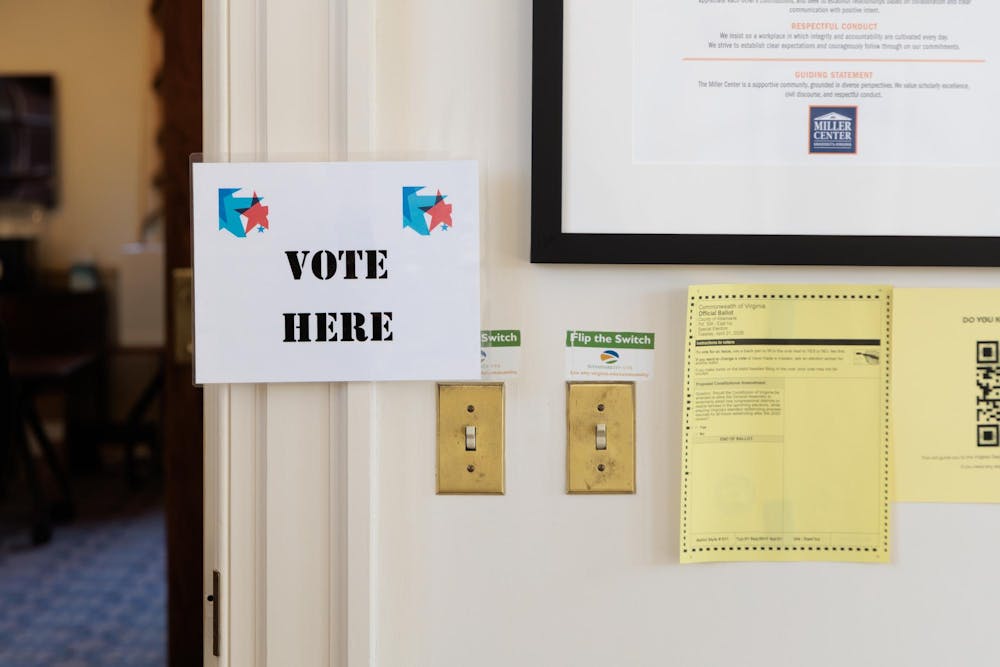
Virginia’s congressional primaries will take place Aug. 4 this year, marking the first time in over a decade that the Commonwealth is not holding its nominating contests in the month of June. Early voting in these races officially began June 18, meaning Charlottesville voters have begun selecting their party’s candidates for Virginia’s 5th Congressional District. Republican voters are also weighing in on a three-way contest to challenge Sen. Mark Warner (D) in the fall.
In primary elections, Republican and Democratic voters pick their party’s candidates to appear on the November general election ballot, and this year, the General Assembly passed a bill to reschedule primaries from June 16 to Aug. 4. The rescheduling of primaries was part of Democratic legislators’ unsuccessful attempt to amend the Constitution of Virginia and instate a 10-1 congressional map. This change would have given voters time to approve the amendment in April and enact new maps for 2026.
The Supreme Court of Virginia intervened, however, striking down the amendment due to procedural concerns. The decision left the current 6-5 congressional map intact, meaning Charlottesville residents will remain in the 5th Congressional District as they head to the polls to elect a U.S. representative this year. Voters across the Commonwealth will also elect a U.S. senator this year, with Warner facing re-election in 2026.
Here is a guide to who is running in Charlottesville’s congressional primaries, and how a student at the University can vote in these races.
Who is running for the House?
Three Democrats and two Republicans are currently running in Virginia’s 5th Congressional District.
On the Democratic side, congressional candidate Tom Perriello (D) is viewed as the frontrunner. A former member of Congress, Perriello was the last Democrat to win Virginia’s Republican-leaning 5th District in 2008 — narrowly prevailing by just over 700 votes. Perriello then lost re-election in 2010. He has received the backing of Gov. Abigail Spanberger (D), Sen. Tim Kaine (D), Warner and numerous other Democratic state officials.
According to Perriello’s website, his primary campaign focus is the issue of affordability. The website says he is currently fighting to “double the minimum wage, outlaw predatory lenders and expand paid medical leave.” Perriello’s campaign had raised over $1.4 million at the end of the first Federal Election Commission filing quarter March 31, according to the Virginia Public Access Project.
Congressional candidate Robert Tracinski (D) — author of “Dictator from Day One: How Donald Trump Is Overthrowing the Constitution and How to Fight Back,” and a former member of the conservative “Tea Party” movement — is also running for the nomination.
According to his website, Tracinski is running to “restore the power of Congress” in response to President Donald Trump, who he characterizes as an “out-of-control executive.” Specific proposals he has put forward include utilizing Congress’ spending power to withhold funding from the Trump administration, revoking the President’s discretion over research funding for higher education institutions and banning the U.S. Department of State from denying visas on the basis of political speech. Tracinski’s campaign had raised $44,132 at the end of March, according to VPAP.
The third candidate running in the Democratic primary is Dr. Suzanne K. Krzyzanowski (D). Krzyzanowski has been a family physician in the Commonwealth for over 20 years and her website indicates that she is focusing much of her campaign’s attention on the nation’s healthcare crisis — pointing to rising expenses, overworked doctors and nurses and insurance companies denying patients coverage for their treatment. Krzyzanowski supports a universal healthcare system, in which every individual has health insurance — whether through the government or a private health insurance company. Her campaign had raised $15,577 by the end of March, according to VPAP.
On the Republican side, first-term Rep. John McGuire (R) is seeking renomination. McGuire does not include specific policy positions on his campaign website, but notes that he is “Pro-Life,” “Pro-God,” “Pro-Gun” and “Pro-Trump.” His congressional website also outlines recent legislative actions from his time in office.
Of the 19 bills McGuire has sponsored, the website highlights the Riley Gaines Act, which he proposed in February and “would allow female athletes to take legal action” if physically harmed by other female athletes who are transgender. The bill is in its first stage and in order to become law, it must be passed by both chambers of Congress and then presented to the President to be vetoed or signed into law.
The website also highlights McGuire’s Wintergreen Emergency Egress Act, which passed the House with bipartisan support in March. The bill directs the U.S. Department of the Interior to establish an additional emergency exit from the Wintergreen Resort in Nelson County, Va.
McGuire has received the endorsement of Trump, and his campaign had raised over $1.4 million by the end of March, according to VPAP.
Congressional candidate Melanie Lucero (R), a Marine and intelligence analyst, is challenging McGuire for the nomination. Lucero told Cville Right Now in February that she is running, in part, because she is unsatisfied with McGuire’s constituent services. According to Lucero, she and her husband spoke with McGuire at an event about cutting “red tape” — removing unnecessary government regulations — for small business owners, and he provided them with his card, but did not respond to calls or attempts to contact him through his website.
Further, Lucero said that McGuire ignored similar attempts the couple made to contact him about their support for Trump’s addition of a ballroom to the White House. She finally told Cville Right Now in February that she knows a local fire chief who attempted to contact McGuire about issues impacting local fire stations, but was unsuccessful. McGuire’s office has denied ever receiving such inquiries, according to Cville Right Now.
Lucero has expressed alignment with Trump on a variety of issues, including his “peace through strength” foreign policy and efforts to “cut reckless government spending,” according to her website. Lucero’s website also states that she is a supporter of “properly funding” Immigration and Customs Enforcement, that she will work to end Planned Parenthood, and that she hopes to outlaw congressional stock trading, among other policy positions. Lucero had raised $64,422 as of March 31.
Kyle Kondik, managing editor of Sabato’s Crystal Ball, said in an email to The Cavalier Daily that he is not expecting either contest to be close.
“In the 5th Congressional District, there's not much drama in either primary,” Kondik wrote. “[The November election] should be John McGuire versus Tom Perriello. McGuire is clearly favored, but the district is not completely unwinnable for a Democrat.”
The University’s Center for Politics currently rates the general election in November as being “Likely R.” This means Republicans have a “clear edge,” but an upset would be possible.
Who is running for Senate?
Three Republican candidates are also seeking the party’s nomination to run for Virginia’s Class II U.S. Senate seat — currently held by Warner, who is seeking re-election as a Democrat. According to the platforms on their websites, the three Republican candidates have similar conservative positions, but note slightly different priorities.
Senate candidate Bert Mizusawa, retired major general in the U.S. Army and president of Paxcentrix, prioritizes decreasing government spending, as well as a “simpler tax code” with fewer brackets and more deductions, according to his website. Mizusawa’s website states that another priority is a “pro-military” doctrine in which Congress should not “micromanage” the military's mission. Further, the website notes Mizusawa’s support for the Second Amendment, secure borders and nuclear energy. Mizusawa’s campaign raised $192,041 as of March 31.
Senate candidate Kim Farington, chief executive officer of KTech, prioritizes eliminating “waste” and “fraud” in government spending, protecting the Second Amendment and helping small businesses grow, according to her website. Farington’s campaign had raised $125,579 at the end of March.
Senate candidate David Williams, lieutenant colonel in the U.S. Marine Corps Reserves, prioritizes reducing waste in government spending, supporting law enforcement and securing the nation’s borders, according to his website. Williams further hopes to work to support school choice and encourage pathways for Americans to escape poverty — including military service, vocational training and educational opportunities. Williams’ campaign had raised $50,555 as of March.
Kondik said he “[doesn’t] really have a sense” of which Republican candidate is leading — the only poll conducted showed most voters were undecided, with Mizusawa and Farington in a dead heat and Williams in third. Kondik noted, however, that whoever Republicans nominate will face an uphill battle challenging Warner, who has served in the Senate since 2009. Warner is unopposed for the Democratic nomination.
The Center for Politics currently rates the race as “Safe D,” meaning it believes Warner is the “overwhelming favorite,” and Republicans are “not making a credible effort to win the seat.”
How can University students vote?
All in-state and out-of-state students can use their dorm or college address when registering to vote. This allows them to cast a ballot in the Charlottesville area.
In-state students with a valid Virginia Driver’s License can register online through the Citizen Portal, located on the Virginia Department of Elections’ website. Students can also use the portal to switch their registration from a different Virginia address to their University address.
For students who prefer to register with a paper application, physical voter registration forms are available at most public buildings — including voter registration offices, state and local government offices and public libraries — as well as other places listed on the Department of Elections’ site.
For all out-of-state students wanting to vote in Charlottesville with their University address, they cannot use the Citizen Portal to register or alter their registration status online — they must obtain a paper form at one of those locations or download and print the PDF registration form.
The deadline to register — including to switch voter registration to a new location — is officially July 24. After that date, voters can still do both, but only when going to vote in-person, and they will likely receive a provisional ballot. A provisional ballot is the same as a regular ballot but is used when a voter’s identity cannot be verified at the time they vote, so their vote is “held” until their identification is confirmed. The Department of Elections’ website notes that some previously registered Virginia voters who are updating their information same-day could be eligible for a regular ballot, but should ask a general registrar or elections officer for more information.
Once a student is registered at their University address, they will either be a voter in the City of Charlottesville or Albemarle County, depending on where they live. Students registered at addresses in McCormick Road dorms, Alderman Road dorms, Brown Residential College, Norris, Johnson and Malone Houses in Hereford College, Lambeth Field Apartments, Copeley Road, Copeley Hill, Peyton Court, Farrish Circle and Seymour Road in Copeley Apartments, Gooch-Dillard Suites, on the Lawn or on the Range vote in Albemarle County.
Students registered at addresses at the International Residential College, the language houses, apartments on Brandon Ave., Weedon and Whyburn Houses in Hereford College and Snavely, Abbott and Ribble Copeley Apartments vote in Charlottesville. Students living off Grounds — such as in fraternity and sorority houses, private apartments and homes in the City — also vote in Charlottesville.
Students registered in Albemarle can vote early, in-person, at the Albemarle registrar’s office, located in Room A of the County Office Building at 1600 5th St. Extended in Charlottesville. Early voting at this location will occur from 8:30 a.m. to 5 p.m. on weekdays.
Additionally, the Albemarle registrar’s office will be open for early voting on two Saturdays — July 25 and Aug. 1 — from 8:30 a.m. to 5 p.m. It will also be open on two Sundays — July 19 and July 26 — from 11 a.m. to 4 p.m.
Students registered in Charlottesville can cast a ballot early at the Charlottesville registrar’s office, located in Room 142 of the City Hall Annex at 120 7th St. NE. Early voting began June 18 and will occur on weekdays from 8:30 a.m. to 4:30 p.m. until July 31.
Additionally, early voting in Charlottesville will occur on two Saturdays — July 25 and Aug. 1 — from 8:30 a.m. to 5 p.m. The City will post updates on its homepage if the office decides to host additional early voting hours.
Early, in-person voting ends across the Commonwealth at 5 p.m. Aug. 1, at which time any voter who still wishes to cast a ballot in person must do so at their polling place on Election Day, Aug. 4. Registered voters can find their Election Day polling place with the Citizen Portal, their registration card or by contacting the county registrar’s office.
All registered Virginia voters who are voting by mail can request an absentee ballot from the Citizen Portal. They can also obtain a physical request form here. The deadline to request an absentee ballot is July 24, and absentee voters must postmark their ballots and send them back by Election Day at the latest. All mail-in votes must arrive by noon the Friday after the election in order to be counted. Voters in Charlottesville and Albemarle can track their ballot to see when it has arrived using the Ballot Scout page.
Under Virginia’s open primary system, voters do not have to register with a particular party in order to vote in that party’s primary. All Virginia voters can freely request either a Democratic or Republican primary ballot when voting.
In-state students who wish to vote elsewhere can find a list of all of Virginia’s congressional primaries on the VPAP website. Out-of-state students voting elsewhere can find their state’s primary election date on the National Conference of State Legislatures’ website.

Luca Bailey is a third-year Politics student from Free Union, Va. As a staffer on the news and video desks, he has covered topics ranging from the General Assembly and state elections to local politics and University governance. He is also The Cavalier Daily’s beat writer for the Charlottesville City Council.
Read More
A look at the changes in higher education since Gov. Spanberger took office
By Jaylynn Perez | 10 hours agoWithin hours of taking office, Spanberger appointed 27 members total across the governing boards at the University, George Mason and VMI.
The “One Year Series” — unpacking a year at the University since Ryan’s resignation
By Grace Little | YesterdayJim Ryan, former University president and School of Law professor, resigned as president June 27, 2025.

Teresa Sullivan on institutional stability eight years since her presidency, one year since Ryan’s resignation
By Lauren Seeliger | Yesterday“The University is much more than its leadership writ large, and I think [that is] really important to remember,” Sullivan said.