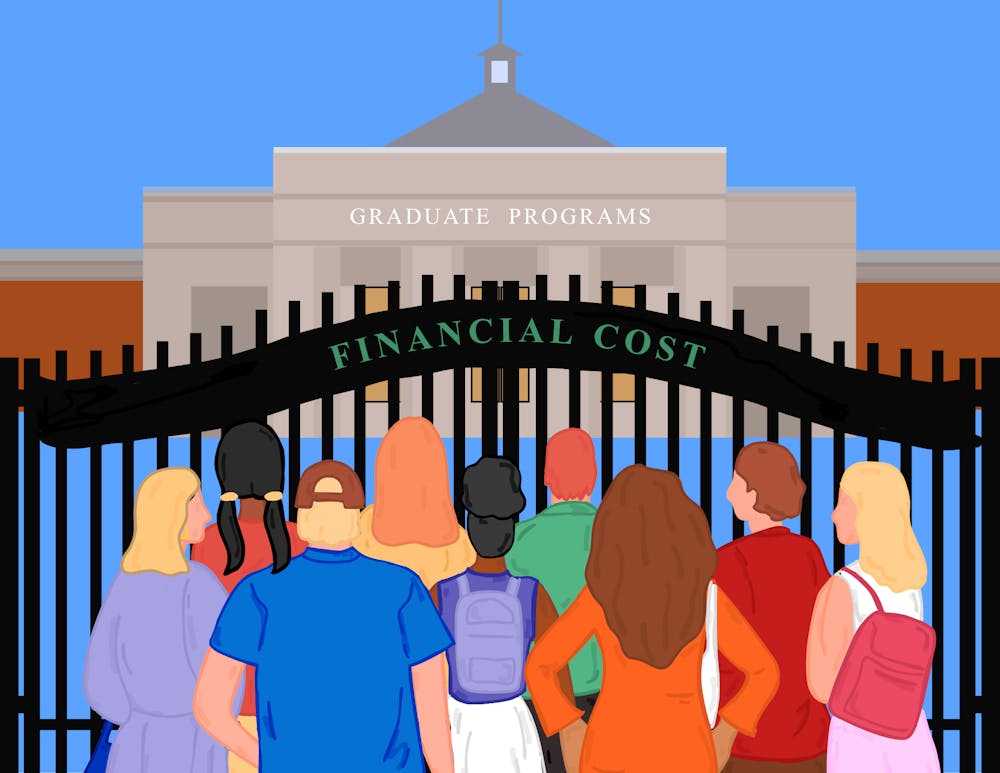
From July 1 onward, the higher education bubble for graduate students will only worsen thanks to federal student loan policies. As a result of last year’s federal budget bill, the Grad PLUS student loan program is discontinued for new borrowers. This program, which has been available to eligible graduate and professional students since 2006, provides a way to borrow up to a graduate program’s total cost of attendance, as opposed to being subject to lifetime caps applicable to other federal loans. Now, graduate students will only be able to borrow up to $20,500 a year with a lifetime limit of $100,000 — “professional” students in schools of law, medicine and similar programs can borrow up to $50,000 a year with a lifetime cap of $200,000. With the cost of attendance at programs such as the University’s School of Law exceeding $110,000 a year, these changes to student loan borrowing limits will have an adverse effect on an already-deteriorating situation for graduate students.
The immediate effects of losing the Grad PLUS program are intuitive enough — prospective graduate students will have to look elsewhere to borrow for their education or forgo it entirely. This generally leaves two options, seeking other federal student loans or entering the private market. Students who turn to other types of federal loans will be met with the newly-imposed $257,000 lifetime limit for all borrowers. Crucially, this includes every loan a student might have taken out for every level of education — undergraduate, graduate, professional and doctoral. While current borrowers are generally exempt from new requirements for a period of three years, new borrowers will have to measure out just how much financial aid they receive from the federal government if they wish to complete more than an undergraduate program. Rather than encouraging graduate and professional study, then, these new limits and the elimination of Grad PLUS loans wholesale will only serve to make it harder for students wishing to continue their studies or earn a professional degree — creating serious issues of financial accessibility that divide upon lines of economic privilege.
The other option for borrowers is to enter the private student loan market, a market replete with traps for student borrowers. Private loans are not subject to various federal protections, such as Borrower Defense to Repayment programs if an institution misleads students or otherwise violates state law. Forgiveness programs that encourage public service, such as the Public Service Loan Forgiveness Program, similarly do not apply to private loans, disincentivizing graduates from entering these vital fields. Beyond these structural disadvantages, a recent report conducted by Protect Borrowers and the Century Foundation found that over 40 percent of Americans would most likely be denied loans from traditional private lenders based on credit requirements. Indeed, the report notes that their findings apply not only to undergraduate loans, but also — at potentially higher rates as well — to graduate loans. As such, the private student loan market is not a viable pathway for many Americans to seek a graduate or professional education, and the new restrictions on federal loans may close the door to these programs entirely for many.
For its part, the University continues to unnecessarily exacerbate the problem of absurd financial burden in its graduate and professional programs. Indeed, some University officials have taken the initiative to communicate directly with the federal government, such as U.Va. Health CEO Mitch Rosner and School of Nursing Dean Marianne Baernholdt. However, words from a couple representatives are not enough. Look no further than this year’s tuition increases in graduate programs to see the issue — the School of Law will see at most a 5.1 percent tuition increase for the 2026-27 school year, the Darden School of Business will see a 4.3 percent increase and other programs will see a tuition increase of around 3 percent. These tuition increases harm both current and prospective students, and with the elimination of Grad PLUS loans, will likely freeze out many potential students who might otherwise be able to study at the University. If the University truly wishes to be an institution of world-class graduate and professional education, it must take steps to ease the financial burden already plaguing both current and prospective students.
By sharply limiting students’ access to these vital funds, particularly for graduate students, the federal government is undoubtedly closing off an avenue to personal prosperity and societal contribution. With federal funds curtailed for the foreseeable future, the University must do its part to provide an affordable opportunity for those wishing to pursue professional studies, and consistent tuition increases do not meet this mark. Multiple administrators from both the University and U.Va. Health writing to the federal government about the consequences of this action is a commendable step in the right direction, but one which must be met with continued ground-level support for students.
Programs such as increased scholarships for merit and demonstrated financial need would certainly fill the gap, and the University is financially well poised to provide these services — one of the stated goals of its recent $6 billion Honor the Future fundraising campaign is investing in student access and affordability. Whatever the method, students pursuing graduate and professional courses of study deserve better from both their government and the institutions they hope to join.
The Cavalier Daily Editorial Board is composed of the Executive Editor, the Editor-in-Chief, the two Opinion Editors, two Senior Associates and an Opinion Columnist. The board can be reached at eb@cavalierdaily.com.
Read More

DUTTENHOFER: A case for 287(g) agreements
By Lucy Duttenhofer | 12 hours agoICE is not going away. 287(g) agreements are not, either. Understanding and using them effectively must be a priority.

YOUNIS: University networks protect rapists
By Ayat Younis | 2 days agoWhen a university's response to sexual violence is limited, who is the institution actually protecting?

HAWKINS: The Cornell sexual assault scandal showcases the importance of student journalism
By Joshua Hawkins | 2 days agoWhile the Cornell University administration faltered, it was the students who rose to the occasion.