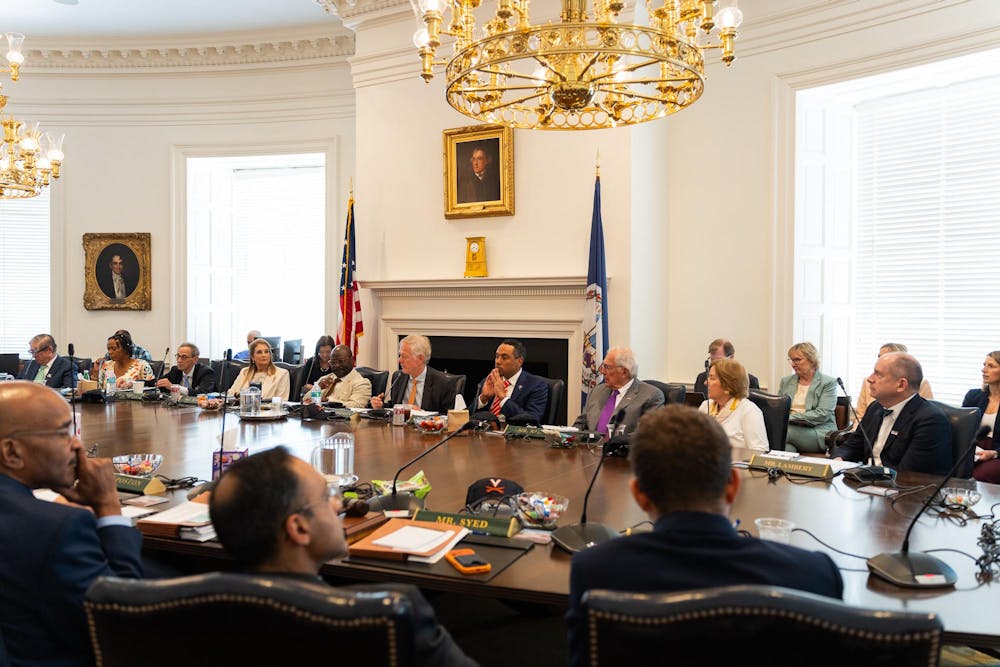
The Board of Visitors Finance Committee met Thursday and approved a 3.6 percent average increase in tuition, a 4.8 percent average increase in meal plan costs and a 5 percent increase in the cost of double-room housing for the 2026-27 school year. The approval was unanimous amongst Board members, though some expressed resistance to the increases before voting in favor of them.
The Committee heard from Jennifer Wagner Davis, executive vice president and chief operating officer, and Donna Price Henry, chancellor of the College at Wise, about reasons for the raise in tuition and rates. According to Davis and Henry, salary increases for professors and legislation passed by the General Assembly contribute to tuition and rates increases.
The Finance Committee, chaired by Vice Rector Victoria Harker, is responsible for the University’s financial affairs and business operations, and the Committee manages the budget, tuition and student fees.
Changes in tuition vary between schools, with the School of Law seeing at most a 5.1 percent increase, the School of Engineering & Applied Science seeing at most a 3.2 percent increase and the College of Arts and Sciences seeing at most a 3.1 percent increase in tuition for the 2026-27 school year.
For the 2026-27 school year at the College at Wise, the Committee also unanimously approved a 2.5 percent average increase in tuition, a 3.8 percent increase in meal plans and a 2 percent increase in the cost of housing.
Last year, the Committee approved a 3 percent average increase in tuition, a 5.5 percent increase in meal plans and a 5.5 percent increase in the cost of housing for the University.
Davis cited increased costs as the primary reason for the approved increase in tuition. She said that the budget that could be passed by the General Assembly for June 30, 2027 through June 30, 2028 could increase professor salaries — University professors receive raises via this process. Davis said that the Senate and House of Delegates have separate proposals dealing with the pay increases that are currently unresolved, with House Bill 30 raising salaries by 2 percent and Senate Bill 30 raising salaries by 3 percent.
Davis said every percent increase in faculty salaries costs the University $15 million annually, and the Commonwealth will increase funding to the University by $1-2 million to help pay for that increase. According to Davis, the most common way to stabilize the budgetary imbalance caused by raised salaries is through tuition raises.
Beyond the increase in salary, Davis cited the minimum wage increase, inflation and Virginia Military Survivors & Dependents Education Program as increased costs to the University. VMSDEP is a program that gives education benefits to spouses and children of disabled veterans or military service members killed, missing in action or taken prisoner. Davis said that the program is “partially unfunded” and could cost the University somewhere between $3.6 to $6 million, depending on how many students qualify for the program.
Davis spoke on other contributing factors to the increase in tuition, specifically collective bargaining — which allows workers to bargain for better wages and working conditions.
“If we look at other institutions or other states that have collective bargaining, [collective bargaining] does put an upward pressure on tuition,” Davis said.
Prior to Thursday’s meeting, the Committee heard the proposal for tuition increases from Davis and Henry April 6 in a Finance Committee tuition workshop with public comment. During the tuition workshop, tuition increases ranged from 3 to 4.5 percent for the University and 2 to 3 percent for the College at Wise. Both increases approved Thursday are within the ranges originally proposed.
Meal plan costs, on average, will be increasing by 4.8 percent in the upcoming academic year. Davis said that the University has been expanding dining options with the opening of the Gaston House and new locations for the Ivy Corridor student housing that is still in progress. She also said that the University has been taking steps to increase the availability of allergen-friendly food options.
Davis shared that the 5 percent cost increase in housing is due to the expansion of student housing in the Ivy Corridor. Davis also said that there will be 3,000 new units added to the Charlottesville housing market by 2027, of which 780 beds will be for University housing. Davis said that she hopes the Ivy Corridor housing would “free up” the city housing supply by having more students live on Grounds.
Board member Amanda Pillion said she was “concerned” about how tuition increases would harm rural families — she said the constant increases in cost could make a University education out of reach for middle-income Virginians.
“This is the second governor I've served under. Both times I've heard affordability, affordability, affordability,” Pillion said. “We need to really be conscious of the fact that … there is a large group of people that [are middle-income] that these increases [in tuition and fees] are really tough for.”
The Committee also approved a renovation for The Park — an 18-acre recreational hub in North Grounds — which will cost $10 million. As part of the renovation, The Park will include a maintenance facility, storm water systems and a maintenance access route. Davis said the renovation will address safety and security issues for the 200 people that use The Park daily. According to Davis, the University will use $2 million of institutional funds and issue $8 million of debt to fund the renovation.
The Finance Committee will reconvene during the regularly scheduled June Board meetings.

Edward Christopher is a staff writer on the news desk as well as a member of the advertising team for The Cavalier Daily. He is a second-year Commerce student from Northern Virginia. Edward enjoys covering state politics and University developments.
Read More

Students, professors weigh in on the importance of letter grades
By Ruby Budetti | 1 hours agoWhen thinking about letter grades for themselves, many University students and faculty said they prefer letter grading throughout all four years of college.
What services does the Student Health Fee provide for students?
By Melody Yuan | 1 hours agoThe University Board of Visitors approved tuition and fees for the 2026-27 academic year in April, and the Student Health fee rose from $1,147 to $1,184 per student.

The ‘AI and Future of Work’ Series — How the University is preparing students for what is next
By Lidia Zur Muhlen | 3 hours agoIn a recent Gallup Inc poll, 79 percent of Americans believe that artificial intelligence will reduce the number of jobs over the next 10 years.